.

No Announcement

"O Allah! We seek goodness from Your Knowledge and with Your Power (and Might) We seek strength, and We ask from You Your Great Blessings, because You have the Power and We do not have the power. You Know everything and I do not know, and You have knowledge of the unseen. Oh Allah! If in Your Knowledge this action (We are about to take) is better for my religion and faith, for our life and end [death], for here [in this world] and the hereafter then make it destined for us and make it easy for us and then add blessings [baraka'] in it, for us. O Allah! In Your Knowledge if this action is bad for us, bad for our religion and faith, for our life and end [death], for here [in this world] and the hereafter then turn it away from us and turn us away from it and whatever is better for us, ordain [destine] that for us and then make us satisfied with it."

NOTE


عَنْ عُمَيْرِ بْنِ هَانِئٍ الْعَنْسِيِّ ، قَالَ : سَمِعْتُ عَبْدَ اللَّهِ بْنَ عُمَرَ ، يَقُولُ : كُنَّا قُعُودًا عِنْدَ رَسُولِ اللَّهِ ، فَذَكَرَ الْفِتَنَ فَأَكْثَرَ فِي ذِكْرِهَا حَتَّى ذَكَرَ فِتْنَةَ الْأَحْلَاسِ ، فَقَالَ قَائِلٌ : يَا رَسُولَ اللَّهِ وَمَا فِتْنَةُ الْأَحْلَاسِ ؟ قَالَ : ” هِيَ هَرَبٌ وَحَرْبٌ ، ثُمَّ فِتْنَةُ السَّرَّاءِ ، دَخَنُهَا مِنْ تَحْتِ قَدَمَيْ رَجُلٍ مِنْ أَهْلِ بَيْتِي يَزْعُمُ أَنَّهُ مِنِّي ، وَلَيْسَ مِنِّي ، وَإِنَّمَا أَوْلِيَائِي الْمُتَّقُونَ ، ثُمَّ يَصْطَلِحُ النَّاسُ عَلَى رَجُلٍ كَوَرِكٍ عَلَى ضِلَعٍ ، ثُمَّ فِتْنَةُ الدُّهَيْمَاءِ ، لَا تَدَعُ أَحَدًا مِنْ هَذِهِ الْأُمَّةِ إِلَّا لَطَمَتْهُ لَطْمَةً ، فَإِذَا قِيلَ : انْقَضَتْ ، تَمَادَتْ يُصْبِحُ الرَّجُلُ فِيهَا مُؤْمِنًا ، وَيُمْسِي كَافِرًا ، حَتَّى يَصِيرَ النَّاسُ إِلَى فُسْطَاطَيْنِ ، فُسْطَاطِ إِيمَانٍ لَا نِفَاقَ فِيهِ ، وَفُسْطَاطِ نِفَاقٍ لَا إِيمَانَ فِيهِ ، فَإِذَا كَانَ ذَاكُمْ فَانْتَظِرُوا الدَّجَّالَ ، مِنْ يَوْمِهِ ، أَوْ مِنْ غَدِهِ ” أبو داود
---------------------------------

The Webmaster (Pok Nik) would like to express his highest gratitude and thanks to (Almarhum) Ustaz Haji Ahmad Junaidin bin Che Din for his permission and greatest support in order to make this Global Abjad Blog as a reality.

Contact Pok Nik at : pgssajkm@gmail.com

----------------------------------
Importance of a good shaykh by Shaykh Abd'al-Qadir al-Jilani Radi Allahu anhu

Al Ghawth al-Adham Shaykh Sayyad Abd'al-Qadir al-Jilani Radi 'Allahu anhu said: You must work hard to ensure that your hearts are not locked out of the door of His nearness. Be sensible! You are getting nowhere. You must seek the company of a Shaykh who is learned in the law [hukm] and knowledge ['ilm] of Allah (Almighty and Glorious is He), and who will show you the way toward Him. Without seeing the successful [muflih], one cannot succeed. If a person does not seek the company of scholars who put their knowledge into practice ['ulama 'ummal], he is a chicken from an egg abandoned by the rooster and the mother hen.

Seek the fellowship of those who enjoy fellowship with the Lord of Truth (Almighty and Glorious is He). What each of you should do, when the night has grown dark and people have gone to bed and their voices are silent, is get up, take an ablution [yatawadda'], perform two cycles of ritual prayer [yusalli rak'atain] and say: "O my Lord, guide me to one of Your righteous servants near to You, so that he may guide me toward You and make me familiar with Your path." The instrument [sabab] is necessary. Allah (Almighty and Glorious is He) was quite capable of guiding [His servants] to Him without the Prophets [anbiya']. Be sensible! You are getting nowhere. You must awaken from your heedless folly. As the Beloved Prophet Salla Allahu ta'ala 'alayhi wa Sallam has said: If someone relies entirely on his own subjective judgement, he will go astray. Try to find someone who will be a mirror for the face of your religion [din], just as you look in the mirror to check the appearance of your outer face, your turban and your hair. Be sensible! What is this crazy foolishness? You say, "I don't need anyone to teach me," and yet the Beloved Prophet Salla Allahu ta'ala 'alayhi wa Sallam has said: The believer is the believer's mirror [al-mu'minu mir'atu 'l-mu'min].

When the believer's faith is sound, he comes to be a mirror for all creatures. They behold their religious faces [wujuh adyanihim] reflected in the mirror of his speech, every time they see him and get close to him. What is this craziness? Not a moment goes by without your begging Allah (Almighty and Glorious is He) to provide you with more than you already have to eat, to drink, and to wear, with more sexual opportunities and more income. These are not things that could increase or decrease, even if you were to be joined in your plea by every supplicant whose prayers are answered [da 'in mujab].

Supplication [da 'wa] will neither increase one's sustenance by so much as an atom, nor reduce it by an atom. This is a foregone conclusion [mafrugh minhu]. You must devote your attention to doing what you have been commanded to do, and to avoiding what you have been forbidden to do. You should not worry about that which is bound to come your way, because He guarantees that it will come to you. Allotted shares [aqsam] arrive at their appointed times, whether they be sweet or bitter, whether you like them or dislike them.

The people [of the Way] attain to a condition in which they no longer have any prayer of supplication [du'a] or request [su'al] to make. They do not beg [in their prayers] to gain advantages, nor to get rid of disadvantages. Their supplication comes to be a matter concerning their hearts, sometimes for their own sake and sometimes for the sake of all creatures, so they utter the prayer of supplication without conscious premeditation [fi ghaiba].
---------------------------------------
"O '' Allah, endow us with good behaviour in Your company under all circumstances!
---------------------------------------
[When the believer's faith is sound], fasting [sawm], prayer [salat], remembrance [dhikr] and all acts of obedience [ta 'at] become second nature to him, mingled with his flesh and blood. Then he receives protection from Allah (Almighty and Glorious is He) under all circumstances. The restraint of the law [hukm] does not desert him, not for an instant, while he is on this course. The law comes to be like the vessel in which he sits, as he travels over the ocean of the power [qudra] of his Lord (Almighty and Glorious is He). He goes on traveling over it until he arrives at the shore of the hereafter, at the shore of the ocean of grace and the hand of nearness. Thus he is sometimes in the company of creatures and at certain times in the company of the Creator. His work and toil are with creatures, while his relaxation is with the Creator.
--------------------------------------
From Shaykh 'Abd al-Qadir al-Jilani, "The Sublime Revelation (Al-Fath ar-Rabbani)," translated by Muhtar Holland (Al-Baz Publishing, Houston, 1992), p. 426-8.
--------------------------------------
On the authority of Abu Hurayrah r.a., who said that Prophet Muhammad S.A.W. said: Allah SWT said:

Whosoever shows enmity to someone devoted to Me, I shall be at war with him. My servant draws not near to Me with anything more loved by Me than the religious duties I have enjoined upon him, and My servant continues to draw near to Me with supererogatory works so that I shall love him. When I love him I am his hearing with which he hears, his seeing with which he sees, his hand with which he strikes and his foot with which he walks. Were he to ask [something] of Me, I would surely give it to him, and were he to ask Me for refuge, I would surely grant him it. I do not hesitate about anything as much as I hesitate about [seizing] the soul of My faithful servant: he hates death and I hate hurting him. (It was related by al-Bukhari)
------------------------------

“Allah! There is no God save Him, the Alive, the Eternal. Neither slumber nor sleep overtaketh Him. Unto Him belongeth whatsoever is in the heavens and whatsoever is in the earth. Who is he that intercedeth with Him save by His leave? He knoweth that which is in front of them and that which is behind them, while they encompass nothing of His knowledge save what He will. His throne includeth the heavens and the earth, and He is never weary of preserving them. He is the Sublime, the Tremendous.”

Tuesday, May 27, 2008

MUSLIM ANCIENT SCIENTIST PART 2

ORIGINAL SOURCE
Based on the book Introduction to the History of Science by George Sarton (provided with photos and portraits)Edited and prepared by Prof. Hamed A. Ead

George Sarton's Tribute to Muslim Scientists in the "Introduction to the History of Science,"

"It will suffice here to evoke a few glorious names without contemporary equivalents in the West: Jabir ibn Haiyan, al-Kindi, al-Khwarizmi, al-Fargani, al-Razi, Thabit ibn Qurra, al-Battani, Hunain ibn Ishaq, al-Farabi, Ibrahim ibn Sinan, al-Masudi, al-Tabari, Abul Wafa, 'Ali ibn Abbas, Abul Qasim, Ibn al-Jazzar, al-Biruni, Ibn Sina, Ibn Yunus, al-Kashi, Ibn al-Haitham, 'Ali Ibn 'Isa al-Ghazali, al-zarqab, Omar Khayyam. A magnificent array of names which it would not be difficult to extend. If anyone tells you that the Middle Ages were scientifically sterile, just quote these men to him, all of whom flourished within a short period, 750 to 1100 A.D."

Preface

On 8 June, A.D. 632, the Prophet Mohammed (Peace and Prayers be upon Him) died, having accomplished the marvelous task of uniting the tribes of Arabia into a homogeneous and powerful nation.

In the interval, Persia, Asia Minor, Syria, Palestine, Egypt, the whole North Africa, Gibraltar and Spain had been submitted to the Islamic State, and a new civilization had been established.

The Arabs quickly assimilated the culture and knowledge of the peoples they ruled, while the latter in turn - Persians, Syrians, Copts, Berbers, and others - adopted the Arabic language. The nationality of the Muslim thus became submerged, and the term Arab acquired a linguistic sense rather than a strictly ethnological one.
As soon as Islamic state had been established, the Arabs began to encourage learning of all kinds. Schools, colleges, libraries, observatories and hospitals were built throughout the whole Islamic state, and were adequately staffed and endowed.

In the same time, scholars were invited to Damascus and Baghdad without distinction of nationality or creed. Greek manuscripts were acquired in large numbers and were studied, translated and provided with scholarly and illuminating commentaries.
The old learning was thus infused with a new vigor, and the intellectual freedom of men of the desert stimulated the search for knowledge and science.

In early days at least, the Muslims were eager seekers for knowledge, and Baghdad was the intellectual center of the world.

Historians have justly remarked that the school of Baghdad was characterized by a new scientific spirit.

Proceeding from the known to the unknown; taking precise account of phenomena; accepting nothing as true which was not confirmed by experience, or established by experiment, such were fundamental principles taught and acclaimed by the the masters of the sciences.


The Islamic Empire At Its Greatest Extent 750 c

The Time of Jabir Ibn Haiyan
Second half of Eighth Century


The intellectual relaxation which characterized the second half of the seventh century and the first half of the eighth was followed by a period of renewed activity which was entirely due to Muslim initiatives, that is why this period gave an Arabic name marking the beginning of Muslim science. The name Jabir Ibn Haiyan came from the highly important contributions by him in this period. Jabir's texts, whether in Arabic or Latin, are one of the most urgent and promising tasks of scholarship. He will remain a very impressive personality.


Imaginative portrait of Jabir Ibn Haiyan
(Photograph, A. Chelazzi, Florence,...Makers of Chemistry, E. L. Holmyard)

Cultural Background of this Period in the East

Two rulers of the Abbasid caliphs used their authority to promote the intellectual welfare and progress of the peoples, and distinguished themselves greatly in this respect; the second, al-Mansur (founded Baghdad) and the fifth, Harun-al-Rashid (whose fame has been immortalized by many legends). Both caliphs encourage the work of translators who were busily unlocking the treasures of Greek knowledge.

Abu Ja'far 'Abdallah al-Mansur, i.e. the victorious. Died in 775 at Bir Maimun, near Mecca, at the age of 63 - 68 Muslim years (Hegra), i.e. 61-66 Christian years. He was the second 'Abbasid caliph and ruled from 754 to his death.

He was a great statesman and the founder of Baghdad. Memorable because of the many translations from the Syriac, Persian, Greek, and Hindu languages into the Arabic which were accomplished in his reign.

Harun al-Rashid, born in 763 or 766 at al-Ray; died at Tus in 809. Caliph from 786 to his death; the fifth and one of the greatest 'Abbasid monarchs. Magnificent patron of science, art, and literature. Many more Greek works were translated by his order. In 807 he presented a very remarkable water-clock to Charlemange (King of the Franks since 768; crowned Emperor of the West on Christmas 800 by Leo III in Rome)

Islamic Mathematics and Astronomy

All of the mathematical and astronomical work of this period was done by Muslims. It is interesting to recall that the mathematical work of the previous period had been done almost exclusively by Chinese. Some amount of stimulation had come from India. In addition to transmission of some Hindu mathematics.
Ibrahim al-Fazari is said to have been the first Muslim to construct astrolabes.

Ya'qub ibn Tariq and Muhammad, son of Ibrahim al-Fazari, are the first to be mentioned in connection with Hindu mathematics: Ya'qab met at the court of al-Mansur, a Hindu astronomer called Kankah (?), who acquainted him with the Siddhanta, and Muhammad was ordered to translate it. The physician al-Batriq translated Ptolemy's Quadripartitum. Two astrologers, one of them a Jew named Mashallah, the other a Persian called al-Naubakht, worked together to make the measurements necessary for the building of Bagdad. Al-Naubakht's son, al-Fadl, wrote astrological treatises and translations from the Persian into Arabic.

Ibrahim al-Fazari

Abu Ishaq Ibrahlm ibn Habib ibn Sulaiman ibn Samura ibn Jundab. Died c. 777.
Muslim astronomer. The first to construct astrolabes, he wa the author of a poem (qasida) on astrology and of various astronomical writings (on the astrolabe, on the armillary spheres, on the calendar).

H. Suter: Die Mathematiker und Astronomer der Araber (3, 208, 1900)

Ya'qub Ibn Tariq

Probably of Persian origin, flourished in Baghdad, c.767-778 died c. 796. One of the greatest astronomers of his time. He probably met, c. 767, at the court of al-Mansur, the Hindu Kankah (or Mankah?), who had brought there the Siddhanta. He wrote memoirs on the sphere (c. 777), on the division of the kardaja; on the tables derived from the Siddhanta.

H. Suter: Die Mathematiker und Astronomer der Araber (p. 4, 1900)

Muhammad Ibn Ibrahim Al-Fazari

Abu 'Abdallah Muhammad ibn Ibrahim al-Fazari. Son of the astronomer Ibrahim dealt with above, for whom he is sometimes mistaken (he may be the author of the astrological poem ascribed to his father). Died c. 796 to 806. Muslim scientist and astronomer. He was ordered by the Caliph al-Mansur in 772/3 to translate the Sanskrit astronomical work Siddhanta. This translation was possibly the vehicle by means of which the Hindu numerals were transmitted from India to Islam.

H. Suter: Die Mathematiker und Astronomen der Araber (p. 4,1900).
Cantor: Geschichte der Mathematik (I, 3rd ed., 698, 1907).
D. E. Smith and L. C. Karpinski: The Hindu-Arabic Numerals (p.92, Boston, 1911)


Mashallah

His real name was probably Manasseh (in Arabic, Misha). Latin translators named him Messahala (with many variants, as Macellama, Macelarma). Mashallah is a contraction of ma'aha Allah meaning "What wonders Allah has willed." (What hath God wrought.) Flourished under al-Mansur, died c. 815 or 820. One of the earliest astronomers and astrologers in Islam, himself an Egyptian (?) Jew. Only one of his writings is extant in Arabic, but there are many mediaeval Latin and Hebrew translations. The Arabic text extant deals with the prices of wares and is the earliest book of its kind in that language. He took part with the Persian astrologer al-Naubakht in the surveying preliminary to the foundation of Baghdad in 762-63. His most popular book in the Middle Ages was the 'De scientia motus orbis', translated by Gherardo Cremonese.
Text and Translation. The De scientia motus orbis is probably the treatise called in Arabic "the twenty-seventh;" printed in Nuremberg 1501, 1549. The second edition is entitled: 'De elementis et orbibus coelestibus', and contains 27 chapters. The De compositione et utilitate astrolabii was included in Gregor Reisch: Margarita phylosophica (ed. pr., Freiburg, 1503; Suter says the text is included in the Basel edition of 1583). Other astronomical and astrological writings are quoted by Suter and Steinsehneider.

An Irish astronomical tract based in part on a mediaeval Latin version of a world by Messahalah. Edited with preface, translation, and glossary, by Afaula Power (Irish Texts Society, vol. 14, 194 p., 1914. A relatively modern translation of the De scientia motus orbis, the preface is uncritical).


Astrolabe


Astronomers Using Astrolabe

slamic Alchemy

It is noteworthy that the earliest alchemical texts in Arabic and Latin are contemporaneous, that is, if our dating of them is correct. The most famous alchemist of Islam, Jabir Ibn Haiyan, seems to have had a good experimental knowledge of a number chemical facts; he was also an able theoretician.

Jabir ibn Haiyan
Abu Musa Jabir ibn Haiyan al-Azdi (al-Tusi, al-Tartusi; al-Harrani meaning that he was a Sabian?; al-Sufi). Flourished mostly in Kufa, c. 776, he was the most famous Arabic alchemist; the alchemist Geber of the Middle Ages. He may be the author of a book on the astrolabe, but his fame rests on his alchemical writings preserved in Arabic: the "Book of the Kingdom," the "Little Book of the Balances," the "Book of Mercy," the "Book of Concentration," the "Book of Eastern Mercury," and others. According to the treatises already translated (by Berthelot), his alchemical doctrines were very anthropomorphic and animistic. But other treatises (not yet available in translation) show him in a better light. We find in them remarkably sound views on methods of chemical research; a theory on the geological formation of metals; the so-called sulphur-mercury theory of metals (the six metals differ essentially because of different proportions of sulphur and mercury in them); preparation of various substances (e.g. basic lead carbonate; arsenic and antimony from their sulphides). Jabir deals also with various applications, e.g. refinement of metals, preparation of steel, dyeing of cloth and leather, varnishes to water-proof cloth and protect iron, use of manganese dioxide in glass making, use of iron pyrites for writing in gold, distillation of vinegar to concentrate acetic acid. He observed the imponderability of magnetic force.
It is possible that some of the facts mentioned in the Latin works, ascribed to Geber and dating from the twelfth century and later, must also be placed to Jabir's credit. It is impossible to reach definite conclusions until all the Arabic writings ascribed to Jabir have been properly edited and discussed. It is only then that we shall be able to measure the full extent of his contributions, but even on the slender basis of our present knowledge, Jabir appears already as a very great personality, one of the greatest in mediaeval science.

Text and Translations:- M. Berthelot: La chimie au moyen age (vol. 3, L'alchimie arabe, Paris,1893. The Arabic text of a few of Jabir's writings is edited by Octave Houdas. French translation, p. 126-224. See E. J. Holmyard's criticism in Isis, XI, 479-499, 1924). Ernst Darmstaedter: Die Alchemie des Geber (212 p., 10 pl.; Berlin, 1922. German translation of the Latin treatises ascribed to Geber; reviewed by J. Ruska in Isis, V, 451-455, concluding that these Latin treatises are apocryphal); Liber misericordiae Geber. Eine lateinisehe ubersetzung des grosseren Kitab al-rahma (Archive fur Geschichte der Medizin, vol. 17, 181-197, 1925; Isis, VIII, 737).


Page of one of Jabir's Chemical Works in Arabic


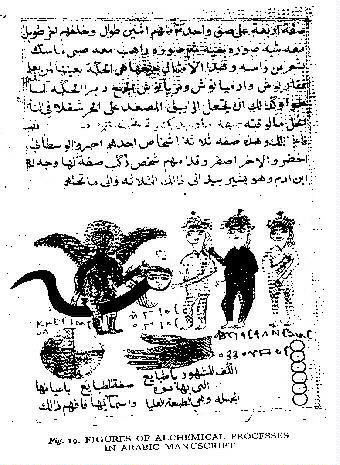
Figures of some Alchemical Processes in Arabic Manuscript


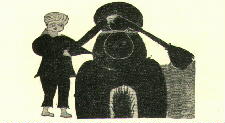
An illustration from an Arabic Manuscript in the British Museum


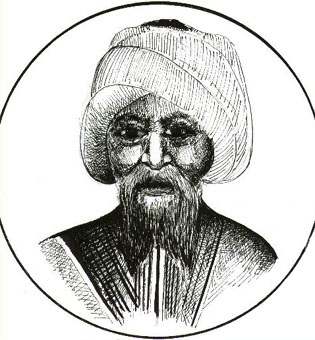
Portrait of Gaber Ibn Haiyan by an Egyptian artist

MUSLIM ANCIENT SCIENTIST PART 1

ORIGINAL SOURCE
Based on the book Introduction to the History of Science by George Sarton (provided with photos and portraits)Edited and prepared by Prof. Hamed A. Ead

The Time of Al-Biruni
First Half of Eleventh Century

The great leaders were so many - Ibn Yunus, Ibn al-Haitham, Al-Biruni, Ibn Sina, Ali ibn Isa, al-Karkhi, Ibn Gabirol (all Muslim except the last, who was Jewish) - that, for a moment at least, the historian is bewildered. Yet, however distinguished all of those men, and many others who will be named presently, two stand out head and shoulders above the others: al-Biruni and Ibn Sina (Avicenna). It was chiefly because all of them that this period was one of such excellence and distinction. These two men, who by the way, knew one another, were extremely different. Al-Biruni represents the more adventurous and critical spirit, Ibn Sina the synthetic spirit, al-Biruni was more of a discoverer, and in that respect he came nearer to the modern scientific ideal; Ibn Sina was essentially an organizer, an encyclopedist, a philosopher. Both, even the latter, were primarily men of science, and it would be difficult to choose between them but the accidental fact that al-Biruni's life covered more fully the present period and thus may be said to represent it more completely. Ibn Sina was only 20 at the beginning of the century, and his life was ultimately cut short in 1037. Al-Biruni's first important work appeared about 1000 and he lived until 1048. Thus his time of activity and the first half of the eleventh century are not identical periods, and we are fully justified (more fully so than in almost every short case) in calling it the Time of al-Biruni.

Muslim Mathematics and astronomy

It is almost like passing from the shade to the open sun and from a sleepy world into one tremendously active. For the sake of convenience, I divide Muslim mathematicians into three groups: those of the West, those of Egypt, who occupied, so to speak, an intermediate position, and those of the East. This is also a logical division, for though communications between the eastern and western ends of the Islam were frequent (there were a number of itinerant scholars to whom the universality of Islam seems to have been a continual provocation to move on from place to place), it is clear that local influences were felt more constantly and to greater advantage.
The greatest astronomer and trigonometrician of the time was Ibn Yunus, who lived in Cairo. Every thing considered, he was perhaps the greatest Muslim astronomer, and the Fatimid rules of Egypt gave him magnificent opportunities. Indeed, under the sixth Fatimid, al-Hakim, a sort of academy of science (Dar al-Hikma) had been established in Cairo, and, had been the case for the academy founded by al-Ma'mun in Bagdad two centuries earlier, an observatory was an essential part of it. Ibn Yunus made excellent use of these exceptional facilities to measure more accurately the number of astronomical constants and to compile improved tables named after his patron, the Hakemite tables. He contributed his share to the development of trigonometry, discovering new solutions of spherical problems and introducing the first of the prosthapheretical formulas. His colleague in al-Hakim's academy, Ibn al-Haitham, better known as a physicist, was also a great astronomer and mathematician. He made a curious attempt to measure the height of the atmosphere on the basis of his knowledge and of the length of twilight. He solved al-Mahani's equation and the so-called Alhazen's problem by means of intersecting conics.

The mathematicians of the East were so numerous, and though they could boast no man comparable in his branch of learning to Ibn Yunus, their work was generally on a very high level and full of originality. Kushyar ibn Labban especially interested in trigonometry, he made a deeper study on the tangent function and compiled new astronomical tables which were sooner translated into Persian. He also wrote on astrology and arithmetic. Ibn al-Husain investigated the classical problems of the Greek geometry (for example, the duplication of the cube) and tried to solve them by purely geometrical means. Abu-l-Jud was also a geometer; he made a special study on the regular heptagon and enneagon and of those problems which can not be solved by means of ruler and compass alone; he tried to classify equations with reference to conic sections, he is one of the mathematicians who prepared the work of Omar al-Khayyam in the following period. The greatest of them all, al-Karkhi was chiefly an arithmatician and algebraist. He solved a number of Diophantine problems and invented a series of new one. His work contains many of the original features, but the most extra-ordinary of these is the systematic neglect of Hindu numerals. No numerals are used, the names of the numerals being written in full. It is as if al-Karkhi had considered the use of Hindu numerals as vulgar and non-scientific. Al-Nasawi wrote a practical arithmetic in Persian and later translated it into Arabic. He explained the Hindu methods and applied them to difficult numerical problems; in these computations the sexagesimal fractions introduced by astronomical measurements were replaced by decimal fractions. Ibn Tahir wrote also arithmetical book of a practical nature; he showed how to solve the complicated inheritance problems entailed by the Muslim fondness for juridical niceties. To al-Biruni we owe the best mediaeval account of Hindu numerals. He composed an astronomical encyclopedia and a general treatise on mathematics , astronomy, and astrology. He was deterred neither by formidable computations nor by the most difficult geometrical problems of his time, those called after him Albirunic problems. He introduced a simplified method of stereographic projection. As we would expect, the philosophical aspects of mathematics were more to ibn Sina than the more technical details. We already know that in spite of his encyclopedic activities Ibn Sina found time to carry on a number of astronomical observations and to improve the observational technique.

I named these Eastern mathematicians, as well as possible, in chronological order. This does not, perhaps, bring out with sufficient clearness the full complexity of their activities. In the first place, observe that, I did not mention a single astrologer; only one named in this section flourished not in the East, but in the orthodox Tunis, where there was much less freedom of thought. In the second place, if we leave out of account the astronomical work, which was determined by practical necessities, we find that there were two distinct streams of mathematical thought: the one theoretical represented by Ibn al-Husain, Abu-l-Jud, and al-Karkhi, the other, more practical, represented by al-Nasawi and Ibn Tahir. Al-Biruni and Ibn Sina can not be included in that classification, for they were equally in the most abstruse and in the most practical questions; they had no contempt for humble means, for there are no small matters for great minds.

Muslim Physics, Chemistry and Technology

Contemporary accounts of Muslim achievements must be started with Ibn al-Haitham, who flourished in Cairo at the beginning of the century. He was not only the greatest Muslim physicist, but by all means the greatest of mediaeval times. His researches on geometrical and physiological optics were the most significant to occur between ancient times and the sixteenth century. His description of the eye and his explanation of vision were distinct improvements. Muslim scientists had developed a great interest in the determination of specific gravity. Al-Biruni continued that tradition and measured the density of 18 precious stones and metals with remarkable accuracy. He observed that the speed of light is incomparably greater than the of sound. Ibn Sina investigated all the fundamental questions of physics which could be formulated finite. His study of music was especially important and far ahead of the contemporary Latin work. He described the doubling with octave, the fourth and the fifth, and even with the third.

A college of Ibn al-Haitham in the Cairo academy, Masawaih al-Mardini, explained the preparation empyreumatic oils. Ibn Sina intertained original views on chemistry; he did not share the common belief of Muslim alchemists that the coloring or bronzing of metals affected their substance, he thought that the differences between metals were to deep to permit their transmutation. An important alchemical treatise was composed in 1034 by al-Kathi.

Muslim or Arabic Medicine

There are so many that I must again divide them into three groups. Those of Spain, those of Egypt, and those of the East.

Spain: Al-Karmani has already been mentioned. He was at once a mathematician and a surgeon. Ibn al-Wafid composed a treatise on simple drugs, which is partly extant in Latin, and a treatise on Balneography. To these two Muslims may be added the Jew, Ibn Janah, who flourished in Saragossa and wrote there in Arabic, a book on simple remedies.

Egypt: Not less than four great Physician enjoyed the patronage of the Fatimid rulers of Egypt. Masawaih al-Mardini (Mesue the Younger) compiled a large dispensatory which was immensely popular in mediaeval Europe. For centuries it remained the standard work on the subject. Ammar was perhaps the most original oculist of Islam, but his work was superseded by that of the Eastern contemporary, Ali ibn Isa. The surgical part of Ammar's ophthalmologic treatise is particularly important. The third of these physicians, Ibn al-Haitham (Alhazen) has already been dealt with many times; he must be remembered her because of his studies in physiological optics. Ali ibn Ridwan wrote various commentaries on Greek medicine, of which the best known was one on Galen's Ars prava; he also wrote a treatise on hygiene with special reference to Egypt. It should be noted that Masawaih was a monophysite Christian; the others were Muslims.

East: The greatest physician of the time and one of the greatest of all times was Ibn Sina (Avicenna). His enormous medical encyclopedia, the Qanun (Canon), remained the supreme authority, not simply in Islam but also in Christendom, for some six centuries. It contained a number of original observations, but its hold on the people was chiefly due to its systematic arrangement and its very dogmatism. Ibn Sina was not as great a physician as Galen, but he had very much the same intellectual qualities and defects and his ascendancy was largely based upon the same grounds. He had the advantage over Galen being able to take into account the vast experience of Muslim physicians.

Ibn al-Taiyib wrote commentaries on Greek medicine. Abu Sa'id Ubaid Allah, of the famous Bakhtyashu family, wrote treatise on love-sickness and discussed the philosophical terms used by physicians. Ibn Butlan compiled the so-called Tables of Health, a medical summary, divided into 15 vertical columns; he is perhaps the originator of that typical form of synopsis. Finally Ali ibn Isa (Jesu Haly) was the author of the most famous ophthalmologistical treatise written in Arabic, it is very remarkable that not than three of these physicians, that is more than half of them, were Christians living in Bagdad: Ibn al-Taiyib, Abu Sa'id Ubaid Allah, and Ibn Butlan. This testifies for the faithfulness of the Christian community of Bagdad and the toleration of the Muslim rulers. It should be added that the other physicians, i.e., the Muslims, were far more important.


Muslim Mathematics and Astronomy
Muslim Mathematics of the West

AL-KARMANI

Abu Hakam Amr (or Omar) ibn Abd al-Rahman ibn Ahmed ibn Ali al-Karmani (that is of Carmona). Born in Cordova, died in Saragossa. Spanish-Muslim mathematician and surgeon. Disciple of Maslam ibn Ahmed (q. v., second half of tenth century). It is he (or else the latter) who introduced the writings of the Brethren of Purity into Spain.

Suter: Die Mathematiker und Astronomen der Araber (105, 1900).

IBN AL-SAMH

Abu al-Qasim Asbagh ibn Mohammed ibn al-Samh. Flourished at Granada; died May 29, 1035, at the age of 56. Hispano-Muslim mathematician and astronomer. He wrote treatises on commercial arithmetic (al-mu'amalat), on two mental calculus (hisab al-hawa'i), on the nature of numbers, two on geometry, two on astrolabe, its use and construction. His main work seems to have been the compilation of astronomical tables, according to the Siddhanta method (for which see my notes on Mohammed ibn Ibrahim al-Fazari second half of eighth century), together with theoretical explanations (c. 1025).

H. Suter: Mathematiker (85, 1900; 168, 1902).

IBN ABI-L-RIJAL

In Latin, Abenragel (also Albohazen, Alboacen, which was more correct, for Abenragel was his father's name, rather than his own). Abu-l-Hasan Ali ibn Abi-l-Rijal al-Saibani al-Katib al-Maghribi. Born in Cordova or else where in Spain or in northern Africa, flourished in Tunis some time about 1016 to 1040, died after 1040. Muslim astrologer. His main work is the "distinguished book on horoscopes from the constellations" (al-bari fi ahkam al-nujum). It was translated by Judah ben Moses from Arabic into Castilian, then from Castilian into Latin by Aegidius de Tebaldis and Petrus de Regio. He wrote a physiognomic treatise on Naevi.

H. Suter: Die Mathematiker und Astronomen der Araber (100, 1900; Nachtrage, 172, 1902); encyclopedia of Islam (vol. 2, 356, 1916).

IBN AL-SAFFAR

Abu-l-Qasim Ahmed ibn Abdallah ibn Omar al-Ghafiqi, best known under the name of Ibn al-Saffar, meaning son of coppersmith. Flourished at Cordova, toward the end of his life he retired in Denia and died there in 1035. Hispano-Muslim mathematician and astronomer. He wrote a treatise on the astrolabe and compiled tables according to the Siddhanta method.

H. Suter: Mathematiker (86, 225, 1900; 169, 1902).

Muslim Mathematics of Egypt

IBN YUNUS

Abu Hasan Ali ibn abi Sa'id Abd al-Rahman ibn Ahmed ibn Yunus (or Ibn Yunus) al-Sadafi al-Misri. Died in Cairo, 1009 (not 1008). The date of his birth is unknown, but his father died in 958-59. Perhaps the greatest Muslim astronomer. A well equipped observatory in Cairo enabled him to prepare improved astronomical tables. Begun c. 990 by order of the Fatimid caliph al-Aziz (975-996), they were completed in 1007 under the latter's son al-Hakim (996-1020) and are called after him the Hakemite Tables (al-zij al-kabir al-Hakimi). They contain observations of eclipses and conjunctions, old and new, improved values of astronomical constants (inclination of the ecliptic, 23o 35`; longitude of the sun's apogee, 86o 10`; solar parallax reduced from 3` to 2`; precession, 51.2`` a year, no allusion to trepidation) and accounts of the geodetic measurements carried on order by al-Ma'mun (q. v., first half of ninth century.)

His contributions to trigonometry, though less important than those of Abu-l-Wafa; are considerable. He solved many problems of spherical astronomy by means of orthogonal projections. He introduced the first of those prosthapheretical formulae which were indispensable before the invention of the logarithms, namely, the equivalent of

cosacosb =1/2 [cos (a - b) + cos (a +b)].
Approximate value of sin 1o = 1.8/3.9 sin (9/8)o + 2.16/3.15 sin(15/16)o

Ibn Yunus's observatory was a part of Hall of Wisdom (Dar al-hikma, abode of wisdom) founded in Cairo by the Fatimids. This institution, which lasted from 1005 to the end Fatimid regime (1171), might be considered the second Muslim academy of science, the first being that founded by al-Ma'mun in Bagdad almost two centuries earlier.

Suter: Encyclopaedia of Islam (vol. 2, 428, 1918).

Muslim Mathematics of East

AL-BIRUNI

Abu-Raihan Mohammed ibn Ahmed al-Biruni. Born in Khwarizm (Khiva) in 973 sojourned a considerable time in India; died in 1048, probably at Ghazna in Sijistan (Afghanistan). He was by birth a Persian and a Shi'ite; his religion was tempered with agonistic tendencies, but his national, anti-Arabic feelings remained very strong until the end. Traveler, mathematician, philosopher, astronomer, geographer, encyclopedist. One of the very greatest of Islam, and, all considered, one of the greatest of all times. His critical spirit, toleration, love of truth, and intellectual courage were almost without parallel in mediaeval times. He claimed that the phrase "Allah is omniscient" does not justify ignorance.

He wrote, in Arabic, a number of books on geographical, mathematical, and astronomical subjects. His main works were: (1) the "Chronology of ancient nations" or "Vestige of the past" (Kitab al-athar al-baqiya ani-l-qurun al-khaliya), written in 1000 and dealing chiefly with the calendars and ears of various peoples; (2) an account on India (Ta'rikh al-Hind) composed in Ghazna c. 1030; (3) an astronomical encyclopedia, the Mas,udic canon (al-qanon al-Mas'udi fi-l-hai'a wal-nujum), so-called because it was dedicated in 1030 to the Ghaznawid sultan Mas'ud; (4) a summery on mathematics, astronomy, and astrology (Al-tafhim li-awa'il sina'at al-tanjim). His description of Brahmanical India was based upon a deep study of the country and its people. He had been charmed by Hindu philosophy, especially by the Bhagavadgita. He translated from Sinskrit into Arabic (e. g., two of Varahamihira's works, q. v., first half of sixth century), and on the other hand, transmitted Muslim knowledge to the Hindus.

He gave a clear account (the best mediaeval account) of Hindu numerals (principle of position). Sum a geometric progression apropos of the chess game; it led to the following number: 1616 -1 = 18, 446, 744, 073, 709, 551, 916. Trisection of the angles and other problems which can not be solved with ruler and compass alone (Albirunic problems). Simplified stereographic projection, similar to that first published by G.B. Nicolosi di Paterno in 1600 (Isis, V, 498).

Accurate determination of latitudes. Determination of longitudes. Geodetic measurements. Al-Biruni discussed the question whether the earth rotates around its axis or not, without reaching a definite conclusion.

Investigations on specific gravity. Remarkably accurate determination of the specific density of 18 precious stones and metals. As compared to the speed of sound, that of light is immense. The work of natural springs and "artesian" wells is explained by the hydrostatic principle of communicating vessels.

Description of monstrosities, including what we call "Siamese" twins.
The Indus valley must be considered as ancient sea basin filled up with alluvions.

H. Suter and E. Wiedemann: Uber al-Biruni (Erlangen, 1920. Quoted above). Carra de Vaux: Penseur de l'Islam (vol. 2, 1921, passim).

KUSHYAR IBN LABBAN

Abu-l-Hasan Kushayr ibn Labban ibn Bashahri al-Jili (i. e., from Jilan, south of the Caspian Sea). Flourished c. 971-1029; his main work was probably done about the beginning of the eleventh century. Persian mathematician and astronomer, writing in Arabic. He seems to have taken an important part in the elaboration of trigonometry. For example, he continued the investigations of Abu-l-Wafa, the devoted much space to this in his tables, al-zij al-jami wa-l-baligh (the comprehensive and mature tables), which were translated into Persian before the end of the century. He wrote also an astrological introduction and an arithmetic treatise (extant to Hebrew).

H. Suter: Mathematiker und Astronomen der Araber (83, 235, 1900; 168, 1902).

IBN AL-HUSAIN

Abu Ja'far Mohammed ibn al-Husain. Flourished not long after al-Khujandi (q. v., second half of the tenth century). Mathematician. He wrote a memoir on rational right angled triangles and another on the determination of two mean proportionals between two lines by a geometrical method (vs. kinematic method), i. e., by the use of what the Muslims called "fixed geometry", al-handasa al-thabit. Solution of the equation

x2 + a = y2.

Suter: Die Mathematiker und Astronomen der Araber (80, 1900; Nachtrage, 168, 1902).

ABU-L-JUD

Abu-l-Jud Mohammed ibn al-Lith, contemporary of al-Biruni. Mathematician. Solution of al-Birunic problems by means of intersecting conics. Regular heptagon and enneagon. Classification of equations and their reduction to conic sections.

Suter: Die Mathematiker und Astronomen der Araber (79, 1900).

AL-KARKHI

Abu Bakr Mohammed ibn al-Hassan (or Husain) al-Hasib (the calculator) al-Karkhi, meaning of Karkh, a suburb of Bagdad. Flourished in Bagdad during the vizierate of Abu Ghakib Mohammed ibn Khalaf Fakhr al-mulk (glory of the realm), who died in 1016; he died himself c. 1019 to 1029. One of the greatest Muslim mathematicians. His book on arithmetic (the sufficient on calculation, alkafi fi-l-hisab) is based chiefly of the Greek and Hellenistic knowledge. No numerals of any kind are used, the names of the numbers being written in full. Casting out of the nines and elevens.

If r < (2a + 1), [(a2 + r)] ~ a + r/(2a + 1).

His algebra called (al-fakhri) in honor of the vizier is largely based on Diophantos. Complete solutions of quadratic equations (with proofs; two roots considered if positive and if not null). Reduction of equations of the type ax2p + bxp = c to quadratic equations. Addition and subtraction of radicals. Summation of series. Solution of Diophantine equations (including 25 problems not found in Diophantos). Al-Karkhi's neglect Hindu mathematics was such that it must have been systematic.

H. Suter: Encyclopaedia of Islam (vol. 2, 764, 1925. Very little).

AL-NASAWI

Abu-l-Hasan Ali ibn Ahmed al-Nasawi. From Nasa, Khurasan. Flourished under the Buwayhid sultan Majd al-dawla, who died in 1029-30, and under his successor. Persian mathematician. He wrote a practical arithmetic in Persian, before 1030, and later under Majd al-dawla's successor an Arabic translation of it, entitled the "Satisfying (or Convincing) on Hindu Calculation" (al-muqni fi-l-hisab al hindi). He also wrote on Archemedes's lemnata and Menelaos's theorem (Kitab al-ishba, satiation). His arithmetic explains the division of fractions and the extraction of square and cubic roots (square root of 57,342; cubic root of 3, 652, 296) almost in the modern manner. It is remarkable that al-Nasawi replaces sexagesimal by decimal fractions, e. g.,

Suter: Die Mathematiker und Astronomen der Araber (96, 1900) Uber das Rechenbuch des Ali ben Ahmed el-Nasawi (Bibliotheca Mathematica, vol. 7, 113-119, 1906).

Muslim Physics, Chemistry and Technology

IBN AL-HAITHAM

Latin name: Alhazen. Abu Ali al-Hasan ibn al-Hasan (or al-Husain) ibn al-Haitham. Born c. 965 in Basra, flourished in egypt under al-Hakim (996 to 10200 died in Cairo in 1039 or soon after. The greatest Muslim physicist and one of the greatest students of optics of all the times. He was also an astronomer, a mathematician, a physician, and he wrote commentaries on Aristotle and Galen.

The Latin translation of his main work, the Optics (kitab al-manazir), exerted a great influence upon Western science (R. Bacon; Kepler). It showed a great progress in the experimental method. Research in catoptrics: spherical and parabolic mirrors, spherical aberration; in dioptrics: the ratio between the angle and incidence and refraction does not remain constant; magnifying power of a lens. study of atmospheric refraction. The twilight only ceases or begins when the sun is 19o below the horizon; attempt to measure the height of the atmosphere on that basis. Better description of the eye, and better understanding of vision, though ibn al-haitham considered the lens as the sensitive part; the rays originate in the object seen, not in the eye. Attempt to explain binocular vision. Correct explanation of the apparent increase in the size the sun and the moon when near the horizon. earliest use of the camera obscura.

The catoptrics contain the following problem, known as Alhazen's problem: from two points of the plane of a circle to draw lines meeting at point of the circumference and making equal angles with the normal at that point. It leads to an equation of the fourth degree. Alhazen solved it by the aid of an hyberpola intersecting a circle. He also solved the so-called al-Mahani's (cubic) equation (q. v., second half of the ninth century) in a similar (Archimedian) manner.

Suter: Die Mathematiker und Astronomen der Araber (91-95, Nachtrage, 169, 1902).

AL-KATHI

Abu-l-Hakim Mohammed ibn Abd al-Malik al-Salihi al-Khwarizmi al-Kathi. Flourished in Bagdad c. 1034. Muslim Chemist, he wrote, in 1034, a treatise on alchemy entitled "Essence of the Art and Aid to the Workers" (Ain al-san'a wa awn-al-sana'a), strikingly similar in some respects to the "Summa perfectionis magisterii" of the Latin Geber (for which see my notes on Jabir, second half of eighth century).

H. E. Stapleton and R. F. Azo: Alchemical Equipments in the Eleventh century (Memories of Asiatic Society of Bengal, vol. 1, 47-70, 1 pl., Calcutta, 1905. Containing Arabic text, an analysis of it, and an introduction; very important).

Muslim (or Arabic) Medicine
Arabic-Writing physicians of the West

IBN AL-WAFID

Latin name: Abenguefit. Abu-l- Mutarrif abd al-Rahman ibn Mohammed ibn Abd al-Karim ibn Yahya ibn al-Wafid al-Lakhmi. From Toledo, where he flourished; born 997, died c. 1074. Hispano-Muslim physician, Pharmacologist. His main work, on simple drugs (Kitab al-adwaiya al-mufrada), based on Galen and Discorides and also on personal investigations, is partly extant in a Latin translation. He preferred to use dietetic measures, and, if drugs were needed, to use the simplest ones. He advised a method of investigating the action of the drugs. He also wrote a balneotherapy.

C. Brocklmann: Arabischen Litteratur (vol. 1, 485, 1898. Two Arabic manuscripts mentioned).

Arabic-Writing physicians of Egypt

MASAWIAH AL-MARDINI

Mesue the Younger. Masawaih al-Mardini, from Mardin in Upper Mesopotamia. Flourished in Bagdad, later at the court of the Fatimid caliph al-Hakim in Egypt, where he died in 1015 at the age of ninety. Physician. Jacobite Christian. He wrote book on purgatives and emetics (De medicins laxativis) and on the complete pharmacopoeia in 12 parts called the Antidotarium sive Grabadin medicamentorum, based on Muslim knowledge. The last-named work was immensely popular. It remained for centuries the standard text-book of pharmacy in the West, and Mesue was called "pharmacopoeorum evabgelista". Distillation of empyreumatic oils.

There is still a third Mesue (q. v., first half of thirteenth century), author of a treatise on surgery.

Neuburger: Geschichte der Medizin (vol. 2, 226-227, 1911).

AMMAR

Latin name: Canamusali. Abu-l-Qasim Ammar ibn Ali al-Mawsili. From Mawsil in Iraq; flourished in Egypt in the reign of al-Hakim, who ruled from 996-1020. Physician. The most original of Muslim oculists, His work was eclipsed by that of his contemporary Ali ibn Isa, which was more comprehensive. His summary on the treatment of the eye (Kitab al-muntakhab fi ilaz al-ain) contains many clear descriptions of diseases and treatments, arranged in logical order. The surgical part is especially important.

E. Mittwoch: Encyclopaedia of Islam (vol. 1, 332, 1910).

ALI IBN RIDWAN

Abu-l-Hasan Ali ibn Radwan ibn Ali ibn Ja'far al-Misri. Born in Jiza near Cairo, c. 998. Flourished in Cairo and died there in 1061 or in 1067. Astrologer. physician. The author of many medical writings of which the most popular was his commentary on Galen'a Ars prava, which was translated by Gerardo Cremonese. I may still quote his treatise on hygiene with special reference to Egypt (fi daf mudar al-abdan bi-ard Misr). He wrote various other commentaries on Hippoctates and Galen and on Ptolemy's astrological books.

C. Brocklmann: Arabischen Litteratur (vol. 1, 484, 1898).

Arabic-Writing physicians of the East

IBN SINA

Abu Ali al-Hassan ibn Abdallah ibn Sina. Hebrew, Aven Sina; Latin, Avicenna. Born in 980 at Afshana, near Bukhara, died in Hamadhan, 1037. Encyclopaedist, philosopher, physician, mathematician, astronomer. The most famous scientist of Islam and one of the most famous of all races, places, and times; one may say that his thought represents the climax of mediaeval philosophy. He wrote a many great treatises in prose and verse; most of them in Arabic, a few in Persian. His philosophical encyclopedia (Kitab al-shifa, sanatio) implies the following classification: theoretical knowledge (subdivided, with regard to increasing abstraction, into physics, mathematics, and metaphysics), practical knowledge (ethics, economy, politics). His philosophy roughly represents the Aristotelian tradition as modified by Neoplatonic influences and Muslim theology. Among his many other philosophical works, I must still quote a treatise on logic, Kitab al-isharat wal-tanbihat (The Book of Signs and Adonitions). As ibn Sina expressed his views on almost any subject very clearly, very forcible, and generally more than once, his thought is, or at any rate can be, known with great accuracy.

His most important medical works are the Qanun (Canon) and a treatise on cardiac drugs (hitherto unpublished). The Qanun fi-l-tibb is an immense encyclopedia of medicine (of about a million words), a codification of the whole ancient and Muslim knowledge. Being similar in many respects to Galen, Ibn Sina elaborated to a degree the Galenic classifications (for example, he distinguished 15 qualities of pain). Because of its formal perfection as well as its intrinsic value, the Qanun superseded Razi's Hawi, Ali ibn Abbas's Maliki, and even works of Galen, and remained supreme for six centuries. However the very success of Ibn Sina as an encyclopedist caused his original observations to be correspondingly depreciated. Yet the Qanun contains many examples of good observation - distinction of mediastinitis from pleurisy; contagious nature of phthitis; distribution of diseases by soil and water; careful description of skin troubles, of sexual diseases; and supervisions; of nervous ailments (including love sickness); many psychological and pathological facts clearly analyzed if badly explained.

Ibn Sina's interest in mathematics was philosophical rather than technical and such as we would expect in a late Neoplatonist. He explained the casting out of nines and its application to the verification of square and cubes. Many of his writings were devoted to mathematical and astronomical subjects. He composed a translation on Euclid. He made astronomical observations, and devised a contrivance the purpose of which was similar to that of the vernier, that is, to increase the precision of instrumental readings.

He made a profound study of various physical questions - motion, contact, force, vacuum, infinity, light, and heat. He observed that if the perception of light is due to the emission of some sort of particles by the luminous source, and speed of light must be finite. He made investigations on specific gravity.

He did not believe the possibility of chemical transmutation, because in his opinion the differences of the metals were not superficial, but much deeper; coloring or bronzing the metals does not affect their essence. It should be noted that these views were radically opposed to those which were then generally accepted.

Ibn Sina's treatise on minerals was the main source of the geological ideas of the Christian encyclopedist of the thirteenth century.
Ibn Sina wrote an autobiography which was completed by his favorite disciple al-Juzajani.

His triumph was too complete; it discouraged original investigations and sterilized intellectual life. Like Aristotle and Vergil, Avicenna was considered by the people of later times as a magician.

C. Brocklmann: Geschichte der arabischen Litteratur (vol. 1, 452-458, 1898. With list of 99 works).


IBN AL-TAIYIB

Abu-l-Faraj Abdallah Ibn al-Taiyib al-Iraqi. Latin name : Abulpharagius Abdalla Benattibus. Died in 1043-44. Nestorian physician. Secertary to Elias I, Nestorian Catholics from 1028 to 1049. Physician at the Adudite hospital in Bagdad. He had many commentaries on Greek medicine, and original memories on various medical topics, also a translation of the pseudo-Aristotelian De plantis, with additional excerpts from ancient literature.

From Arabic translation of the Diatessaron ascribed to him.

Brocklmann: Arabischen Litteratur (vol. 1, 482, 1898).

ABU SA'ID UBAID ALLAH

Abu Sa'id Ubaid Allah ibn Bakhtyashu. Flourished in Maiya-fariqin, Jazirah; friend of Ibn Butlan; died in 1058. Physician. The last and possibly the greatest representative of the Bukhtyashu, a syrian family of physicians which emigrated from Junsishapur to Bagdad in 765. His main works are the Reminder of the Homestayer, dealing with the philosophical terms used in medicine, and a treatise on lovesickness.

C. Brocklmann: Encyclopaedia of Islam (t. 1, 601, 1911).

IBN BUTLAN

Abu-l-Hasan al-Mukhtar ibn al-Hasan ibn Abdun ibn Sa'dun ibn Butlan. Latin name: Elluchasem Elimither. Flourished in Bagdad; died, probably in Antioch, in or soon after 1063. Christian physician. He wrote synoptic tables of hygiene, dietetics, domestic medicine, called the Tables of Health. He probably originated that form of synopsis, which was developed by ibn Jazla (q. v., second half of eleventh century). Medical polemic with Ali ibn Ridwan.

C. Brocklmann: Arabischen Litteratur (vol. 1, 483, 1898).

ALI IBN ISA

Ali ibn Isa or Jesu Haly. flourished in Bagdad in the first half of the eleventh century. He is said to have been a christian. The most Famous Arabic oculist. His "Manual" in three books, Tadhkirat al-kahhalin, is the oldest Arabic work on ophthalmology of which the original text is completely extant. It is based partly on ancient knowledge, partly on personal experience. It is at once very detailed and very comprehensive. The first book deals with the anatomy and physiology of the eye; the second with the diseases externally visible; the third with hidden diseases, dietetics, and general medicine from the oculistic standpoint; 130 eye diseases are carefully described; 143 drugs characterized.

J. Hirschberg: Die arabischen Lehrbucher der Augenheilkunde (Abhd. der preuss. Ak. der Wiss., 117 p., Berlin, 1905).

SEJARAH PERJUANGAN PATTANI


DISESUAIKAN KEMBALI DARI TEKS ASAL

Pattani (Thai ปัตตานี) merupakan salah satu wilayah (changwat) di selatan Thailand. Provinsi-provinsi yang berjiran (dari arah selatan tenggara searah jarum jam) adalah Narathiwat (Menara), Yala (Jala) dan Songkhla (Senggora).

Masyarakat Melayu setempat menggelarkan wilayah mereka, Patani Darussalam atau Patani Raya.

Pattani terletak di Semenanjung Melayu dengan pantai Teluk Thailand di sebelah utara. Di bahagian selatan terdapat gunung-ganang dan tarikan pelancong seperti taman negara Budo-Sungai Padi yang yang berada di persempadanan wilayah Yala(Jala) dan Narathiwat(Menara). Di sini juga terdapat beberapa tumbuhan yang agak unik seperti palma Bangsoon dan rotan Takathong. Di kawasan sempadan Songkhla dan Yala pula terdapat sebuah taman rimba yang terkenal Namtok Sai Khao.

Pada awalnya, Pattani merupakan sebuah kerajaan Melayu Islam yang berdaulat, mempunyai kesultanan dan perlembagaan yang tersendiri. Patani adalah sebahagian dari 'Tanah Melayu'. Namun pada pertengahan abad ke-19 Patani telah menjadi korban penaklukan Kerajaan Siam.

Pada tahun 1826, penaklukan Siam terhadap Patani mendapat pengakuan British. Dalam usahanya untuk mengukuhkan kedudukannya di Pattani, pada tahun 1902 Kerajaan Siam melaksanakan undang-Undang Thesaphiban.

Dengan itu, sistem pemerintahan kesultanan Melayu telah dihapuskan. Dengan ditandatanganinya Perjanjian Bangkok pada tahun 1909, Pattani telah diakui oleh British sebagai tanah jajahan Siam tanpa mempertimbangkan keinginan penduduk asli Melayu Patani.

Sejak penghapusan pemerintahan Kesultanan Melayu Pattani, masyarakat Melayu-Pattani berada dalam kedudukan tertekan dan lemah . Seperti yang diungkap oleh W.A.R. Wood, di Songkhla, penduduk Melayu telah menjadi mangsa sebuah pemerintahan yang tidak diperintah dengan baik. Akibat tekanan inilah kekacauan sering terjadi di Pattani sehingga kini. Pada tahun 1923, Tengku Abdul Kadir Kamaruddin, bekas Raja Melayu Patani, dengan bantuan pejuang-pejuang dari Turki, memimpin satu gerakan pembebasan. Semangat anti-Siam menjadi lebih hebat di saat Kerajaan Pibul Songgram (1939-44) cuba mengacukkan kaum minoriti Melayu ke dalam masyarakat Siam melalui Undang-Undang Rathaniyom.

Penglibatan Siam dalam Perang Dunia Kedua di pihak tentera Jepun telah memberikan harapan kepada orang-orang Melayu Pattani untuk membebaskan tanah air mereka dari penjajahan Siam. Tengku Mahmud Mahyudin, putra kepada bekas Raja Melayu Patani juga seorang pegawai berpangkat Major dalam Pasukan Force 136, telah mengajukan cadangan kepada pihak berkuasa British di India supaya mengambilalih Pattani dan wilayah sekitarnya serta digabungkan dengan Tanah Melayu.

Cadangan Tengku Mahmud itu selaras dengan cadangan Pejabat Tanah Jajahan British dalam mengkaji kedudukan tanah ismus Kra dari sudut kepentingan keamanan Tanah Melayu setelah tamatnya perang nanti.

Harapan itu semakin terbuka saat pihak sekutu, dalam Perjanjian San Francisco pada bulan April 1945, menerima prinsip hak menentukan nasib sendiri (self-determination) sebagai usaha membebaskan tanah jajahan dari belenggu penjajahan.

Atas semangat itu, pada 1 November 1945, sekumpulan pemimpin Melayu Patani dipimpin oleh Tengku Abdul Jalal, bekas wakil rakyat wilayah Narathiwat, telah mengemukakan petition kepada British dengan tujuan memohon agar empat wilayah di Selatan Siam dibebaskan dari kekuasaan Pemerintahan Siam dan digabungkan dengan Semenanjung Tanah Melayu. Namun perspektif British terhadap Siam berubah apabila Peperangan Pasifik selesai. Keselamatan tanah jajahan dan kepentingan British di Asia Tenggara menjadi pertimbangan utama British dalam perbincangannya dengan Siam mahupun Pattani.

British memerlukan kerjasama Siam untuk mendapatkan stok beras untuk keperluan tanah jajahannya. Tidak kurang pentingnya, British terpaksa menyesuaikan perundangannya terhadap Siam dengan tuntutan Amerika Syarikat yang ingin menetapkan wilayah Siam pada tahun 1941.

Kebangkitan Komunis di Asia Tenggara, khususnya di Tanah Melayu pada tahun 1948, menjadi faktor pertimbangan British dalam menentukan keputusannya. Kerajaan British menganggap Siam sebagai negara benteng terhadap ancaman Komunis China. Oleh itu British perlu memastikan Siam terus stabil dan memihak kepada Barat dalam persaingan dengan Negara-Negara Komunis. British memerlukan kerjasama Siam untuk menghapuskan kegiatan pengganas Komunis di sempadan Tanah Melayu-Siam.

Kebetulan pula Siam telah memberikan jaminan untuk memperkenalkan perubahan di Pattani untuk mengatasi masalah yang dihadapi masyarakat Melayu. Oleh kerana itu, isu Pattani yang awalnya dianggap kurang penting malah kembali dibangkitkan akan memperkuat hubungan dengan Siam.

Setelah Persidangan Songkla pada awal Januari 1949, pihak berkuasa British di Tanah Melayu atas tuntutan pihak Siam mulai mengambil tindakan terhadap pemimpin-pemimpin pejuangan Pattani. Tengku Mahmud Mahyudin mendapat tekanan yang hebat sementara Haji Sulung dihukum penjara. Pergerakan politik Pattani semakin lemah dengan kematian Tengku Mahmud Mahyudin dan Haji Sulung pada tahun 1954.

Monday, May 26, 2008

MELAKA - PALACE AND WARRIORS

Note from Author : This is my small and humble personal tribute to the 5 Warriors and the Greatness of of the Once Malacca Sultanate

ORIGINAL SOURCE

THE MALLACA SULTANATE

The Sultanate of Malacca was founded by Parameswara in 1402 and later married the princess of Pasai in 1409. Centered in the modern town of Malacca, the sultanate stretched from southern Thailand in the north to Sumatra in the southwest. The Portuguese invaded its capital in 1511 and in 1528, the Sultanate of Johor was established by a Malaccan prince to succeed Malacca.

Parameswara founded Malacca around 1400. He was a Buddhist Srivijayan prince and Sejarah Melayu mentioned that he laid claims of being descended from the Macedonian King Alexander the Great / Iskandar Zulkarnain. When Parameswara became the ruler of Palembang, the Srivijaya Empire was already in decline. In 1390s, Majapahit sent thousands of ships to attack Palembang. Parameswara had fled his palace and eventually reached Temasek island which was headed by a Srivijayan descendent. However, Temasek had been a vassal of Majapahit since 1365. After several days, Parameswara was betrayed by his relative and he had to kill him. Parameswara then ruled Temasik for about 4 years, where he was finally attacked by the Majapahit armies when one of the ministers opened the gates for Majapahit armies to attack the palace. Parameswara fled north to Muar before founding Melaka in 1400. In 1409, Parameswara assumed the title Sultan Iskandar Shah due to his marriage to a princess from Pasai. His marriage to the Muslim princess encouraged a number of his subjects to embrace Islam. According to the Sejarah Melayu, legend has it that the king saw a mouse deer outwit a dog when he was resting under the Melaka tree. He took what he saw as a good omen and decided to establish a capital for his kingdom there. Today, the mouse deer is part of modern Malacca's coat of arms.

Malacca had a well-defined government with a set of laws. On top of the sultanate's hierarchy sat the sultan and he was an absolute monarch. Below him was a bendahara, a position similar to that of a prime minister. Most of all, a bendahara was an adviser to the sultan. A bendahara is a common person appointed by the sultan and it was the highest ranking officer that could be held by any common people. After bendahara, a laksamana's authority is paramount. A laksamana is an admiral and was responsible for the state and the sultan's security. He commanded the army. Later comes the temenggung which more or less a chief of public police. At the bottom of this nobility structure are penghulu bendahari, who was the treasurer of the state and the shahbandars of whom were responsible to matters of trade and ports.

The most famous Malaccan bendahara is Tun Perak. Under his advice, he managed to expand Malacca to its greatest extent. Hang Tuah is an example of Malaccan laksamana.

The sultanate was governed with several set of laws. The formal legal text of traditional Melaka consisted of the Undang-Undang Melaka (Laws of Malacca), variously called the Hukum Kanun Melaka and Risalat Hukum Kanun, and the Undang-Undang Laut Melaka (the Maritime Laws of Malacca). The laws as written in the legal digests went through an evolutionary process. The legal rules that eventually evolved were shaped by three main influences, namely the early non-indigenous Hindu/Buddhist tradition, Islam and the indigenous "adat".

The Sultanate thrived on entrepot trade and became the most important port in Southeast Asia during the 15th and the early 16th century. Furthermore, Malacca was as a major player in the spice trade, serving as a gateway between the Spice Islands and high-paying Eurasian markets. This is reflected by the Portuguese Tomé Pires who claimed "Whoever is lord of Malacca has his hand on the throat of Venice".

One of the factors that contributed to the rise of Malacca was the monsoon winds that enabled Arab and Indian traders from the west to travel to China in the east and vice versa. At the height of its power, the Sultanate encompassed most of modern day Peninsular Malaysia, the site of modern day Singapore and a great portion of eastern Sumatra. It was also the center of Islam in the eastern sphere, where imams and ustazes came to discuss religion and the like. Muslim missionaries were also sent by the Sultan to spread Islam to other communities in the Malay Archipelago, such as in Java, Borneo, and the Philippines. Most of South East Asia at that time was Hindu.

The Sultanate's most important regional rivals were Siam in the north and the declining Majapahit Empire in the south. Majapahit was not able to control or effectively compete with Malacca within the archipelago, and came to an end during the later 15th century. Siam on the other hand attacked Malacca three times, but all attacks were repelled.

At the same time, Malacca had a good relationship with Ming, resulting in Zheng He's visits. Parameswara had met the Ming emperor to receive a Letter of Friendship, hence making Malacca the first foreign kingdom to attain such treatment. In 1409, the sultan paid tribute to the Ming emperor to ask for protection against Siam. Moreover, one of the sultans, Mansur Shah even married a Ming princess named Hang Li Po. This Sino-Malacca relationship helped deter Siam from further threatening Malacca.
---------------------------
ORIGINAL SOURCE

ABOUT THE 5 WARRIORS

Hang Tuah was born in Kampung Sungai Duyong, Melaka. His parents were Hang Mahmud and Dang Merdu Wati. His parents owned a small shop near Kampung Bendahara. When Hang Tuah was small, he worked as a woodcutter in his parents� shop. Hang Tuah grasp of religious knowledge and his skill in the art of self-defence became obvious even when he was just ten years old. Hang Tuah had four special friends of his own age and they were Hang Kasturi, Hang Jebat, Hang Lekir and Hang Lekiu and they were known as The Five Comrades. The five of them on the advice of Hang Tuah learned the art of self defence from a teacher who called Guru Ali Putera who practiced the art of self defence at the top of a mountain. Hang Tuah also learned to meditate.

Hang Tuah's appearance in the history of the region began when some men ran amuk near Kampung Bendahara. Tun Perak came with a party of guards to investigate the incident, but was also attacked. His guards fled, but when Hang Tuah and his friends who happened to be at a nearby stall, saw what was happening and rushed to save Tun Perak. They fought the amuk group and killed them all.

Tun Perak was amazed by the courage of Hang Tuah and his friends and he rewarded them for their gallant service with a suit of clothes each and appointed them as commanders. They were also presented to Sultan Muzaffar Syah and they became a well known legend in the history of Melaka. Hang Tuah was later appointed as an admiral and served under four Sultans, that is, Sultan Muzaffar Syah, Sultan Mansur Syah, Sultan Alauddin Riayat Syah and Sultan Mahmud Syah. Hang Tuah died at an very old age during the reign of Sultan Mahmud Syah. He was given a state burial By Sultan Mahmud Syah and was buried in Tanjung Keling, Melaka.
ORIGINAL SOURCE

Hang Tuah

In the early days of Sultan Mansor’s reign in Malacca, a son is born to Hang Mahmud and his wife Dang Merdu Wati. The child is named Hang Tuah. When Hang Tuah is seven, his parents decide to move to Malacca. There they stay in the house of a relative not far from the residence of the Datuk Bendahara. Hang Mahmud starts a small provision shop, which his wife helps to run, while he himself goes into the forest to collect wood.

Hang Tuah meets Hang Jebat, Hang Kasturi. Hang Lekir and Hang Lekieu. Together the boys, who were to become lifelong friends, learn the art of silat. Hang Tuah is elected leader of the group of youngsters and they declare loyalty to him. At around the age of ten Hang Tuah and his friends, while on a boat into the open sea notice three boats approaching in their direction. The boats are those of pirates. The boys take refuge on an island, and when the pirates land on the island, the youngsters, kill several of them and wound ten others. The survivors escape. The wounded pirates are handed over to the Batin of Singapore, who tells the boys that their brave deed would be brought to the attention of the Datuk Bendahara. In Malacca, the boys’ deed becomes the talk of the town.

Fearing repercussions, Hang Tuah and his companions decide to delve deeper into the arts of silat and also to learn other skills from the guru named Sang Andi Putra lives. Their training lasts forty-four days. Sang Andi Putra advises them to go to his brother Sang Persanta Nata in Majapahit, Java, to further their mastery of the silat and mystical arts. Meanwhile the Datuk Bendahara meets Hang Mahmud and compliments the boys on their bravery.

On day while chopping firewood in front of his house, Hang Tuah sees a man running amok and killing several persons. Hang Tuah kills the amok. A few days later a similar incident causes disturbances in Malacca. The Datuk Bendahara is at that time on his way to the palace to meet the Sultan. Hang Tuah protects him from the violent crowd, and even succeeds in killing the leader of the group and a few others. Impressed, the Datuk Bendahara and his wife decide to “adopt” Hang Tuah and his companions.

Datuk Bendahara takes Hang Mahmud, his wife and the boys to pay respects to the Sultan. Already aware of their bravery as well as their exploits, the Sultan orders the five youths to serve him. Each of them receives a keris and is also given the title of “Tun”.

A few days later Sultan Mansor and his entourage leave Malacca for Java where the Sultan is to marry Raden Galoh Chandra Kirana, a Majapahit princess. In Majapahit a plot is hatched by Pateh Gajah Mada to kill Hang Tuah. First a hulubalang, and next Taming Sari, the famous warrior of Majapahit are given the task. Hang Tuah succeeds in killing the soldier and later also destroying Taming Sari with the sword belonging to the Majaphit warrior. This famous sword, also named Taming Sari, possessing the power of giving immortality to its user is presented to Hang Tuah by the Datuk Bendahara.

Hang Tuah and his friends visit Sang Persanta Nata at Gunung Winara as instructed by Sang Andi Putra. Here they receive seven days of intensive training at the hand of this famous teacher, who predicts that Hang Tuah would one day become the Admiral of the Malacca fleet as well as attain invulnerability. At the palace another attempt is made to kill Hang Tuah. Hang Tuah manages to kill his attackers. Sultan Mansor returns to Malacca with his new bride. Hang Tuah is welcomed as a great hero. Soon he is raised to the rank of Admiral or Laksamana.

A few years later, the Sultan becomes interested in marrying Tun Teja of Inderaputera, now known as Pahang. At the Sultan’s command, Hang Tuah and his companions sail to Inderaputra. Tun Teja is already engaged to be married to Megat Panji Alam of Trengganu. Her father, Bendahara Seri Buana, troubled by the impending visit by Hang Tuah, send word to Megat Panji Alam. Megat Panji Alam comes face to face with Hang Tuah who has just landed in Pahang and challenges Hang Tuah to a fight. The battle lasting several days, ends with Hang Tuah killing Megat Panji Alam. Tun Teja is married to Sultan Mansor in Malacca.

The Bentara of Majapahit, hearing of Sultan Mansor’s second marriage is upset. Pateh Gajah Mada says that he will create trouble in Malacca. Another plot is hatched to kill Hang Tuah, and seven warriors go to Malacca from Majapahit to try to achieve this end. Disguised as thieves they cause unrest in the town, hoping thereby to draw Hang Tuah out. Hang Tuah also disguises as a thief and joins them. Together they steal valuable items, including eight boxes of gold, from the palace. Killing the seven thieves, Hang Tuah resents their heads together with the stolen gold to the Sultan. Hang Tuah is now allowed free access to the Sultan’s palace.

The special treatment given to Hang Tuah by the Sultan arouses jealousy among court officials. A scandal is created involving Hang Tuah. The Sultan now upset with Hang Tuah, orders the Datuk Bendahara to immediately get rid of Hang Tuah. Datuk Bendahara sends Hang Tuah into hiding in his own orchard, but spreads the rumour that Hang Tuah has been killed.

Hang Jebat is appointed Admiral in Hang Tuah’s place, and he is now given free access to the palace. While in the palace, Hang Jebat misbehaves himself. The helpless Sultan and his consorts, thrown out of the palace by Hang Jebat, move in with the Datuk Bendahara. Hang Jebat now abandons himself to a life of debauchery. Those sent by the Sultan to apprehend him are killed. This he does in order to avenge the Sultan’s unjust treatment of Hang Tuah.

The Sultan now regrets at having so hastily sentenced Hang Tuah to death. Hang Hang Tuah alone could, if he were still alive, overcome Hang Jebat. Seeing the Sultan’s plight Datuk Bendahara asks the Sultan if he would be prepared to pardon Hang Tuah in the event that the hero was still alive. When the Sultan says that he would do anything to have Hang Tuah back, Datuk Bendahara confesses that in fact Hang Tuah is still alive.

Hang Tuah returns a few days later. He is fully pardoned by the Sultan, and is informed of the crisis in Malacca caused by Hang Jebat. Following a few days of rest, Hang Tuah is ready to face Hang Jebat. He discovers, however, that Jebat has been given possession of Taming Sari, following his own “death.” Despite his loss of confidence, Hang Tuah proceeds to face Hang Jebat. When at the palace, Hang Tuah calls out for his friend, Hang Jebat is taken aback at the fact that Hang Tuah is still alive. A reconciliation, however is no longer possible, in view of Hang Jebat’s disloyalty to the Sultan.

The battle between the two greatest warriors of Malacca begins. Hang Tuah, recovering Taming Sari for a moment, succeeds in killing his best friend, Hang Jebat, with it. Once again Hang Tuah becomes the Sultan’s favourite. He is, however, wary, knowing that he has enemies constantly on the lookout for opportunities to destroy him. Sultan Mansor dies and is succeeded by Sultan Mahmud as ruler of Malacca.

Soon after ascending the throne Sultan Mahmud loses his consort. Hearing of the beauty of the princess of Gunung Ledang, he decides to approach her for her hand in marriage. Hang Tuah, Hang Setia and Tun Mamat, the Datok Bendahara’s son, travel to Gunung Ledang, or Mount Ophir, to negotiate the terms of the proposed marriage. The princess is prepared to marry the Sultan if certain requirements are fulfilled. Due to the difficulties in fulfilling the conditions, the Sultan abandons his intention of marrying the princess.

Hang Tuah decides to forsake court life. Just before dawn one day, accompanied by Tun Mamat, Hang Tuah goes to the mouth of Sungei Duyong, taking his kris, Taming Sari, with him. He kisses the weapon and throws it into the river. A few days later he leaves the court to live a life of solitude at Gunung Ledang
-------------
ORIGINAL SOURCE

Hang Jebat


Hang Jebat was the closest companion of the legendary Malay hero Hang Tuah. He is well known for his vengeful rebellion against the Malacca Sultan whom he served. After Hang Tuah was sentenced to death, Hang Jebat was conferred by the Sultan of Malacca with the Taming Sari, a sacred kris formerly used by Hang Tuah. Believing that Hang Tuah was unjustly murdered by the Sultan he served, Hang Jebat turned against the Sultan to avenge his friend's death. No one knew, however, except the Bendahara who went against the Sultans orders and hid Hang Tuah in a remote region of Malacca that he was still alive.

With the kris in his possession, Hang Jebat became invincible and there was not one person in the entire Malacca Empire who was capable of killing him. Hang Jebat's revenge had forced the Sultan of Malacca to abandon his palace. Jebat seduced the women of the palace and spent his days eating, drinking and sporting with them. All the warriors sent by the Sultan to challenge him were killed. Even his friend Hang Kasturi was driven out when Hang Jebat realized that the other man hadn't come to join him in merrymaking.

After learning from the Bendahara that Hang Tuah was still alive, The Sultan had him recall Hang Tuah and gave Hang Tuah full amnesty. The Sultan then ordered Hang Tuah to kill Hang Jebat. Being unquestioningly loyal to the Sultan, Hang Tuah obeyed the Sultans biddings and went on to challenge Hang Jebat. After fighting in a battle that lasted for seven days, Hang Tuah eventually managed to reclaim the Taming Sari by tricking Hang Jebat. Although stabbed by Tuah, Hang Jebat bandaged his wounds and ran amok in the city square for three days, killing thousands of people before retreating to Tuah's house and dying in his friend's arms.

Hang Jebat's famous quote was "Raja adil raja disembah, raja zalim raja disanggah" which literally means "A fair king is a king to obey, a cruel king is a king to fight against".

After the fight, The Sultan ordered his men to tear down, burn and throw the ashes of the house into the sea. Two months later, when a lady of the Bendahara's retinue gave birth to Jebat's son, the sultan ordered Hang Tuah to throw the baby into the sea as well. Instead, the laksamana entrusted the child, Hang Kadim, to the Bendahara.
-------------
ORIGINAL SOURCE


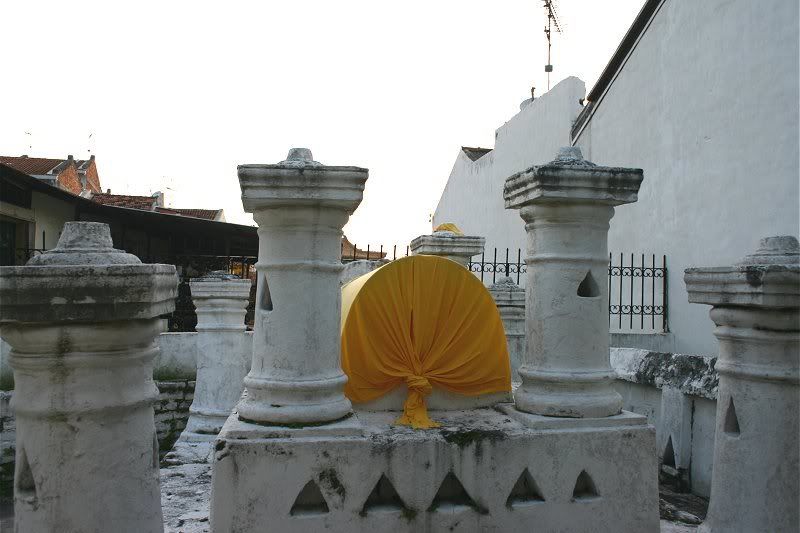
Exploring the Hang Kasturi Mausoleum
Jalan Hang Jebat, Malacca


Hang Kasturi is one of the five great warriors during the time of the Malacca Sultanate, particularly during the reign of Sultan Mansur Shah (1456-1477), the other four being Hang Tuah, Hang Jebat, Hang Lekiu and Hang Lekir. As young men, they studied silat under the same silat master. The title "Hang" is bestowed by the sultan for the highest ranking Malay warriors.

According to a version of the Malay Annals (Sejarah Melayu), Hang Kasturi is said to have gained notoriety for having an affair or having outraged the modesty of one of the Sultan's concubines, and Hang Tuah was sent to kill him. Unfortunately in a different version (as the Malay Annals were initially handed down by mouth, there are now many different written versions in existence), it was Hang Tuah, another Malay warrior, who was accused of having an affair with the palace ladies.

In one popular version, Hang Tuah so offended the Sultan that he order Tuah to be executed. However, the Bendahara Tun Perak (similar to prime minister) took him into hiding. Later, courtiers discovered that Hang Kasturi was having an affair with one of the sultan's concubines. They surrounded the palace but no one dared to enter to capture Kasturi. When the sultan was told that Hang Tuah was still alive, he ordered Hang Tuah to kill his best friend to prove his loyalty. During the fight, Hang Tuah embedded his kris in the palace wall three times, but Kasturi allowed him to remove it. But when the same thing happened to Kasturi, Tuah stabbed him to death. The sultan later rewarded Hang Tuah the title of laksamana, for his loyalty.

Hang Kasturi's Mausoleum is located along, interestingly, Jalan Hang Jebat (formerly Jonker Street), whereas Hang Jebat's Mausoleum is located at Lorong Tukang Kuli, within a stone's throw from Jalan Hang Kasturi. Although the mausoleums were claimed to belong to these warriors, no factual evidence has been put forth to verify this.
--------------------
Note : Unfortunately - there isn't much about Hang Lekir and Hang Lekiu

Guru Sheikh Ahmad al-Fathani di Mekah dan Madinah

Ruangan Bicara Agama Utusan Malaysia - 26 Mei, 2008/20 Jamadil Awal 1429

Belum sampai 30 tahun umurnya, telah diakui sebagai seorang ulama besar yang menguasai pelbagai bidang ilmu pengetahuan sekurang-kurangnya 47 jenis. Namun bagi Sheikh Ahmad bin Muhammad Zain al-Fathani sendiri masih tetap dahagakan ilmu pengetahuan.

Dia pulang ke Mekah kerana ingin memperdalam ilmunya, tetapi ulama yang tahu bahawa Sheikh Ahmad al-Fathani itu seorang yang telah banyak menguasai ilmu pengetahuan jarang yang sudi untuk mengajarnya.

Berbulan-bulan Sheikh Ahmad al-Fathani menyamar seperti orang yang tidak mengerti apa-apa. Dia mendatangi seluruh halaqah tempat guru-guru mengajar dalam Masjidil Haram untuk mencari guru mana yang layak untuk tempatnya belajar.

Pada suatu hari beliau mendatangi seorang ulama yang sangat terkenal di Masjidil Haram. Apabila Tuan Guru itu selesai mengajar, ketika diadakan ruang soal jawab, Sheikh Ahmad al-Fathani menanyakan sesuatu masalah kepada Tuan Guru itu.

Tuan Guru itu tidak mahu menjawab pertanyaannya. Dengan demikian Syeikh Ahmad al-Fathani telah maklum adanya, lalu dia minta izin untuk meninggalkan majlis itu. Setelah dia pergi, murid-murid yang hadir dengan tercengang-cengang menanyakan kepada Tuan Guru, “Apa sebab Tuan Guru tidak menjawab pertanyaan pemuda itu? Jangankan Tuan Guru kami pun dapat menjawabnya kalau Tuan memberikan izin kepada kami untuk menjawabnya. Dan siapakah pemuda itu?".

Tuan Guru menjawab, “Apakah kamu tidak kenal itulah yang dinamakan orang Ahmad az-Zaki Mesir yang berasal dari negeri Patani, bahawa ilmunya melebihi ilmuku. Kalau hanya itu yang ditanyakan mudah saja menjawabnya, namun aku malu sekiranya dia menanyakan hal-hal yang lebih mendalam lagi. Oleh sebab itu aku sengaja tidak menjawab pertanyaannya”.

GURU-GURU BELIAU

Guru-guru Sheikh Ahmad al-Fathani yang disebut dalam puisi beliau berjudul Nazham ‘Uqudid Durri adalah seperti berikut:

* Sheikh Umar Asy-Syami Al-Baqa’ie.

Setelah beliau mempelajari pelbagai permasalahan tatacara dan keilmuan para ulama di Mekah, maka jatuhlah pilihannya sebagai tempat dia belajar. Di antaranya yang beliau sebut pada bahagian akhir Nazham ‘Uqudid Durri ialah para gurunya sebelum beliau berangkat ke Mesir dulu.

Masih belum jelas siapakah yang beliau maksudkan dengan Wa bi Syaikhina ad-Dardir dalam nazham itu. Kemungkinan Syeikh Umar bin Barakat asy-Syami al-Baqa’ie yang lahir pada 1245 H/1829 M, dan wafat 1313 H/1896 M, pengarang Syarh ‘Umdah dan lain-lain.

Sebelum Sheikh Ahmad al-Fathani pergi ke Mesir dulu (sebelum tahun 1292 H/1875 M), beliau mendalami pelbagai ilmu dalam banyak kitab daripada Sheikh Umar asy-Syami.

Disebut oleh Sheikh Abdullah Mirdad Abul Khair bahawa kepada Sheikh Umar tersebut, Sheikh Ahmad al-Fathani mendalami pelbagai kitab seperti: ilmu-ilmu arabiah, usul, tafsir, hadis, fiqh, ma’ani, bayan, ‘arudh dan lain-lain.

Sheikh Umar asy-Syami pula memberi tempat kepada Sheikh Ahmad al-Fathani mengajar di Masjid al-Haram Mekah terutama dalam bidang sastera Arab.

Menurut Sheikh Abdullah Mirdad Abu Khair, dalam beberapa buah karangan Sheikh Umar al-Baqa’ie, di antaranya tentang ilmu Bayan, terdapat syair-syair Sheikh Ahmad al-Fathani. Dalam Mafahat ar-Ridhwan oleh Sheikh Zainuddin bin Sheikh Utsman as-Sarawaqi diriwayatkan juga bahawa Sheikh Umar al-Baqa’ie Shahibul Maqamis Sami (empunya makam yang tinggi) dan Hazam (gelaran perempuan yang masyhur pada orang Arab yang benar Arab).

* Saiyid Husein Al-Habsyi.

Dimaksudkan pula dengan Mulazina al-Hifni Quthub lit Thariqati qad hada’ dalam nazham yang sama tersebut berkemungkinan adalah Saiyid Husein al-Habsyi.

Nama ‘al-Hifni’ untuk Saiyid Husein Al-Habsyi di sini kemungkinan mengambil gelaran yang sama yang pernah diberikan kepada Asy-Syamsu Muhammad Salim al-Hifni.

Tentang ini kedudukan salah satu sanad keilmuan ialah Sheikh Ahmad al-Fathani belajar kepada Saiyid Husein Al-Habsyi, Saiyid Husein Al-Habsyi belajar kepada Saiyid Ahmad bin Zaini Dahlan, Saiyid Ahmad bin Zaini Dahlan belajar kepada Sheikh Ustman ad-Dimyathi, Sheikh Ustman ad-Dimyathi belajar kepada Sheikh Abdullah asy-Syarqawi, Sheikh Abdullah asy-Syarqawi belajar kepada Asy-Syamsu Muhammad Salim al-Hifni.

Ketika membahas tentang permainan catur nama ‘Hifni’ juga disebut oleh Sheikh Ahmad al-Fathani dalam karyanya Hadiqatul al-Azhar, cetakan pertama, halaman 175, “..... seperti barang yang berkata akan dia ‘Hifni’ atasnya....” Nama ‘Hifni’ di sini juga tidak jelas apakah yang dimaksudkan Asy-Syamsu Muhammad Salim al-Hifni atau pun Saiyid Husein Al-Habsyi.

Dalam puisi Sheikh Ahmad al-Fathani juga menyebut Quthub. Disebabkan Saiyid Husein Al-Habsyi dalam beberapa tulisan ulama adalah diakui sebagai seorang Quthub pada zamannya. Maka penulis bertambah yakin bahawa yang dimaksudkan oleh Sheikh Ahmad al-Fathani pada nazham/syairnya ialah Saiyid Husein Al-Habsyi.

Sheikh Muhammad Mahfuz Termas menyebut bahawa Saiyid Husein Al-Habsyi adalah Khatimatull Muhaqqiqin wa ‘Umdatul Fuqaha’ wal Muhadditsin. Ulama yang lain pula menggelarnya dengan Al-Quthbur Rabbaniyul Qurasyisyu.

Sheikh Ahmad al-Fathani pada satu catatan menyebut bahawa beliau mendapat ijazah amalan yang bersalasilah sampai kepada Saidina Ali bin Abi Thalib karamahullah wajhah dari Saiyid Husein Al-Habsyi. Selain itu guru tersebut memberikan kata-kata pujian atas karyanya yang berjudul Tashilu Naili Amani.

Kata puji-pujinya (taqrizh) Saiyid Husein Al-Habsyi itu sentiasa tercantum pada karya Sheikh Ahmad al-Fathani itu, iaitu pada terbitan Mekah dan Mesir. Sedangkan pada terbitan di Jawa, Singapura dan Pulau Pinang tidak pernah dicantumkan lagi.

Salah satu sanad, selain sanad-sanad yang lain, tentang pembacaan kitab Hadis Sahih Bukhari.

Syeikh Ahmad al-Fathani bertitik mula seperti berikut, iaitu:

* Sheikh Ahmad al-Fathani (1272 H/1856M-1325 H/1908M), belajar kepada

* Saiyid Husein Al-Habsyi (wafat 1330 H/ 1912 M), belajar kepada

* Ayahnya, Saiyid Muhammad bin Saiyid Husein al-Habsyi (1213 H/1798-9 M - 1281 H/1864-5 M), belajar kepada

* Sheikh Umar bin Abdul Karim bin Abdur Rasul al-‘Athar, belajar kepada

* Sheikh Ali bin Abdul Barri al-Wana-I, belajar kepada

* Sheikh Abdul Qadir bin Ahmad bin Muhammad al-Andalusi, belajar kepada

* Sheikh Muhammad bin Abdullah al-Idrisi, belajar kepada

* Al-Quthub Muhammad bin 'Alauddin an-Nahruali, belajar kepada

* Ayahnya Sheikh Falih al-Madani, belajar kepada

* Sheikh Abil Futuh Ahmad bin Abdullah ath-Thawus, belajar kepada

* Baba Yusuf al-Harawi, belajar kepada

* Muhammad bin Syaz Bakhat al-Farghani, belajar kepada

* Abi Luqman Yahya bin Ammar al-Khanlani, belajar kepada

* Muhammad bin Yusuf al-Farbari, belajar kepada

* Imam al-Bukhari

* Saiyid Abu Bakri Syatha.

Sheikh Ahmad al-Fathani ada hubungan erat dengan Saiyid Abu Bakri bin Saiyid Muhammad Syatha (wafat 12 Zulhijjah 1310 H/27 Jun 1893 M).

Disebutnya pada nazham Wa bi Syaikhina wa Mulazina al-Bakriy man haza wilayah wal karamah wal huda. Saiyid Abu Bakri Syatha yang lahir tahun 1266 H/1849 M lebih tua kira-kira enam tahun daripada Sheikh Ahmad al-Fathani (lahir 1272 H/ 1856 M) sebenarnya sama-sama belajar dengan beberapa orang ulama di Mekah.

Antara guru mereka ialah Saiyid Zaini Dahlan, Sheikh Muhammad bin Sulaiman Hasbullah al-Makki dan lain-lain.

Saiyid Abu Bakri Syatha adalah seorang ketua telaah (tutor) bagi Sheikh Ahmad al-Fathani.

Selepas Saiyid Abu Bakri Syatha selesai menyusun kitab I’anatuth Thalibin, Sheikh Muhammad bin Sulaiman Hasbullah al-Makki mengadakan ujian penggubahan nazham (puisi).

Penyusun puisi yang terbaik itulah yang akan diberikan kepercayaan untuk mentashhih kitab I’anatuth Thalibin tersebut. Daripada jumlah 35 orang yang menyertai pertandingan itu, ternyata yang memenanginya ialah Sheikh Ahmad bin Muhammad Zain al-Fathani.

Puisi tersebut termaktub dalam cetakan awal kitab itu, dan penulis juga lampirkan terjemahannya dalam artikel ini. Terjemahan lengkap dilakukan oleh salah seorang cicit Sheikh Ahmad al-Fathani, iaitu Ustazah Zaharah binti Awang, sebagai berikut:

* Khabar gembira tentang I’anah telah dinamakan menyinari ketinggian dan penerimaan dengan senyuman

* Bergelora kegembiraan hati orang yang berakal dan burung pemikiran menyanyi gembira

* Bangkitlah, berilah padaku minuman yang melegakan maka menyelami ingatanku tempat-tempat keagungan

* Kehadhrat Allah aku mengadu kerinduanku dan berfikir ketika malam yang gelap gulita

* Betapa jalan kembali kepada asalnya dan dengan apakah untuk mengatasi halangan dan kebosanan

* Dia adalah tempat ketenangan, gedung segala kebajikan di Kaabah-Nya hamba-hamba-Nya haji dan ihram

* Allah yang berkuasa dan memberi hidayah kemunculan sinar mentari, kelahiran Islam

* Di kalangan mereka seorang pemuda seperti bulan dipagari bintang-bintang seperti samudera, dilingkari sungai-sungai, airnya melimpah ruah

l Hamparan segala kebaikan ada tempat letak kakinya dan padanya ilmu-ilmu yang melahirkan para ulama

* Saiyid al-Bakri seorang yang berwibawa mempunyai ketinggian cita-cita yang membara

* Dia mujaddid menjadikan kebenaran zamannya dari datuknya yang mengiringi tsiqah/kepercayaan dengan penuh teliti

* Penghulur bantuan kepada para pelajar, ilmu-ilmu dalam kitab al-I’anah dan membina menara-menara dan menyerlahkannya pada yang telah binasa

* Sesungguhnya kitab al-I’anah itu kelebihannya amat tinggi iaitulah kitab yang menerangkan ayat-ayatnya secara terperinci

* Bahkan ia adalah perbendaharaan bernilai bagi yang mencarinya mencukupi bagi tetamu, yang meninggalkannya hina dan bodoh

* Padanya segala kebenaran yang telah tetap baginya menanggung segala kesusahan dan berserah

* Maka balasan untuk pengarangnya dan kelebihannya, hanyalah Allah SWT dengan segala kurniaan dan hadiah kebaikan

* Ya Allah, peliharalah Sheikhnya, iaitu Wali Quthub yang bertakwa perhiasan syariat, dialah ulama yang sertanya kemuliaan yang tinggi.

Penutup

Masih ramai lagi guru Sheikh Ahmad al-Fathani yang belum dibicarakan. Penulis hanya membicarakan guru- guru yang hanya disebut oleh beliau dalam puisinya berjudul Nazham Uqudid Durri.

Guru-guru beliau selain yang dinyatakan ini disebut dalam karya-karya beliau yang lain, yang akan dibicarakan lagi seterusnya.

Saturday, May 17, 2008

7 Tips for Muslim Businesses

SOURCE

How to Increase Profits and Help The Muslim Economy Grow

“I live in a suburban where there are 3 "Halal" meat stores within a 5 mile area, and another which is about 30 minutes away. I am an "American" Muslimah. In the three stores owned by Pakistani/Indian businessmen, the treatment I receive is terrible. In addition, the stores are filthy and no health code is followed. Blood from the meat is spread from meat counter to checkout counter, hands to money and pens, etc. In the store that is further away, the owner has argued and almost had fist fights with customers, and will not disclose his meat source. I have gone to great lengths to continue to buy Halal meat, but I feel that doing business with these people is not something I can continue to do." (Comment in the Halal and Healthy forum of the Sound Vision website, July 22, 1999)

Muslim consumers are often criticized for not doing enough to support Muslim businesses, whether it's paying the extra dollar (or two or three or four) to buy products, or to drive the extra mile (or two or three or four) to get to the store.

But what is rarely discussed in the North American context is what obligation Muslim businesses, especially Halal grocery stores, have to the Muslim community.

The above-mentioned complaint is not a reflection of all Halal grocery stores. However, the problems outlined in it cannot be ignored.

If Muslim businesses want the support of Muslim consumers, they will have to do more to accommodate them, provide better service and prices.

New York-based Muslim social scientist Ilyas Bayunus conducted a study in which he found that Chicago has a Muslim population of about 300,000. The state of Illinois has a population of 400,000.

This indicates the tremendous buying power of Muslims in this city and this state.

In Chicago alone, there are a minimum of 60 retail Halal meat shops that are owned and operated by Muslims.

Currently, the Halal meat business makes close to $5 million a year. But the potential profit could be as high as $60 to $80 million. The market hasn't developed for a number of reasons, some of them can be attributed to Muslim consumers, others to Muslim businesses.

Below are some tips on how you can improve service and profits of your Halal business. This can be applied to all business, not just the meat business:

1. MAKE PROFIT THE SECONDARY AIM

The first goal of a Muslim business should not be cashing in on a Muslim market. It should be pleasing Allah and establishing Halal as a way of life.

Seeking profit is not a bad aim, but it should be secondary.

By making Allah the goal, and implementing Islamic rules of honesty, truthfulness, and good behavior with customers, Insha Allah, any Muslim business is bound to boom.

2. BE TRUTHFUL AND HONEST

The Prophet has said the the honest and truthful businessman will be in Jannah amongst the Prophets the Truthful and the martyrs. Honesty and truthfulness are essential in this business. And when it comes to Muslim businesses, it means building a relationship of trust with customers, which cannot be done with lies and deceit.

3. BE OPEN TO SCRUTINY AND CRITICISM

While this may be a bitter pill to swallow, being ready to have your product or business scrutinized for cleanliness or the “Halalness” of products indicates a willingness to work with the consumer. This serves to build trust.

For those business people who may feel hesitant or downright angry with a Muslim consumer for even asking about the acceptability of a given product in their store, remember that this is the right of the consumer.

Remember, ultimately, we are all responsible to Allah. If a business is cheating Muslims, Allah will eventually expose those involved.

As well, a Halal business is not just one person's profit-making machine. It is also an institution of the Muslim community. Therefore, it must be ensured that it meets not just state and federal standards, but most importantly, the Quran and Sunnah's standards.

4.BE CLEAN!

This is especially important for Halal grocery stores where the presence of animal blood is expected. Not being careful of this means not only lost customers, but also possible sicknesses from the germs in the blood.


The Prophet (peace and blessings be upon him) said: "Cleanliness invites towards faith (Iman) and faith leads its possessor to paradise." (Tabarani)

This cleanliness, by the way, does not just apply to those areas of a store a customer will see. It includes equipment and storage areas as well.

5. AIM FOR A HIGHER GOAL

Don't just aim for one successful Halal grocery shop in your chosen neighborhood. Think big. Improve the inventory of your store, the types of items in it, and strive to find ways to improve service and profit margins.

As well, look into the possibility of pooling resources within the Muslim community or with other shareholders to expand the business. Doing this will also reduce overhead costs and in the long run, the price of products for your consumers.

6. WORK WITH OTHERS IN YOUR MARKET

Yes. This can be very difficult. Finger pointing, accusations and nasty rivalry often characterize Muslim businesses aiming to market the same products. But this is not the way a Muslim economy should work.

Brotherhood in the Ummah cannot be forgotten. Consider forming an association of Muslim meat retailers or distributors that can sit down together share experience, and learn to cooperate. This cooperation could, in the long run, benefit the Muslim consumer, and in turn the Muslim businesses themselves.

One example of where cooperation can take place in the Halal meat industry is by having all grocers or butchers slaughtering the animals in one place, Instead of doing it the way it's been done since the beginning: every individual or couple of retailers slaughtering their own animals.

By slaughtering in one place, costs are reduced, and in turn, the Muslim consumer pays less for the same product.

7. DO NOT SELL THE HARAM

While there are more “Muslim” businesses sprouting up, not everything they sell is Islamic.

It is not difficult to find Muslim owned businesses selling pork, alcohol, pornographic magazines, and renting these kinds of movies on the one hand, while selling Halal meat on the other.

Of a less offensive nature, perhaps, are those businesses which sell Halal products but rent or sell cultural (especially Indo-Pakistani) movies. While these movies may seem harmless in comparison to those of the pornographic variety, what must be remembered is that when Muslim parents and elders indulge in watching such cultural films, their children can very easily find an excuse to watch their own “cultural” films (i.e. American-Hollywood).

This requires efforts on the part of Muslim business owners to wipe out the Haram and ensure the Halal in their businesses.

A telling anecdote about Haram business practices was provided by Imam Siraj Wahhaj of Brooklyn, New York during a Khutbah.

He recounted the case of a Muslim who owned a shop that sold newspapers and magazines-including pornographic magazines. The Imam tried to convince the Muslim brother to stop selling these publications. At one point he agreed, and removed them from his shelves.

But after a while, Imam Wahhaj noticed they were back on the shelves. When he asked the brother about their reappearance, he said he was losing money.

Shortly after that, the entire store was destroyed in a fire.

Monday, May 12, 2008

Sheikh Ahmad al-Fathani

UTUSAN MALAYSIA - BICARA AGAMA - 12 MEI, 2008


Koleksi tulisan Allahyarham Wan Mohd. Saghir Abdullah


Pada mulanya penulis tidak mengenali Sheikh Ahmad al-Fathani, kerana penulis selalu diceritakan tentang kehebatan Sheikh Daud bin Abdullah al-Fathani dan Sheikh Nik Mat Kecik al-Fathani sahaja. Oleh sebab itu, pada penyelidikan awal penulis hanya tertumpu pada biografi Sheikh Daud bin Abdullah al-Fathani dan sahabat-sahabatnya.

Ibu penulis, Hajah Wan Zainab binti Syeikh Wan Ahmad al-Fathani pada mulanya enggan bercerita lebih panjang mengenai ayahnya.

Namun di antara cerita yang paling awal, katanya: "Kalau kamu ingin tahu tentang ayahku hendaklah kamu merantau ke Kelantan. Di sana ada murid-murid dan anak angkat ayahku. Anak angkat dan murid angkat ayahku yang paling terkenal ialah 'Awang Kenali'. Dia ialah ulama besar dan keramat. Ada murid ayahku menjadi ulama besar Kelantan namanya 'Nik Mahmud' dan 'Haji Muhammad Sa'id'.

"Sebelum kamu dengar dan temukan riwayat ayahku dari orang lain, aku tidak akan menceritakan kisahnya semua, tapi cukup kamu ketahui bahawa ayahku pergi ke Baitulmadqis dari Mekah dengan berjalan kaki. Sewaktu beliau pulang dari Turki pernah mendapat pelbagai hadiah dari Sultan Turki, di antaranya globe dunia yang besar sehingga tidak muat pintu ketika akan dibawa masuk ke rumah...", demikian cerita ibu penulis.

Setelah itu sekitar tahun 1960-an, penulis sering terbaca tentang Sheikh Ahmad bin Muhammad Zain bin Musthafa al-Fathani terselit dalam riwayat beberapa ulama yang diperkenalkan di majalah-majalah dan buku-buku.

Maklumat awal yang penulis perolehi mengenai beliau adalah berupa tulisan terdapat dua sumber. Sumber pertama pernah dibicarakan oleh salah seorang muridnya, seorang orientalis iaitu, Prof. Dr. C.Snouck Hurgronje yang dimuat dalam bukunya Mecca in The Latter Part Of The Nineteenth Century.

Maklumat pertama didengar bahawa Snouck Hurgronje adalah murid Sheikh Ahmad al-Fathani melalui cerita Saiyid Muhammad Yusof Zawawi, yang ketika hidupnya pernah sebagai Mufti Terengganu. Beliau menjelaskan kepada penulis sewaktu berada di Masjid Negara pada tahun 1977. Cerita beliau tersebut dikuatkan pula dengan pelbagai catatan yang penulis temui beberapa tahun kemudiannya.

Sumber kedua ditulis oleh murid Tok Kenali dalam majalah Pengasuh, bertarikh 2 Zulkaedah 1352 H/ 15 Februari 1934 M, hari khamis, jilid ke 17, muka ke 13 dan 14.

Sedikit mengenainya penulis salin tanpa perubahan bahasa, iaitu: "....al-Allamah Sheikh Wan Ahmad bin Muhammad Zain al-Fathani yang terkaya daripada ujian umpama kita ini. Betapakah tiada berkata demikian itu? Kerana ilmu yang mengandungi pelajaran agama itu masih ada lagi sekarang 60 perkara ilmu. Maka al-Allamah itu dapat empat puluh tujuh ilmunya seperti mengkhabarkan kepada penulis satu orang alim yang dipercayai khabarannya kerana dia berkebetulan pada satu masa itu ada peluang. Maka al-Allamah itu mentakrifkan 47 ilmu itu satu persatunya.

"Dan setengah-setengah ia karang ilmu itu. Maka sekarang ini, ada juga setengahnya seperti syaikhuna al-Kanali, dapat dua puluh empat. Kalau pembaca-pembaca hendak tahu insya-Allah saya akan sebut. Sebab almarhum itu (Maksudnya Tok Kenali) dapat setengah ilmu al-Allamah pada bilangan itu ialah kerana banyak mukhalathah dan mengaji daripadanya. Katakanlah seperti Abu Hurairah dengan Nabi kerana banyak bercampurnya dapat riwayat hadis tujuh ribu lebih. Dan al-Allamah yang tersebut itu almarhum sentiasa puji dan sebut; menunjukkan kasihnya demikianlah al-Allamah itu telah dapat khabar bahawa murid-murid yang lebih disayang ialah almarhum..."

Mengenai Sheikh Ahmad al-Fathani ini, penulis pernah menerbitkan buku kecil di Yala (1971-1972) dan pernah dimuat dalam majalah Dian bilangan 49, tahun 1972. Kedua-dua karya tersebut adalah karya penulis yang pertama diterbitkan.

Selain itu, khusus mengenai pemikiran Sheikh Ahmad al-Fathani ada tujuh siri pernah dimuat dalam Dewan Budaya mulai April 1991 sehingga September 1991 dan disambung dalam bulan Oktober 1991. Dalam majalah Dakwah pula mulai Ogos 1989 hingga April 1991, dan disambung lagi Jun 1991 hingga Disember 1991, yang penulis tulis khusus membicarakan ulama-ulama Malaysia dan Patani. Sebahagian besar ulama yang dibicarakan ada hubungkaitnya dengan Syeikh Ahmad al-Fathani.

Adakalanya mengenai pertalian dalam kekeluargaan, pertalian keilmuan daripadanya hingga ke atas dan murid-murid beliau.

Riwayat ringkasRiwayat ringkas Sheikh Haji Wan Mushthafa al-Fathani, iaitu datuk kepada Sheikh Ahmad al-Fathani, pernah penulis tulis dalam majalah Al-Islam, Januari 1990, iaitu siri ke-3 di bawah judul Thabaqat Para Ulama Patani.

Dalam Jurnal Dewan Bahasa, Mac 1990, penulis perkenalkan pemikiran bahasa dan huruf Melayu baru ciptaan Sheikh Ahmad al-Fathani. Dalam Jurnal Bahasa, September 1991, diperkenalkan pula kitab Hadiqatul Azhar war Rayahin yang merupakan karya Sheikh Ahmad al-Fathani.

Sepanjang tahun 1990 dan 1991, dalam Jurnal Dewan Bahasa, penulis perkenalkan pelbagai kitab karya ulama dunia Melayu, yang sebahagian besar juga menyentuh nama Sheikh Ahmad al-Fathani, kerana beliau adalah selaku pentashih pertama. Nazham atau syair Sheikh Ahmad al-Fathani, baik dalam bahasa Arab mahu pun dalam bahasa Melayu, beberapa buah di antaranya juga penulis sebut dalam jurnal tersebut itu.

Selain yang penulis sebutkan, masih banyak mengenai Sheikh Ahmad al-Fathani yang ditulis dalam majalah lainnya, di antaranya majalah Pengasuh.

Sebagai kesinambungan dari semua yang tersebut di atas, penulis menerbitkan pula buku khusus mengenai ulama ini, berjudul Sheikh Ahmad al-Fathani: Pemikir Agung Melayu dan Islam, Jilid 1 dan 2, terbitan Khazanah Fathaniyah, 2005.

Buku tersebut terkumpul maklumat lengkap mengenai Sheikh Ahmad al-Fathani hasil dari kajian demi kajian yang penulis selidiki. Dalamnya terkandung di antaranya mengenai pemikiran dan perjuangannya, termasuk aktiviti keseluruhan murid-muridnya yang terkenal, keluarganya yang menjadi ulama dan tokoh dunia Melayu, dan lain-lain yang penulis fikirkan perlu ditonjolkan.

Penulis dulukan perkataan 'Melayu' dari perkataan Islam dalam judul buku tersebut adalah bermaksud bahawa beliau adalah seorang ahli fikir yang terbesar untuk seluruh zaman bagi dunia Melayu.

Penulis tidak bermaksud mengatakan bahawa Sheikh Ahmad al-Fathani adalah pemikir agung atau besar untuk dunia Islam antarabangsa. Namun walau pun kecil, tidak dapat dinafikan bahawa ada peranan, sumbangan dan pemikiran beliau untuk kepentingan umat Islam sejagat hingga peringkat antarabangsa.

Kesinambungan daripada itu, penulis memperkembangkan lagi perbicaraan mengenai Sheikh Ahmad al-Fathani melalui artikel ini secara bersiri, seperti yang pernah penulis lakukan sebelum ini.

Ia dimulakan dengan pengenalan, seterusnya biografi yang mengandungi asal-usul keluarga beliau, keturunannya, keluarga yang menjadi ulama dan tokoh, murid-muridnya, kewafatannya, hasil-hasil karya beliau yang terkenal, dan pemikiran-pemikiran dalam pelbagai bidang.

Sebagai permulaan, penulis memulakan dengan pengenalan dan asal-usul nama beliau sahaja. Seterusnya mengenai yang selainnya akan dibicarakan dalam siri-siri selanjutnya.

Asal-usulNama lengkap Sheikh Ahmad al-Fathani ialah Sheikh Wan Ahmad bin Muhammad Zainal Abidin bin Datu Panglima Kaya Sheikh Haji Wan Mushthafa bin Wan Muhammad bin Wan Muhammad Zainal Abidin (faqih Wan Musa al-Jambui as-Sanawi al-Fathani) bin Wan Muhammad Shalih al-Laqihi bin Ali al-Masyhur al-Laqihi.

Walau bagaimana pun nasab yang sahih dan tahqiq dari Sheikh Ahmad al-Fathani sendiri ialah: Ahmad bin Zainal Abidin bin Haji Wan Mushthafa bin Wan Muhammad bin Wan Muhammad Zainal Abidin al-Fathani.

Nasab ini beliau tulis pada tiga tempat iaitu pada akhir Hadiqah al-Azhar, juga pada akhir Tuhfatul Ummah dan dalam sebuah catatan.

Tetapi pada semua cetakan Ar-Risalah al-Fathaniyah ialah: Ahmad Zainal Abidin bin Haji Wan Mushthafa bin Wan Muhammad bin Musa al-Fathani. Pada nama Zainal Abidin disebut nama 'Musa'.

Ada kemungkinan 'Zainal Abidin' adalah sebagai nama gelar untuk Syeikh Faqih Wan Musa al-Fathani, kerana 'Zainal Abidin' bermaksud 'perhiasan orang-orang yang mengabdikan diri kepada Allah'.

Dalam salah satu manuskrip tulisan Tok Kelaba al-Fathani, ada dicatat bahawa datuk-neneknya berasal dari negeri Khurasan, iaitu yang pertama datang ke dunia Melayu bernama 'Syarif Zainal Abidin'.

Beliau ini merantau ke Pulau Jawa, lalu berkahwin dengan seorang perempuan yang berasal dari Minangkabau. Oleh sebab terjadi sesuatu peperangan di Jawa, maka 'Syarif Zainal Abidin' bersama dengan salah seorang Raja Jawa keluar dari Pulau jawa lalu terdampar di Kelaba, iaitu sebuah negeri dalam Daulah Islam Patani Darussalam.

Syarif Zainal Abidin adalah seorang ulama, sehingga mudah baginya mendapat pengaruh di Kelaba dan juga meninggal dunia di Kelaba. Anak Syarif Zainal Abidin bernama Abu Bakar, berpindah ke Kelantan, dan tinggal di Kampung Laut, Kelantan. Di Kampung Laut (Kelantan), beliau memperolehi anak bernama Abdullah. Abdullah memperolehi anak bernama Abdul Shamad.

Abdul Shamad ini pindah pula ke Kelaba dan mendapat anak bernama Abdul Mukmin. Abdul Mukmin mendapat anak bernama Abdul Latif, dan Abdul Latif mendapat anak bernama Husein (Tok Kelaba).

Syarif Zainal Abidin yang dicatat oleh Tok Kelaba sebagai datuk neneknya itu adalah sezaman dengan Zainal Abidin yang disebut oleh Sheikh Ahmad al-Fathani. Oleh sebab ada hubungan kekeluargaan antara Sheikh Ahmad al-Fathani dengan Tok Kelaba, maka penulis yakin pertemuan nasab kedua-duanya adalah pada nama Zainal Abidin. Zainal Abidin pada salasilah Tok Kelaba kemungkinan adalah orang yang sama dengan Zainal Abidin pada salasilah Sheikh Ahmad al-Fathani.

Adapun nama Musa bin Muhammad Salleh bin Ali al-Masyhur al-Laqihi al-Fathani adalah berdasarkan tulisan Sheikh Muhammad Nur bin Sheikh Muhammad Ismail Daudy al-Fathani.

PenutupSelanjutnya, mengenai yang lain-lainnya akan dibicarakan dalam artikel ini secara bersiri-siri. Ia meliputi asal-usul keluarganya, keturunannya, keluarga yang menjadi ulama dan tokoh, murid-muridnya, kewafatannya, hasil-hasil karyanya yang terkenal, dan pemikiran-pemikiran beliau dalam pelbagai bidang.