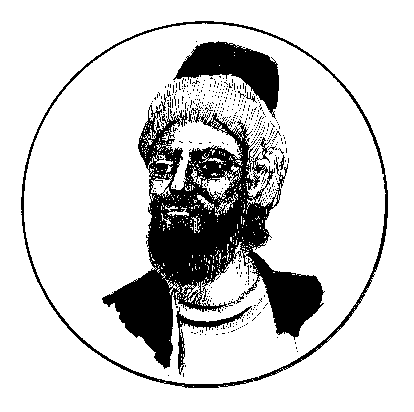
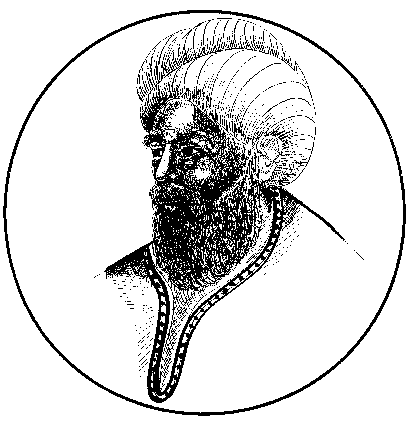
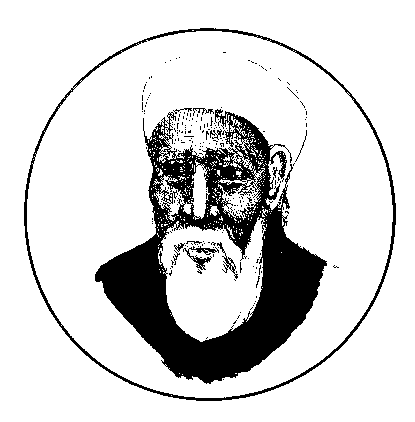
.

No Announcement

"O Allah! We seek goodness from Your Knowledge and with Your Power (and Might) We seek strength, and We ask from You Your Great Blessings, because You have the Power and We do not have the power. You Know everything and I do not know, and You have knowledge of the unseen. Oh Allah! If in Your Knowledge this action (We are about to take) is better for my religion and faith, for our life and end [death], for here [in this world] and the hereafter then make it destined for us and make it easy for us and then add blessings [baraka'] in it, for us. O Allah! In Your Knowledge if this action is bad for us, bad for our religion and faith, for our life and end [death], for here [in this world] and the hereafter then turn it away from us and turn us away from it and whatever is better for us, ordain [destine] that for us and then make us satisfied with it."

NOTE


عَنْ عُمَيْرِ بْنِ هَانِئٍ الْعَنْسِيِّ ، قَالَ : سَمِعْتُ عَبْدَ اللَّهِ بْنَ عُمَرَ ، يَقُولُ : كُنَّا قُعُودًا عِنْدَ رَسُولِ اللَّهِ ، فَذَكَرَ الْفِتَنَ فَأَكْثَرَ فِي ذِكْرِهَا حَتَّى ذَكَرَ فِتْنَةَ الْأَحْلَاسِ ، فَقَالَ قَائِلٌ : يَا رَسُولَ اللَّهِ وَمَا فِتْنَةُ الْأَحْلَاسِ ؟ قَالَ : ” هِيَ هَرَبٌ وَحَرْبٌ ، ثُمَّ فِتْنَةُ السَّرَّاءِ ، دَخَنُهَا مِنْ تَحْتِ قَدَمَيْ رَجُلٍ مِنْ أَهْلِ بَيْتِي يَزْعُمُ أَنَّهُ مِنِّي ، وَلَيْسَ مِنِّي ، وَإِنَّمَا أَوْلِيَائِي الْمُتَّقُونَ ، ثُمَّ يَصْطَلِحُ النَّاسُ عَلَى رَجُلٍ كَوَرِكٍ عَلَى ضِلَعٍ ، ثُمَّ فِتْنَةُ الدُّهَيْمَاءِ ، لَا تَدَعُ أَحَدًا مِنْ هَذِهِ الْأُمَّةِ إِلَّا لَطَمَتْهُ لَطْمَةً ، فَإِذَا قِيلَ : انْقَضَتْ ، تَمَادَتْ يُصْبِحُ الرَّجُلُ فِيهَا مُؤْمِنًا ، وَيُمْسِي كَافِرًا ، حَتَّى يَصِيرَ النَّاسُ إِلَى فُسْطَاطَيْنِ ، فُسْطَاطِ إِيمَانٍ لَا نِفَاقَ فِيهِ ، وَفُسْطَاطِ نِفَاقٍ لَا إِيمَانَ فِيهِ ، فَإِذَا كَانَ ذَاكُمْ فَانْتَظِرُوا الدَّجَّالَ ، مِنْ يَوْمِهِ ، أَوْ مِنْ غَدِهِ ” أبو داود
---------------------------------

The Webmaster (Pok Nik) would like to express his highest gratitude and thanks to (Almarhum) Ustaz Haji Ahmad Junaidin bin Che Din for his permission and greatest support in order to make this Global Abjad Blog as a reality.

Contact Pok Nik at : pgssajkm@gmail.com

----------------------------------
Importance of a good shaykh by Shaykh Abd'al-Qadir al-Jilani Radi Allahu anhu

Al Ghawth al-Adham Shaykh Sayyad Abd'al-Qadir al-Jilani Radi 'Allahu anhu said: You must work hard to ensure that your hearts are not locked out of the door of His nearness. Be sensible! You are getting nowhere. You must seek the company of a Shaykh who is learned in the law [hukm] and knowledge ['ilm] of Allah (Almighty and Glorious is He), and who will show you the way toward Him. Without seeing the successful [muflih], one cannot succeed. If a person does not seek the company of scholars who put their knowledge into practice ['ulama 'ummal], he is a chicken from an egg abandoned by the rooster and the mother hen.

Seek the fellowship of those who enjoy fellowship with the Lord of Truth (Almighty and Glorious is He). What each of you should do, when the night has grown dark and people have gone to bed and their voices are silent, is get up, take an ablution [yatawadda'], perform two cycles of ritual prayer [yusalli rak'atain] and say: "O my Lord, guide me to one of Your righteous servants near to You, so that he may guide me toward You and make me familiar with Your path." The instrument [sabab] is necessary. Allah (Almighty and Glorious is He) was quite capable of guiding [His servants] to Him without the Prophets [anbiya']. Be sensible! You are getting nowhere. You must awaken from your heedless folly. As the Beloved Prophet Salla Allahu ta'ala 'alayhi wa Sallam has said: If someone relies entirely on his own subjective judgement, he will go astray. Try to find someone who will be a mirror for the face of your religion [din], just as you look in the mirror to check the appearance of your outer face, your turban and your hair. Be sensible! What is this crazy foolishness? You say, "I don't need anyone to teach me," and yet the Beloved Prophet Salla Allahu ta'ala 'alayhi wa Sallam has said: The believer is the believer's mirror [al-mu'minu mir'atu 'l-mu'min].

When the believer's faith is sound, he comes to be a mirror for all creatures. They behold their religious faces [wujuh adyanihim] reflected in the mirror of his speech, every time they see him and get close to him. What is this craziness? Not a moment goes by without your begging Allah (Almighty and Glorious is He) to provide you with more than you already have to eat, to drink, and to wear, with more sexual opportunities and more income. These are not things that could increase or decrease, even if you were to be joined in your plea by every supplicant whose prayers are answered [da 'in mujab].

Supplication [da 'wa] will neither increase one's sustenance by so much as an atom, nor reduce it by an atom. This is a foregone conclusion [mafrugh minhu]. You must devote your attention to doing what you have been commanded to do, and to avoiding what you have been forbidden to do. You should not worry about that which is bound to come your way, because He guarantees that it will come to you. Allotted shares [aqsam] arrive at their appointed times, whether they be sweet or bitter, whether you like them or dislike them.

The people [of the Way] attain to a condition in which they no longer have any prayer of supplication [du'a] or request [su'al] to make. They do not beg [in their prayers] to gain advantages, nor to get rid of disadvantages. Their supplication comes to be a matter concerning their hearts, sometimes for their own sake and sometimes for the sake of all creatures, so they utter the prayer of supplication without conscious premeditation [fi ghaiba].
---------------------------------------
"O '' Allah, endow us with good behaviour in Your company under all circumstances!
---------------------------------------
[When the believer's faith is sound], fasting [sawm], prayer [salat], remembrance [dhikr] and all acts of obedience [ta 'at] become second nature to him, mingled with his flesh and blood. Then he receives protection from Allah (Almighty and Glorious is He) under all circumstances. The restraint of the law [hukm] does not desert him, not for an instant, while he is on this course. The law comes to be like the vessel in which he sits, as he travels over the ocean of the power [qudra] of his Lord (Almighty and Glorious is He). He goes on traveling over it until he arrives at the shore of the hereafter, at the shore of the ocean of grace and the hand of nearness. Thus he is sometimes in the company of creatures and at certain times in the company of the Creator. His work and toil are with creatures, while his relaxation is with the Creator.
--------------------------------------
From Shaykh 'Abd al-Qadir al-Jilani, "The Sublime Revelation (Al-Fath ar-Rabbani)," translated by Muhtar Holland (Al-Baz Publishing, Houston, 1992), p. 426-8.
--------------------------------------
On the authority of Abu Hurayrah r.a., who said that Prophet Muhammad S.A.W. said: Allah SWT said:

Whosoever shows enmity to someone devoted to Me, I shall be at war with him. My servant draws not near to Me with anything more loved by Me than the religious duties I have enjoined upon him, and My servant continues to draw near to Me with supererogatory works so that I shall love him. When I love him I am his hearing with which he hears, his seeing with which he sees, his hand with which he strikes and his foot with which he walks. Were he to ask [something] of Me, I would surely give it to him, and were he to ask Me for refuge, I would surely grant him it. I do not hesitate about anything as much as I hesitate about [seizing] the soul of My faithful servant: he hates death and I hate hurting him. (It was related by al-Bukhari)
------------------------------

“Allah! There is no God save Him, the Alive, the Eternal. Neither slumber nor sleep overtaketh Him. Unto Him belongeth whatsoever is in the heavens and whatsoever is in the earth. Who is he that intercedeth with Him save by His leave? He knoweth that which is in front of them and that which is behind them, while they encompass nothing of His knowledge save what He will. His throne includeth the heavens and the earth, and He is never weary of preserving them. He is the Sublime, the Tremendous.”

Showing posts with label PERSONALITY. Show all posts

Tuesday, December 9, 2008

AL-ALLAMAH TUAN GURU HAJI MAHMUD NASRI OTHMANI

AL-ALLAMAH TUAN GURU HAJI MAHMUD NASRI OTHMANI


Dilahirkan pada 13 Safar 1316 / 14 Julai 1898
di Kampung Alor Besar, Kota Sarang Semut, Kedah.

Pulang ke Rahmatullah pada 28 Safar 1400 / 16 Januari 1980
Dilahirkan dan kembali ke Rahmatullah pada hari Rabu


Pengenalan

Nama Tuan Guru Sheikh Mahmud Nasri bukanlah nama yang asing di kalangan masyarakat negeri Kedah dan Seberang Perai. Beliau dikenali sebagai seorang ulama, tuan guru dan pengasas Pondok Lanai Negeri Kedah Darul Aman yang dikenali sebagai Madrasah Misbahul Salam. Selain itu, beliau juga menjadi guru agama di surau-surau dan masjid-masjid yang menjemput beliau mengajar kitab-kitab dalam bidang tauhid, feqah , usuluddin, tasauf dan lain-lain. Isterinya juga mengajar Al-Quran dan kitab-kitab asas fardhu ain. Tuan Guru Sheikh Mahmud banyak memenuhi masa lapangnya dengan beruzlah bersendirian bagi mendekatkan dirinya kepada Allah S.W.T.

Silsilah Keturunan

Keturunan bapa : Haji Mahmud Nasri Othmani bin Haji Othman bin Haji Senik bin Haji Wan Hashim bin Haji Wan Abdul Wahab.

Datuknya ialah Allahyarham Assyahid Tok Nik Had keturunan Tok Mekong Awang Hitam, seorang hulubalang melayu yang syahid dipancung oleh tentera siam ketika sedang menunaikan solat di pinggir medan perang mempertahankan Pattany sekitar tahun 1730M.

Keturunan ibu : Haji Mahmud Nasri bin Hajjah Kamaliah binti Haji Saman bin Haji Abd Samad (Tok Fakeh) bin Hashim bin Wan Abdul Wahab.

Haji Mahmud adalah cicit kepada penghulu kampung Bera Pattany. Semasa kejatuhan Pattany, Wan Hashim (anak kepada AsSyahid Tok Nik Had (Tok Mekong Awang Hitam) telah berpindah ke Negeri Kelantan. Bapanya Haji Othman dilahirkan di Kampung Kuala Lengkung, kawasan bendang padi di pendalaman Kampong Belimbing dalam Jajahan Pasir Mas. Haji Othman dibesarkan dan dididik oleh datuknya dengan pelajaran agama dan kemudiannya di Pondok. Setelah dewasa, Haji Othman dibawa oleh datonya ke Negeri Kedah dan dijodohkan dengan ibunya (Hajjah Kamaliah) bagi merapatkan semula pertalian keluarga keturunannya.

Hasil perkongsian hidup itu, ibubapanya telah dikurniakan Allah SWT dengan 10 orang anak iaitu Ismail, Mahmud Nasri, Saat, Ahmad, Aisyah , Salmah, Cik, Zainab, Rokiah, dan Huduh.

Pengajian Agama

Haji Othman dan Hajjah Kamaliah yang mempunyai pendidikan agama yang baik telah membesar dan mendidik Haji Mahmud. Pada usia 7 tahun, Haji Mahmud telah khatam Al-Qu’ran dan beliau diserahkan kepada seorang guru Al-Quran yang mahir (berasal dari Pattany tetapi telah menetap di Kedah selama 5 tahun) iaitu Pak Ngah Idris untuk mempelajari Al-Quran dan pendidikan agama secara lebih mendalam. Ketika itu, pengajian Islam merupakan pelajaran utama untuk orang Melayu Malaya dan ramai anak-anak watan telah berjaya melanjutkan pelajaran ke Makkatul Mukarramah.

Pada usia 12 tahun, beliau telah berguru pula dengan Tuan Guru Haji Ismail (Tok Chik Dol) di Pondok Gajah Mati, Pendang, Kedah selama 3 tahun. Tidak lama kemudian, beliau telah berguru dengan Tuan Guru Haji Yaakob Kemelong Sik Kedah, seorang ulamak yang masyhur ketika itu.

Selepas itu, beliau telah berhijrah ke Kelantan (bersama kakandanya Ismail) pada usia 18 tahun dan berguru pula dengan seorang lagi ulama terkenal iaitu Tuan Guru Haji Wan Ahmad bin Wan Abdul Halim (Tok Padang Jelapang).Pondok Jelapang juga ketika itu merupakan pusat pengajian yang terkenal. Pada usia 21 tahun, Haji Mahmud masih meneruskan pelajarannya dengan Haji Wan Ahmad tetapi di Pondok Pasir Mas Salor.

Semasa di Pondok Pasir Mas Salor inilah, Haji Mahmud mengenali seorang lagi Ulama Terkemuka iaitu Al-Allamah Syeikh Yusuf Kenali (Tok Kenali)

Akhirnya Haji Mahmud telah berguru dengan Tok Kenali.

Perguruan dengan Tok Kenali

Tok Kenali adalah seorang tokoh ulama yang menguasai banyak bidang ilmu agama. Beliau juga merupakan murid kesayangan Al-Allamah Tuan Guru Syeikh Wan Ahmad bin Muhammad Zin Mustafa Al-Fathoni.

Tok Kenali rata-rata dikenali di Kelantan ketika itu sebagai seorang ‘keramat’ dan ‘wali’ di samping seorang ilmuwan yang bertanggungjawab di atas penerbitan Majalah Pengasuh, Majlis Agama Islam Kelantan.

Di sinilah Tok Kenali telah mengajar Syeikh Mahmud ‘rahsia shatar’ (titik perbezaan antara hak-hak hamba dengan Allah SWT) dan ‘amalan khalifah pusaka wali agama Islam’ bagi melayakkan manusia menjadi Khalifah dalam ertikata sebenar di muka bumi dan tahu membezakan antara ar-risalah (yang dikurniakan kepada Para Rasul) dan an-nubuwah (yang dikurniakan kepada Para Anbia) serta mengikuti sunnah/contoh/teladan.

Dengan adanya hak-hak kehambaan kepada Allah SWT semata-mata barulah seseorang manusia yang digelar Khalifah itu dapat mentadbir dan memakmurkan seluruh isi alam ciptaan Allah SWT.

Tok Kenali juga telah mengarahkan Syeikh Mahmud untuk mempelajari langkahan hulubalang (Jabat dll)/Silat Khalifah dengan Tuan Guru Haji Muhammad Taib (rakan kepada Datuk Perdana Nik Mahmud) di Kota Bharu. Syeikh Mahmud juga telah menerima amalan aurad dengan ayah kepada Haji Taib iaitu Al-Allamah Tuan Guru Haji Abdul Rahman Pattany (juga dikenali sebagai Tuan Guru Haji Abdul Rahman Jabat/Tengku Abdul Rahman Tok Tama) Tok Kenali telah menjelaskan antara lain tujuan mempelajari langkahan hulubalang dan amalan aurad ini ialah untuk mempertahankan agama, keluarga, bangsa dan negara dari sebarang bentuk penjajahan/serangan luar.

Akhirnya Tok Kenali telah mengijazahkan Amalan Khalifah Pusaka Wali Agama Islam kepada Syeikh Mahmud Nasri Osman.

Sebelum kembali ke Kedah pada usia 27 tahun (bersama sahabat-sahabatnya Tuan Guru Haji Othman Yunusi dan Tuan Guru Haji Abdul Aziz Ibrahim) Tok Kenali telah mendoakan Syeikh Mahmud dan berwasiat :

“Di mana ada rimba di situ tempatmu, di mana kamu duduk, hendaklah mendirikan madrasah, kamu jangan tinggal madrasah”.

Pulang Ke Kedah

Syeikh Mahmud Nasri Othmani telah pulang ke kampung halamannya dan tinggal bersama keluarganya. Tidak lama selepas itu, beliau kembali semula ke Pondok Gajah Mati dan tinggal di sana. Beliau telah dikunjungi oleh Tuan Guru Syeikh Othman Jalaluddin (Lebai Salam Penanti) untuk ke Madrasah Manabil Ulum Penanti Bukit Mertajam bagi guru ganti kepada Tuan Guru Syeikh Othman sementara anaknya Haji Muthalib pulang dari Makkatul Mukarramah.

Berkhidmat Di Penanti

Syeikh Mahmud berkhidmat di Madrasah Manabil Ulum Penanti Bukit Mertajam selama setahun sehingga anak Tuan Guru Syeikh Othman iaitu Setelah itu Tuan Guru Haji Muthalib pulang mengambilalih tugasnya sebagaimana pesanan ayahandanya.

Berkhidmat dan berhijrah ke Lenggong

Syeikh Mahmud Nasri kemudiannya dijemput pula oleh saudara sepupunya iaitu Tuan Imam Haji Yusuf Haji Ibrahim, Imam Masjid Lenggong Perak untuk mengajar agama. Imam Haji Yusuf merupakan murid kepada Tuan Guru Haji Abdul Malik bin Haji Hasan Pondok Sungai Pinang.

Syeikh Mahmud telah berhijrah/bermukim di Lenggong selama 2 tahun. Sepanjang tempoh itu, beliau mengajar tauhid, feqah, tasauf di masjid dan surau-surau yang terdekat. Pada usia 31 tahun, beliau kemudiannya berkahwin dengan anak saudara sepupunya Tuan Imam Haji Yusuf yang bernama Azizah. Isterinya merupakan seorang guru Al-Qur’an dan Fardhu Ain dan merupakan murid kepada bapanya sendiri dan bapa saudaranya iaitu Haji Ahmad (Pak Chu Mat Kelantan – murid kepada Tuan Guru Haji Abdullah Senik, Pondok Padang, Pasir Mas Kelantan) yang juga telah berhijrah dan menetap di Lenggong.

Selain Pak Chu Mat, Imam Haji Yusuf iaitu mertua Syeikh Mahmud juga telah berhijrah ke Lenggong selepas Hulu Perak, Kelantan dan Pahang telah dibuka dengan selamatnya oleh Tuan Guru Syeikh Abdul Rahman Jabat. Sebelum pembukaan, kawasan ini amat digeruni orang kerana ‘permainan raja orang asli’ yang mempunyai amalan memuja binatang-binatang buas bagi mengganggu sesiapa sahaja yang mencerobohi kawasan-kawasan yang ‘dijaga’ oleh mereka.

Kisah pembukaan ini telah meninggalkan kesan sejarah di hulu Perak, Kelantan dan Pahang menerusi lambang Gajah Putih iaitu tunggangan Tengku Abdul Rahman Tok Tama atau Sheikh Abdul Rahman Jabat.

Kembali Ke Kedah

Tiada berapa lama selepas perkahwinan beliau, Syeikh Mahmud merasakan amanat gurunya Tok Kenali belum dapat dilaksanakan. Pada tahun 1932 M, dia telah kembali ke Kedah dengan hasrat untuk membuka pondoknya di kawasan rimba yang baru diterokai di mana penduduknya tidak mempunyai guru yang boeh mengajar mereka tentang ilmu-ilmu agama.

Membuka Madrasah Misbahus Salam.

Pada 12 Rabi’ul awal 1351 H bersamaan 15 Ogos1932 M, Syeikh Mahmud telah berhijrah ke Kampung Lanai, Baling, Kedah Darul Aman; selaras dengan amanat Tok Kenali; Kampung Lanai merupakan suatu kawasan yang asalnya rimba yang belum diterokai dan hanya didiami oleh beberapa keluarga sahaja.

Semasa itu, penduduk Lanai mengerjakan solat Jumaat dengan berjalan-kaki sejauh 15km di Masjid Kampung Padang. Syeikh Mahmud telah berbincang dengan penduduk setempat seterusnya mencapai kata persetujuan untuk membuka Madrasah Misbahul Salam bagi digunakan sebagai tempat solat dan mempelajari agama.

Madrasah ini akhirnya menjadi terkenal dan semakin ramailah orang berhijrah ke Kampung Lanai untuk mempelajari agama dengan Syeikh Mahmud Nasri Osmani, murid kepada Ulama Terkemuka Asia Tenggara iaitu Al-Allamah Syeikh/Maulana Muhammad Yusuf Al-Kenali Al-Kelantani (Tok Kenali) Akhirnya Madrasah Misbahus Salam telah dipindahkan ke Caruk Salang, 3 km dari tapak asal.

Titah DYMM Sultan Badlishah

Selepas hampir tamat zaman pemerintahan Jepun, komunis cuba mengambilalih pentadbiran dengan menangkap Syed Abu Bakar dan Tuan Adam, DO Baling dan Residennya dan dibawa ke Kampung Dalam Wang Bawah Gunung, Baling dengan diikat seluruh badan mereka untuk ditanam dalam satu lubang secara hidup-hidup.

Syeikh Mahmud Nasri Osmani telah diminta oleh Tuan Guru Syeikh Yahya Taha, Kg. Pisang, Kupang (bapa mertua Tuan Guru Haji Umar Zuhdi) atas titah DYMM Sultan Badlishah untuk mengetuai operasi menyelamatkan Syed Abu Bakar dan Tuan Adam yang ditangkap bagi memaksa DYMM Sultan Badlishah menyerah diri kepada komunis.

Syeikh Mahmud Nasri dibantu oleh Tuan Haji Ahmad Bok Bak dan Tuan Haji Daud Bongor. Mereka telah pergi tanpa menggunakan sebarang senjata. Dengan Izin Allah, komunis seramai 600 orang yang diketuai oleh Chin Peng menjadi seperti terpukau dan melihat sahaja malah membenarkan Syeikh Mahmud dan rakan-rakannya membawa keluar Syed Abu Bakar/Tuan Adam sehingga jarak 40 meter. Komunis tiba-tiba menembak pasukan penyelamat selama 30 minit tetapi sekali lagi dengan izin Allah SWT, tidak ada satu pun peluru yang mengena mereka.

Tuan Guru Haji Mahmud Nasri Othmani dan rakan-rakannya telah menyerahkan Syed Abu Bakar dan Tuan Adam kepada DYMM Tuanku Sultan Badlishah dan Tuan Guru Haji Yahya Taha di Kampung Caruk Bembam, Kupang. Tempat penyerahan inilah hari ini telah didirikan Sekolah Menengah Syed Abu Bakar, Baling sempena nama Syed Abu Bakar.

Perasmian Madrasah Misbahul Falah

Pembukaan semula Madarasah Misbahul Falah telah disempurnakan pada tahun 1957 setelah terjadinya kesepakatan di antara Tuan Haji Abu Bakar dan menantunya Tuan Guru Haji Omar Zuhdi Solih, Tuan Guru Haji Mahmud Nasri Othmani dan penduduk tempatan.

Tuan Guru Haji Omar Zuhdi Solih adalah anak kelahiran Kelantan yang berasal dari Pengkalan Chepa, Kota Bharu. Beliau merupakan anak murid kepada Tuan Guru Haji Yahya Taha Kampung Pisang yang kemudiannya telah melanjutkan pelajaran ke Makkatul Mukarramah. Semasa di Mekah, Tuan Guru Haji Umar Zuhdi telah berguru kepada beberapa orang ulama terkenal seperti Tuan Guru Syeikh Wan Ismail bin Wan Abdul Qadir (Pak Da’el), Syeikh Mukhtar Abdul Malik Kudri Al-Makki, Syeikh Abdul Qadir bin Abdul Muthalib Al-Mandili dan Sheikh Muhammad Daud Sulaiman Al-Kelantani Al-Makki.

Sekembalinya beliau dari Makkatul Mukarramah bersama isteri dan anak-anaknya, Tuan Guru Haji Umar berhasrat untuk menyebarkan ilmu pengetahuan agama yang dipelajarinya kepada anak-anak bangsanya. Atas kehendak bapanya, Tuan Guru Hj Umar Zuhdi mengambil keputusan untuk menetap di Banggol Berangan, Lanai, Kupang, Kedah dan bersama-sama membuka semula pondok Madrasah Misbahul Falah.

Atas mengenang jasa Tuan Guru Haji Mahmud Nasri Othmani dan rakan-rakannya menyelamatkan Syed Abu Bakar dan Tuan Adam, DYMM Sultan Badlishah telah berkenan merancang untuk berangkat merasmikan Misbahul Falah. Namun, hasrat baginda tidak kesampaian kerana telah mangkat pada hari berkenaan Majlis kenduri untuk menyambut baginda telah bertukar menjadi majlis tahlil untuk Almarhum DYMM Baginda dan akhirnya Madrasah Misbahul Falah telah dirasmikan sendiri oleh Tuan Guru Haji Umar Zuhdi Solih.

Madrasah Misbahul Falah terus berkembang mengikut manhaj yang telah disediakan oleh Tuan Guru Haji Omar Zuhdi sendiri, mengikut system pengajian Nizhomi dan Umumi.Sistem pengajian nizhomi adalah system pengajian kelas bermula tahun I’dadi hingga ke thanawi dan sistem pengajian umumi adalah pengajian kitab-kitab torah dari kulit ke kulit.Sistem pengajian nizhomi dan umumi mendapat sambutan yang hangat di kalangan masyarakat yang dahagakan ilmu pengetahuan agama dan suasana ini berjalan baik sehingga ke hari ini. Tuan Guru Sheikh Mahmud Nasri Osmani pula mendirikan sebuah madrasah dengan mengekalkan nama madrasah Misbahus Salam di rumahnya berhampiran dengan madrasah tersebut.Beliau membantu mengajar kitab-kitab torah secara umumi kepada pelajar-pelajar Madrasah Misbahul Falah yang gemar menuntut ilmu dengannya.

Gerak Seni Silat Abjad.

Gerak Seni Silat Abjad telah diasaskan oleh Tuan Guru Sheikh Mahmud Nasri Osmani adalah sebagai menggantikan nama ilmu dan amalan yang asal diterima daripada gurunya Sheikh Yusuf Kenali dan menerima latihan daripada gurunya Sheikh Muhammad Taib bin Tuan Guru Sheikh Abdul Rahman Jabat. Nama asal ialah Amalan Khalifah Pusaka Wali.

Syeikh Mahmud Nasri memperkenalkan Gerak Seni Silat Abjad ini ialah kerana pada masa itu beliau melihat kedudukan umat Melayu Islam terumbang-ambing selepas peristiwa 13 Mei, 1969. Ketika itu lahirlah berbagai-bagai unsur-unsur syirik, khurafat dan bidaah berlaku berleluasa dalam masyarakat melayu. Lalu beliau berhasrat untuk membersihkan amalan-amalan karut yang tiada dalam ajaran agama.

Amanat Al-Allamah Syeikh Mahmud Nasri Osmani :

Banyak barang tiruan dalam pasaran,
Barang asli dalam rumah ahli,
Dapat beza dalam majlis tandingan,
Datang benar hancur binasa yang bathil,
Benar tetap benar, bathil tetap bathil,
Datanglah kepada kami jika mahu barang yang asli,
Tiada menjadi korban pengorbanan,
Tiada dimahkotakan pahlawan,
Nafsu tujuh rupa tujuh terbit,
Taulannya di luar atas rupanya baik atau jahat,
Tiap-tiap bergerak ditanya guru asal,
Dosa pahala dikira melaluinya,
Tiada guru syaitan mengaku jadi guru,
Ahli sufi palsu berbagai ragam ratib jampian,
Lumrah insan kalah memakai menang membeli.

----------------------------------

AL-FATIHAH

Tuesday, November 25, 2008

JABIR IBN HAIYAN - THE MUSLIM ALCHEMIST (REVISITED)

ORIGINAL SOURCE LINK


Jabir Ibn Haiyan, the alchemist Geber of the Middle Ages, is generally known as the father of chemistry. Abu Musa Jabir Ibn Hayyan, sometimes called al-Harrani and al-Sufi, was the son of the druggist (Attar). The precise date of his birth is the subject of some discussion, but it is established that he practised medicine and alchemy in Kufa around 776 C.E. He is reported to have studied under Imam Ja'far Sadiq and the Ummayed prince Khalid Ibn Yazid. In his early days, he practised medicine and was under the patronage of the Barmaki Vizir during the Abbssid Caliphate of Haroon al-Rashid. He shared some of the effects of the downfall of the Barmakis and was placed under house arrest in Kufa, where he died in 803 C.E.


Jabir's major contribution was in the field of chemistry. He introduced experimental investigation into alchemy, which rapidly changed its character into modern chemistry. On the ruins of his well-known laboratory remained after centuries, but his fame rests on over 100 monumental treatises, of which 22 relate to chemistry and alchemy. His contribution of fundamental importance to chemistry includes perfection of scientific techniques such as crystalization, distillation, calcination, sublimation and evaporation and development of several instruments for the same. The fact of early development of chemistry as a distinct branch of science by the Arabs, instead of the earlier vague ideas, is well-established and the very name chemistry is derived from the Arabic word al-Kimya, which was studied and developed extensively by the Muslim scientists.

Perhaps Jabir's major practical achievement was the discovery of mineral and others acids, which he prepared for the first time in his alembic (Anbique). Apart from several contributions of basic nature to alchemy, involving largely the preparation of new compounds and development of chemical methods, he also developed a number of applied chemical processes, thus becoming a pioneer in the field of applied science. His achievements in this field include preparation of various metals, development of steel, dyeing of cloth and tanning of leather, varnishing of water-proof cloth, use of manganese dioxide in glass-making, prevention of rusting, letterring in gold, identification of paints, greases, etc. During the course of these practical endeavours, he also developed aqua regia to dissolve gold. The alembic is his great invention, which made easy and systematic the process of distillation. Jabir laid great stress on experimentation and accuracy in his work.


Based on their properties, he has described three distinct types of substances. First, spirits i.e. those which vaporise on heating, like camphor, arsenic and ammonium chloride; secondly, metals, for example, gold, silver, lead, copper, iron, and thirdly, the category of compounds which can be converted into powders. He thus paved the way for such later classification as metals, non-metals and volatile substances.

Although known as an alchemist, he did not seem to have seriously pursued the preparation of noble metals as an alchemist; instead he devoted his effort to the development of basic chemical methods and study of mechanisms of chemical reactions in themselves and thus helped evolve chemistry as a science from the legends of alchemy. He emphasised that, in chemical reactions, definite quantities of various substances are involved and thus can be said to have paved the way for the law of constant proportions.

A large number of books are included in his corpus. Apart from chemistry, he also contributed to other sciences such as medicine and astronomy. His books on chemistry, including his Kitab-al-Kimya, and Kitab al-Sab'een were translated into Latin and various European languages. These translations were popular in Europe for several centuries and have influenced the evolution of modern chemistry. Several technical terms devised by Jabir, such as alkali, are today found in various European languages and have become part of scientific vocabulary. Only a few of his books have been edited and published, while several others preserved in Arabic have yet to be annotated and published.


MORE INFO HERE

Monday, October 20, 2008

TENGKU MAHMOOD MAHYIDDEEN

http://www.angkasa.coop/pelancar/index.php?p=aug011-2007

Tokoh Ulung Pejuang Negeri Kelantan

Nama Tokoh : Tengku Mahmood Mahyiddeen Ibni Almarhum
Tengku Abd. Kadir Kamaruddeen
Tarikh Lahir : 30 Oktober 1908
Tempat Lahir: Istana Chabang Tiga, Wilayah Pattani
Tarikh Meninggal : 12 Februari 1954

LATAR BELAKANG Tokoh Tengku Mahmood Mahyiddeen merupakan anakanda Sultan Pattani yang terakhir, iaitu Almarhum Tengku Abdul Kadir Kamaruddeen. Bondanya adalah rakyat negeri Kelantan bernama Cik Maimunah. Tengku Mahmood Mahyiddeen dilahirkan semasa kerajaan Siam dan pihak Inggeris sedang hangat berebutkan negeri Pattani pada 30 Oktober 1908. Beliau dibesarkan oleh ibu tiri selepas ibunya meninggal pada ketika beliau berusia empat tahun. Apabila memasuki alam persekolahan, beliau dihantar ke negeri Kelantan dan memulakan hidup baru di sana.

Beliau memulakan alam persekolahan dengan memasuki Sekolah Majlis Agama Islam Kelantan pada usia tujuh tahun. Lima tahun kemudian, ayahandanya menghantar beliau ke kota raya Bangkok (1920) untuk memasuki Royal Assumption College. Bagaimanapun Tengku Mahmood hanya berada kira-kira tiga tahun sahaja di Bangkok akibat masalah politik yang timbul antara ayahandanya dengan kerajaan Siam. Ekoran itu, Tengku Mahmood dihantar pula ke Government English School di Pulau Pinang pada tahun 1923. Sebagai seorang pelajar yang pintar, Tengku Mahmood kemudiannya menyertai sekolah elit iaitu Penang Free School pada tahun 1926 dan lulus Senior Cambridge dua tahun kemudian. Disebabkan kecemerlangannya itu, beliau telah ditawarkan biasiswa pengajian perubatan di King Edward VII Medical College, Singapura. Bagaimanapun Tengku Mahmood telah menyerahkan tawaran itu kepada seorang rakannya yang miskin berbangsa Cina dan beliau sendiri mengambil keputusan kembali ke pangkuan keluarga di Kelantan. Tengku Mahmood Mahyiddeen telah mendirikan rumah tangga dengan adinda Sultan Kelantan iaitu Tengku Zainab pada tahun 1930.

Sejak awal tahun 1930-an, Tengku Mahmood mula aktif bergiat dalam bidang kemasyarakatan. Sifat prihatin dan peka serta ketajaman fikirannya telah membuatkan kerajaan negeri pada masa itu tertarik dengan kebolehan beliau. Bermula detik itulah beliau diamanahkan memegang jawatan sebagai Nazir Sekolah-Sekolah Melayu Kelantan pada tahun 1933 dan Penguasa Pelajaran Kelantan pada tahun 1938.

Tengku Mahmood kemudiannya telah berjuang bersungguh-sungguh membangunkan sistem pelajaran moden di Kelantan. Beliau berhasrat memastikan anak-anak jati negeri itu tidak ketinggalan dalam pelbagai aspek kehidupan. Dari tahun 1933 – 1941, beliau telah bertanggungjawab menubuhkan sebuah sekolah aliran Inggeris pertama di Kelantan (Maktab Sultan Ismail – 1936) dan sebuah lagi sekolah aliran Inggeris khusus untuk anak-anak perempuan (Zainab English School – 1937).

Bagaimanapun, usaha Tengku Mahmood terhenti apabila Tanah Melayu diserang oleh Jepun pada 8 Disember 1941. Namun, sebagai seorang individu yang berjiwa pejuang, Tengku Mahmood telah menukar arah perjuangannya. Dengan semangat patriotisme yang tinggi, beliau telah mengepalai sekumpulan pemuda Melayu berperang secara berdepan dengan tentera Jepun yang mendarat di pantai Sabak. Keberanian beliau berperang secara berdepan menentang tentera Jepun, pada hal beliau bukannya askar kerajaan telah mengundang rasa hormat yang teramat tinggi dari pihak Inggeris dan masyarakat setempat.

Bermula saat itu, tumpuan Tengku Mahmood mula terarah untuk mempertahankan maruah negara daripada ancaman penjajah. Beliau sanggup meninggalkan keluarga, harta dan pangkat demi berjuang untuk negara. Tengku Mahmood terlibat aktif menyusun serta mengumpul belia-belia Melayu di luar negara bagi menyertai gerila Force 136 yang dipimpinnya. Angkatan Force 136 yang berpusat di India itu adalah kumpulan yang bertanggungjawab menyusup masuk ke Tanah Melayu bagi menjalankan tugas-tugas risikan semasa perang dengan Jepun.

Sememangnya kehidupan Tengku Mahmood Mahyiddeen tidak pernah sunyi dengan perjuangan. Setelah Jepun menyerah kalah, beliau terlibat pula dalam peristiwa penentangan terhadap Malayan Union. Malah, banyak lagi peristiwa besar yang berlaku dalam usaha beliau membebaskan tanah air daripada penjajah sama ada di Tanah Melayu mahupun di wilayah Pattani. Malangnya, beliau tidak sempat melihat usahanya berjaya apabila meninggal dunia pada 12 Februari 1954, dua tahun sebelum rombongan Tengku Abd. Rahman ke London untuk menuntut kemerdekaan. Kematian beliau dalam usia 40-an menimbulkan pelbagai spekulasi. Ini kerana pada waktu itu ramai tokoh pejuang dan pemikir negara yang mati pada usia muda dan kebanyakan mereka mati diracun.

Sehingga hari ini, memang sukar untuk mencari pengganti tokoh seperti Tengku Mahmood Mahyiddeen. Beliau walaupun berketurunan raja tetapi berjiwa rakyat. Malah, kesanggupan beliau menggugurkan gelaran ‘Tengku’ (1 Ogos 1946) pada dirinya adalah bukti betapa beliau seorang yang amat merendah diri. Gabenor Malayan Union, Sir Edward Gent, pada 19 November 1946 telah menyanjung Tengku Mahmood dengan berkata :

“Tengku Mahmood Mahyiddeen seorang tokoh perjuangan Melayu yang bijak, berwibawa dan disenangi ramai. Beliau amat menyintai kedamaian dan kesejahteraan hidup. Walaupun ketika menghadapi kesulitan dan berdukacita, namun senyuman sentiasa terukir di wajahnya.”

SUMBANGAN TOKOH
Pembela Masyarakat Semasa berniaga, beliau banyak melihat penderitaan rakyat. Oleh itu, beliau mula berfikir dan merancang bagi memastikan nasib rakyat dapat dibela. Beliau juga sedih dengan nasib anak-anak gadis yang berkahwin muda, masalah bidan yang kurang cekap serta masalah banyaknya kelahiran bayi yang tidak cukup bulan dan kadar kematian yang tinggi. Beliau menjadikan isu ini perkara pokok dalam menegur sikap Inggeris.
Pembaharuan Pelajaran Masyarakat Beliau diminta untuk menjawat jawatan dalam khidmat awam kerana pemikiran yang tajam dan kritis serta ilmu pengetahuan yang tinggi. Beliau mula menjawat jawatan sebagai Pemangku Nazir Sekolah-Sekolah Melayu Negeri Kelantan. Azam beliau ketika itu untuk membekalkan masyarakat Melayu dengan ilmu pengetahuan yang moden tanpa mengetepikan sistem pelajaran sedia kala.
Pejuang Bahasa Melayu Diberi kepercayaan untuk menjadi Yang Dipertua Pertubuhan Dewan Bahasa Melayu. Matlamat pertubuhan itu adalah untuk memperjuangkan martabat Bahasa Melayu dan menghidupkan ciri-ciri kebudayaan Melayu.
Mengubah Pemikiran Masyarakat Beliau berusaha keras menyedarkan masyarakat betapa pentingnya ilmu pengetahuan moden kepada seluruh rakyat tidak mengira lelaki mahupun perempuan.
Aktif Dalam Badan Sukarelawan Dan NGO Beliau menjadi Pesuruhjaya Pengakap Kelantan dan membawa Pengakap Kelantan ke Jambori Pengakap terbesar di Melbourne, Australia; Ketua Pertubuhan pertama St. John Ambulance Brigade cawangan Kelantan; dan berpangkat Sarjan dalam tentera sukarelawan Kelantan.
Mendirikan Sekolah Tengku Mahmood Mahyiddeen mendirikan sekolah aliran Inggeris pertama di Kelantan pada tahun 1936, iaitu Sekolah Sultan Ismail / Ismail College. Pada tahun 1937, sekolah aliran Inggeris khusus untuk pelajar perempuan ditubuhkan oleh beliau iaitu Zainab English School, kini Sekolah Menengah Zainab.
Ahli Politik Beliau menjadi Yang Dipertua GEMPAR, iaitu pertubuhan yang merancang membawa Pattani menyertai Tanah Melayu; dan dilantik sebagai Ahli Majlis Mesyuarat Persekutuan mewakili Kelantan. Bertanding menentang Datok Onn dalam perebutan jawatan Yang Dipertua UMNO. Tengku Mahmood Mahyiddeen dilantik menjadi Ahli Jawatankuasa Badan Penasihat Hal-Ehwal Pelajaran Kerajaan Tanah Melayu.
Pejuang Kemerdekaan Beliau bertempur dalam serangan pertama tentera Jepun di Tanah Melayu di Kota Bharu, memimpin barisan anak-anak Melayu dalam pasukan Sukarelawan Kelantan (Kelantan Volunteer Force) dan menyertai pasukan Force 136, selain terlibat dalam usaha menentang Malayan Union.

PENGIKTIRAFAN

Menerima Bintang Kehormat Most Excellent Order Of The British Empire / M.B.E.
Menerima Anugerah Kelas II Bintang Kebesaran Kerajaan Kelantan Al-Muhammadi, Darjah Paduka Mahkota Kelantan (DPMK) yang membawa gelaran Dato’.

- AZLAN MOHAMED
Pegawai Pelajaran

Monday, August 18, 2008

Ilmu-ilmu hadis Sheikh Ahmad Al-Fathani

UTUSAN MALAYSIA - BICARA AGAMA - ARKIB : 18/08/2008
Koleksi tulisan Allahyarham WAN MOHD. SHAGHIR ABDULLAH (Al-Fatihah)

SEBAGAIMANA al-Quran dengan kepelbagaian ilmunya, demikian juga halnya dengan hadis yang sangat banyak ilmu yang tertakluk dengannya. Di antara ilmu-ilmu itu ialah Ilmu Mushtalahul Hadis, Ilmu Dirayah Hadis dan Ilmu Rijal Hadis. Selain penghafal hadis dengan jumlah yang banyak, Sheikh Ahmad al-Fathani juga telah khatam pengajian ilmu-ilmu hadis terutama kitab-kitab dalam lingkungan Ahlus Sunni. Beliau belajar semua disiplin ilmu yang ada dalam persekitaran hadis.

Sheikh Ahmad al-Fathani telah memperoleh sanad musalsal yang dianggap penting dalam ilmu hadis. Dalam umur masih muda, Sheikh Ahmad al-Fathani telah menguasai ilmu-ilmu hadis. Ini terbukti apabila beliau telah diberikan ijazah oleh dua orang gurunya di Madinah pada tahun 1319 H/1901 M.

Ijazah hadis yang pertama diberikan oleh Saiyid Muhammad Ali bin Saiyid Zhahir al-Watri al-Hanafi pada tarikh 26 Rejab 1319 H/1901 M dan ijazah hadis yang kedua diberikan oleh Saiyid Abdul Qadir as-Syibli at-Tharablusi as-Syami al-Hanafi. Kedua-dua ulama itu adalah ulama besar ahli hadis pada zaman itu yang mengajar di Masjid Nabawi, Madinah.

Sheikh Ahmad al-Fathani juga menyusun kitab mengenai hadis dalam bahasa Arab dan bahasa Melayu. Yang bahasa Arab masih dalam bentuk manuskrip, manakala dalam bahasa Melayu yang pernah diterbitkan di antaranya ialah Bisyarah al-‘Amilin wa Nazarah al-Ghafilin. Dalam karya beliau Hadiqatul Azhar war Rayahin juga banyak terdapat hadis dan terjemahannya.

Selain itu, sekurang-kurangnya ada tiga kitab yang membicarakan hadis dalam bahasa Melayu telah ditashhih oleh Sheikh Ahmad al-Fathani. Pada ketiga-tiga karya tersebut, terdapat puisi beliau yang ditulis dalam bahasa Arab dan bahasa Melayu. Kitab-kitab yang dimaksudkan ialah Kasyful Ghummah karya Sheikh Daud bin Abdullah al-Fathani, Al-Jauharul Mauhub karya Sheikh Wan Ali bin Abdur Rahman Kutan, al-Kalantani dan Al-Kaukabud Durriy karya Sheikh Muhammad bin Ismail al-Fathani.

Sebelum membicarakan puisi-puisi Sheikh Ahmad al-Fathani pada kitab-kitab yang tersebut, penulis senaraikan sanad lengkap beliau dalam bidang ilmu hadis yang khusus mengenai kitab-kitab hadis shahih. Sanad yang dimaksudkan adalah:

*Sheikh Ahmad al-Fathani, belajar kepada:

*Saiyid Ahmad bin Zaini Dahlan, belajar kepada:

*Maulana Sheikh Utsman bin Hasan ad-Dimyathi al Azhari, belajar kepada:

*Ramai ulama, yang paling terkenal dan banyak disebut ada tiga orang, iaitu: Sheikh Abdullah bin Hijazi asy-Syarqawi, Sheikh Muhammad al-Amir al-Kabir, dan Sheikh Muhammad bin Ali asy-Syanwani. Khusus sanad daripada Allamah Sheikh Abdullah bin Hijazi asy-Syarqawi, belajar kepada:

*Allamah asy-Syamsu Muhammad Salim al-Hifni, belajar kepada:

*Allamah Abdul Aziz az-Ziyadi, belajar kepada:

*Asy-Syamsu Muhammad bin al-Alauddin al-Babli, belajar kepada:

* Sheikh Salim bin Muhammad as-Sanhuri, belajar kepada:

*An-Najmu Muhammad bin Ahmad al-Ghaithi, belajar kepada:

*Sheikh al-Islam Zakaria bin Muhammad al-Anshari, belajar kepada:

*Al-Hafiz asy-sheikh Ahmad bin Ali bin Hajar al-Asqallani, belajar kepada:

*Abi Ishaq Ibrahim bin Ahmad at-Tanukhi, belajar kepada:

*Abi al-Abbas Ahmad bin Abi Thalib al-Hajjar, belajar kepada:

*Al-Husein bin al-Mubarak az-Zabidi al-Hanbali, belajar kepada:

*Abi al-Waqti Abdul Awwal ibnu Isa as-Sijzi, belajar kepada:

*Abi al-Hasan Abdur Rahman bin Muzhaffar bin Daud ad-Dawudi, belajar kepada:

*Abi Muhammad Abdullah bin Ahmad as-Sarakhsi, belajar kepada:

*Abi Abdullah Muhammad bin Yusuf bin Mathar al-Farabri, belajar kepada:

*Muallif Sahih Bukhari, al-Imam al-Hafizh al-Hujjah Abi Abdullah Muhammad bin Ismail bin Ibrahim al-Bukhari.

Berikut pula disertakan puisi-puisi Sheikh Ahmad al-Fathani dalam ketiga-tiga kitab yang disebutkan.

Adapun puisi-puisi tersebut tidak disertakan bersama syarahnya, seperti mana yang terkandung dalam kitab. Mengenai syarah-syarahnya dapat dirujuk melalui kitab-kitab tersebut atau buku penulis berjudul Sheikh Ahmad al-Fathani: Pemikir Agung Melayu dan Islam, Jilid 2, yang dimulai halaman 231.

Puisi pada kitab Kasyful Ghummah karya Sheikh Daud Abdullah al-Fathani

Puisi Sheikh Ahmad al-Fathani yang menerangkan mengenai kitab Kasyful Ghummah terdapat pada cetakan pertama kitab tersebut oleh Mathba’ah al-Miriyah al-Kainah, Mekah pada tahun 1303 H. Transliterasinya adalah sebagai yang berikut:

“Puji bagi Tuhan,

yang menjadikan mawa’izh itu tazkirah lil ummah

Dan dibukakan dengan dia daripada mereka itu

yang menerimanya akan ghummah

Dan shalawat dan salam atas Nabi

al-Hadi ila Rasyad

Dan atas keluarganya dan tolannya

syufa’ana yaumal ma’ad

Wa ba’du,

Maka telah sempurnalah ini kitab yang mustathab

Yang padanya

Hudanl lil muttaqin wa zikra li ulil al-bab

Sungguhnya telah disebutkan padanya

Akhbarut tifaf as-saq bis-saq

Dan ahwal pada hari yang padanya

ila rabbikal masaq

Dan dicetera padanya akan segala

yang menakuti daripada ahwal al-jahim

Dan dinazham pada suluk asrarnya akan segala

lu’lu’ akhbar jannatin na’im

Dan lain daripada ahwal yang barzakhiyah

Dan segala pekerjaan yang ukhrawiyah

Barang yang sayogianya mengambil ibarat

dengan dia oleh ‘aqilun

Dan hendaklah beramal bagi seumpama tsawab

yang tersebut padanya oleh ’amilun

Dan adalah hamba muqabalahkan pada tashhihnya

dengan Mukhtashar asy-Sya’rani

bagi asalnya yang Arabi

Iaitu at-Tazkirat al-Qurthubiyah

Dan hamba tashlihkan setengah daripada

barang yang zhahir padanya tahrif,

maka jadilah ia bersih seolah-olah

Ia-ali manzumah

atawa sabaik zahabiyah

Dan adalah capnya pada al-Mathba’ah al-Miriyah,

yang pada Makkah al-Mahmiyah

Dan selesainya pada pertengahan Syawal,

sanah 1303 Hijrah an-Nabi Shallallahu alaihi

wa sallam,

wa ‘ala alihi wa shahbihi wa syarafi wa karam


Puisi pada kitab Al-Jauharul Mauhub karya Sheikh Wan Ali Kutan al-Kalantani

Pada kitab Al-Jauharul Mauhub wa Munabbihatul Qulub karya Sheikh Wan Ali bin Abdur Rahman bin Abdul Ghafur Kutan al-Kalantani, terdapat puisi Sheikh Ahmad al-Fathani yang digubah dalam bentuk sastera Arab yang terdiri daripada 27 bait. Tiap-tiap satu bait dua baris, dua baris. Selain itu, terdapat juga puisi beliau yang digubah dalam bahasa Melayu. Puisi yang digubah dalam bahasa Melayu transliterasinya adalah sebagai yang berikut:

“Puji itu bagi Allah,

yang dengan kurnia-Nya

sempurna segala yang dituntuti

Dan rahmat dan sejahtera

atas afdal segala Nabi yang diikuti

Dan atas kelurganya dan taulannya

yang semulia-mulia mereka itu,

yang dengan kepujiannya disebuti

Kemudian daripada itu,

Maka dengan pertolongan

Tuhan al-Malikul Wahhab

Dan dengan kemegahan

Penghulu kita an-nathiqu bish-shawab

Telah sempurnalah ini kitab yang mustathab

Yang ialah bagi segala hati yang lalai itu,

sebesar-besar cerca dan 'itab

Yang menyaksi akan dia

oleh al-Muqarrabun

khitamuhu miskun dan pada

falyatanafasil mutanafisun

Yang dinamakan dia

dengan al-Jauharul Mauhub

Iaitu kitab yang terpenuh

dengan guna-gunaan yang mathlub

Dan indah-indahan yang padanya marghub

Daripada ahadits Nabawiyah

Dan atsar Salafiyah

Dan fawaid yang ’ajibah

Dan faraid yang gharibah

Dan asrar yang lami’ah

Dan akhbar yang jami’ah

Dan nashaih dan mawa’izh yang mufidah

Dan ma’arif dan ‘ulum ‘adidah

Maka ialah,

Langit segala bintang yang ’alaih

Dan laut segala mutiara yang ghaliyah

Dan kebun segala bunga-bungaan yang bahiyah

Dan pokok segala buah-buahan yang syahiyah

Ta’lif guru yang a’zham

bagi segala guru yang masyhur

Maka dialah matahari ilmu

dan mereka itu budur

Al-‘Allamah al-‘Amil

wa al-Fadhil al-Kamil

Tuan Sheikh Wan Ali Kutan al-Kalantan

Ibnu al-Marhum Wan Abdur Rahman

Ibnu Abdul Ghafur afadhallahu Taala alaihi

sawabighul judi wal ihsan”


Puisi pada kitab Al-Kaukab Ad-Durriy karya Sheikh Muhammad Bin Ismail Daud Al-Fathani

Kitab yang akan dibicarakan

ini bukanlah kitab khusus membicarakan hadis seperti dua

kitab yang telah dibicarakan. Namun disebabkan cerita-cerita di dalamnya lebih banyak bersumber daripada hadis, maka dikategorikan

di bawah judul Puisi Sheikh

Ahmad Al-Fathani Pada Kitab-Kitab Hadis.

Kitab ini dengan judul lengkapnya Al-Kaukabud Durriy fin Nuril Muhammadiyi, adalah merupakan karya ulama dunia Melayu yang terkenal, iaitu Sheikh Muhammad bin Ismail Daudy al-Fathani, atau digelar juga dengan Sheikh Nik Mat Kecik al-Fathani.

Kitab yang bercorak

sastera

Islam Melayu klasik ini telah ditashhih oleh Sheikh Ahmad al-Fathani, dan padanya terdapat puisi beliau yang ditulis dalam bahasa Arab dan bahasa Melayu. Puisi yang digubah dalam bahasa Melayu transliterasinya adalah sebagai yang berikut:

Wa ba’du,

Maka telah selesailah thaba’ ini kitab

yang mengandung akan beberapa banyak ajaib

Yang menyatakan daripada

ahwal bahamut,

dan malakut,

dan ‘azhamut,

akan badai’ dan gharaib

Maka seyogialah,

bagi segala mata,

bahawa berkuhul ia,

dengan itsmid muthala’ahkan ibaratnya

Dan bagi segala telinga,

bahawa berlazat-lazat ia,

dengan halawah mendengarkan hikayatnya.

Yang diisnadkan sekaliannya,

kepada tsiqat al-ulama zawit tahqiq

Maka lazimlah atas segala hati,

bahawa ada ia baginya Aba Bakar as-Shiddiq

Dan sesungguhnya,

jikalau dituliskan risalah ini,

atas shafaih al-fiddah dengan ma’ az-zahab

niscaya berpatutanlah demikian itu,

dengan mahasinnya yang indah lagi ‘ajab

Sunday, June 15, 2008

Karya Bahasa Arab Sheikh Ahmad al-Fathani


Kitab karangan Syeikh Ahmad AL-Fathani mengenai Feqah yang ditulis dalam Bahasa Arab.
--------------------------------------------------------------------------------
Adalah suatu penyelidikan yang keliru oleh beberapa penulis yang mengatakan Syeikh Ahmad al-Fathani meninggalkan karya lebih kurang 16 buah saja. Menurut kajian penulis sendiri, barangkali boleh ditambah ‘0’ di belakangnya, bererti menjadi 160. Bahkan lebih banyak daripada yang tersebut itu.

Karya Sheikh Ahmad al-Fathani terbahagi kepada tiga bentuk iaitu:

A. Tulisan dalam bahasa Arab

B. Tulisan dalam bahasa Melayu

C. Kitab-kitab yang ditashhihnya termasuk beberapa bahasa daerah disesuaikannya dengan bahasa Melayu yang berlaku menurut zamannya. Kitab-kitab yang ditashhihnya terdiri pula kepada dua bahagian iaitu dalam bahasa Arab dan dalam bahasa Melayu.

Jumlah karya Syeikh Ahmad al-Fathani sebenarnya tidak diketahui kerana sebahagian besar koleksi manuskrip karya beliau atau orang lain yang dipindahkan dari Mekah ke Jambu, Patani oleh anaknya Kadi Haji Wan Ismail Al-Fathani telah musnah dalam Sungai Jambu dalam tahun 1970.

Beberapa naskhah pula diambil oleh beberapa orang yang tinggal di rumah beliau di Mekah yang kemudiannya membawa pulang ke tempat asal mereka. Manuskrip yang dapat diselamatkan hanyalah sebahagian kecil. Itu pun yang dibawa oleh Tuan Guru Haji Mahmud dari rumah Sheikh Ahmad al-Fathani di Mekah ke Gajah Mati, Pendang, Kedah. Ada juga yang dibawa ke Kepulauan Riau oleh anak beliau sendiri, iaitu Hajah Wan Zainab.

Seluruh karya Sheikh Ahmad al-Fathani yang telah diperolehi ataupun maklumat tentangnya yang telah diketahui akan dibicarakan dalam artikel ini. Karya yang ditulisnya dalam bahasa Arab diusahakannya sejak umurnya masih muda belia, ketika ia masih belajar di Baitulmaqdis dan Mesir.

Selanjutnya setelah pulang ke Mekah baru beliau menulis dalam bahasa Melayu. Walau bagaimanapun karyanya yang pertama yang ditulis ketika berusia 15 tahun ditulis dalam bahasa Melayu.


Karya

Berikut adalah sebahagian senarai karya-karyanya yang diketahui ditulis dalam bahasa Arab:

- Jumanatut Tauhid, tahun 1293 H/1876 M di Mesir. Disalin semula pada malam Ahad, pukul 8.12, pada 27 Ramadan 1312 H/24 Mac 1895 M. Ditemui hanya dua salinan selain yang disebut itu, sebuah salinan milik anak beliau Kadi Wan Ismail al-Fathani dan sebuah lagi milik anak saudara sepupu pengarang, iaitu Tuan Guru Haji Abdul Qadir Senawi al-Fathani.

Jumanat al-Tauhid ditulis dalam bentuk puisi terdiri daripada 184 bait. Pada halaman muka Sheikh Ahmad al-Fathani menegaskan bahawa beliau bermazhab Syafie dalam fiqh, Ahli Sunnah wal Jamaah (Al-Asy’ariyah dan al-Maturidiyah) dalam akiidah, dan bertarekat dengan Tarekat Syathariyah dalam tasauf.

- Munjiatul ‘Awam li Manhajil Huda minazh Zhalam, diselesaikan penulisannya pada malam Jumaat, selepas sembahyang Isyak, 12 Rabiulawal 1293 H/7 April 1876 M di Mesir. Hanya dijumpai sebuah manuskrip salinan Tuan Guru Haji Mahmud bin Yusuf Juani, Gajah Mati, Kedah.

Risalah ini juga dalam bentuk puisi Arab, yang terdiri dari 102 bait, dua rangkap-dua rangkap. Kandungannya juga mengenai akidah tetapi beberapa perbicaraannya adalah berbeza dengan Jumanat al-Tauhid.

- Ats-Tsimarusy Syahiyah fi ma la Yastaghnal Mubtadi-una ‘anhu min Masa-ilin Nahwiyah, diselesaikan di Mesir. Tanpa dinyatakan tarikh pada manuskrip, tetapi pada manuskrip milik Abdul Lathif bin Zainal Abidin al-Fathani. Tarikh pada halaman muka dinyatakan 1294 H/1877 M.

Risalah ini yang berupa cetakan pernah dikembarkan dengan cetakan Abniyatul Asma’ wal Af’al dan Ar-Risalatul Fathaniyah. Semua cetakan dilakukan di Patani dan di Kelantan tetapi Abniyatul Asma’ wal Af’al dan Ar-Risalatul Fathaniyah dicetak di Timur Tengah dan risalah ini tidak tercantum. Risalah nahwu tersebut ditulis dalam bentuk puisi terdiri dari 99 bait.

- Syarhuts Tsimarusy Syahiyah, tidak sempat diselesaikan. Dijumpai hanya satu manuskrip asli pada 26 Jamadilawal 1425 H/14 Julai 2004 M di rumah sepupu beliau, Sheikh Wan Ibrahim bin Abdul Qadir bin Mushthafa al-Fathani.

- Manzhumatul ‘Awamil, selesai ditulis pada Jumaat, 19 Syaaban 1296 H/8 Ogos 1879 M. Hanya diperolehi sebuah manuskrip asli saja. Kitab ini mengenai ilmu nahu yang terdiri dari 69 bait. Risalah ini adalah usaha Sheikh Ahmad al-Fathani merubah karya Sheikh Abdul Qahir al-Jurjani (wafat 471 H) daripada bentuk prosa kepada bentuk puisi.

-‘Unqudul La-ali, selesai ditulis pada Selasa, 23 Syaaban 1296 H/12 Ogos 1879 M. Hanya diperolehi satu manuskrip asli saja. Juga mengenai ilmu nahu digubah dalam bentuk puisi yang terdiri daripada 98 bait.

- Tas-hilu Nailil Amani, tahun 1300 H/1882 M di Mekah. Tashilu Nailil Amani atau dengan judul lain Tasrihul Ghawanil fi Syarhil ‘Awamil, selesai ditulis bertepatan dengan azan zuhur, 12 Rabiulawal 1300 H/21 Januari 1883 M. Cetakan pertama diusahakan oleh Mathba’ah al-Bahiyah, Mesir, 1301 H/1883 M manakala cetakan ketiga pula oleh Mathba’ah al-Miriyah al-Kainah, Mekah, 1317 H/1899 M.

Termasuk juga cetakan mutawal oleh Dar al-Kutub al-‘Arabiyah al-Kubra, Mesir, 1325 H/1907 M. Ada lagi cetakan pertama untuk Mathba’ah al-Khairiyah, Mesir pada 1331 H/1912 M. Sejak cetakan pertamanya pada tahun 1301 H/1883 M sehingga kini, kitab tersebut masih dicetak terus oleh pelbagai percetakan termasuk beberapa percetakan di Surabaya, Bandung, Singapura, Pulau Pinang, Patani, Bangkok, dan lain-lain.

Kitab nahwu karya Sheikh Ahmad al-Fathani ini masih dijadikan bahan mengajar di beberapa tempat di dunia Islam.

- Syarh Matnis Sakhawi, diselesaikan penulisannya dalam tahun 1304 H/1886 M. Hanya diperolehi sebuah naskhah asli. Kitab ini membicarakan ilmu matematik.

- Syarh Wasilatith Thullab li Ma’rifati A’malil Laili wan Nahar, diselesaikan penulisannya dalam tahun 1305 H/1887 M. Hanya diperolehi sebuah manuskrip yang membicarakan ilmu falak.

- Sabilus Salam fi Syarhi Hidayatil ‘Awam, diselesaikan penulisannya pada Jumaat, 9 Jamadilawal 1306 H/12 Januari 1889 M di Mekah. Ditemui tiga manuskrip, sebuah yang asli, bertulis tangan, sebuah salinan Tuan Guru Haji Abdul Qadir Senawi tetapi salinan ini telah hilang di Kota Bharu, Kelantan dalam tahun 1391 H/1971 M. Terdapat sebuah lagi salinan Tuan Guru Haji Mahmud bin Yusuf Juani, tetapi tidak sempat diselesaikan penyalinannya.

Diriwayatkan bahawa kitab ini pernah dicetak di Mekah dan diajar oleh Sheikh Ahmad al-Fathani di Masjidil Haram. Kitab syarah mengenai tauhid itu adalah syarah karya gurunya Sheikh Muhammad bin Sulaiman Hasbullah al-Makki. Sheikh Ahmad al-Fathani mensyarahkannya atas perintah gurunya itu.

- Al-Ibrizush Shirfi fi Fannish Sharfi, diselesaikan penulisannya pada Isnin, 4 Jamadilawal 1308 H/16 Disember 1890 M. Manuskrip asli bertulis tangan Syeikh Ahmad al-Fathani, ditemui dua buah dan yang sebuah lagi disalin dalam tahun 1310 H/1892 M. Terdapat pula sebuah salinan yang diusahakan oleh Abdul Hamid Tungkal dan kerja-kerja penyalinan dilakukan di Gajah Mati, Pendang, Kedah.

Kitab ini hanya sekali dicetak yang dilakukan oleh The United Press, Pulau Pinang atau usaha saudara sepupu Sheikh Ahmad al-Fathani, iaitu Sheikh Ibrahim/Pak Cu Him Kedah. Kitab yang membicarakan ilmu sharaf ini mempunyai catatan yang panjang, sehingga catatannya lebih panjang daripada kandungannya sendiri.

- Ghayatul Idrak fil ‘Amal bi Kuratil Aflak, diselesaikan penulisannya pada Isnin, 7 Rejab 1313 H/24 Disember 1895 M. Terdapat dua manuskrip asli tulisan tangan Sheikh Ahmad al-Fathani.

-‘Ilmush Sharf, diselesaikan penulisannya pada Isnin, 21 Syaaban 1317 H/25 Disember 1899 M. Hanya ditemui salinan yang dibuat oleh anak beliau, iaitu Kadi Haji Wan Ismail al-Fathani, yang diselesaikan penulisannya pada Jamadilawal /Jamadil Akhir 1318 H/September/Oktober 1900 M.

Pada mulanya manuskrip ini dibuang ke Sungai Jambu tetapi dapat diselamatkan oleh ahli waris Sheikh Ahmad al-Fathani. Kejadian tersebut terjadi dalam tahun 1970. Kitab mengenai sharaf ini ditulis dalam bahasa Arab dan disertakan maksudnya dalam bahasa Melayu.

- Abniyatul Asma’ wal Af’al. Dijumpai hanya sebuah manuskrip asli. Beberapa percetakan di Patani, Kelantan dan Bangkok sentiasa menggabungkan karya beliau itu dengan Ar-Risalatul Fathaniyah. Semua cetakan tersebut terdapat taqrirat, saudara sepupu beliau, iaitu Sheikh Ismail/Pak De El bin Sheikh Abdul Qadir al-Fathani, sedangkan pada manuskrip tidak ada.

- Matnu Dhammin wa Madkhal, ditemui sebuah manuskrip yang asli dan jauh lebih lengkap daripada yang pernah diterbitkan. Manuskrip tersebut tidak menyertakan ertinya dalam bahasa Melayu sedang yang pernah diterbitkan setiap perkataan Arab disusuli ertinya dalam bahasa Melayu.

Selain itu ditemui sebuah ‘contoh’ naskhah untuk cetakan pertama yang merupakan pembacaan pruf yang disemak oleh Sheikh Ahmad al-Fathani sendiri yang dipenuhi dengan catatan-catatan pembetulan. Kitab ini pernah diterbitkan oleh Al-Ahmadiah Press, Singapura dengan meletakkan nama Muhammad Shiddiq, Sapat, Inderagiri sebagai pengarangnya dan ini menimbulkan suatu kekeliruan.

Edisi cetakan kitab ini sangat banyak, sama ada cetakan di Timur Tengah maupun di Asia Tenggara tetapi semuanya tidak mencantumkan nama Sheikh Ahmad al-Fathani selaku pengarangnya.

- Ar-Risalatul Fathaniyah. Dijumpai hanya sebuah manuskrip asli. Cetakan-cetakannya sama seperti keterangan di atas. Kedua-dua risalah yang berbentuk matan itu masih diajarkan di beberapa buah pondok di Kelantan, Kedah, Patani, Bangkok dan Burma.

Terdapat dua syarah kitab ini, sebuah syarah oleh Sheikh Ahmad al-Fathani sendiri, tidak sempat diselesaikan. Sebuah lagi berjudul Ibanatul I’rabiyah fi Syarh Ar-Risalatul Fathaniyah oleh Haji Abdul Qadir Senawi.

- Syarh Matnir Risalatil Fathaniyah, tidak sempat diselesaikan. Dijumpai hanya sebuah manuskrip asli pada 26 Jamadilawal 1425 H/14 Julai 2004 M di rumah sepupu beliau, Sheikh Wan Ibrahim bin Abdul Qadir bin Mushthafa al-Fathani. Manuskrip itu dalam keadaan rosak.

- Tadrijush Shibyan, tanpa catatan tahun. Dijumpai hanya sebuah manuskrip asli. Kandungannya membicarakan ilmu balaghah. Risalah ini dulunya pernah dicetak di Makkah dan Mesir.

- Ilmu Isti’arah, dinamakan juga Matnul Bayan, tanpa catatan tarikh. Dijumpai tiga buah manuskrip asli. Dua buah dilengkapi dengan catatan yang panjang dan sebuah tanpa catatan. Selain itu dijumpai lagi tiga naskhah salinan, yang dilakukan oleh anak beliau Kadi Haji Wan Ismail al-Fathani, Haji Abdul Qadir Senawi al-Fathani dan naskhah salinan Haji Mahmud bin Yusuf Juani. Cetakan risalah ini yang dijumpai adalah cetakan pertama oleh Mathba’ah al-Miriyah al-Kainah, Makkah, dalam tahun 1325 H/1907 M yang digabungkan dengan Janiyatuts Tsmarat karya Sheikh Tengku Mahmud Zuhdi bin Abdur Rahman al-Fathani.

Judul yang diberikan pada cetakan ini ialah Risalah Tata’allaqu bi ‘Ilmil Isti’arat. Dicetak pula di bahagian tepi kitab Syarhu Tadrijis Shibyan ila Tasywiqil Bayan karya Sheikh Tengku Mahmud Zuhdi bin Abdur Rahman al-Fathani.

Dicetak oleh Mathba’ah al-Miriyah al- Kainah, Mekah, dalam tahun 1332 H/1913 M, judul yang diberikan pada cetakan ini ialah Matnul Bayan. Dicetak pula oleh Mathba’ah al-Kamaliyah, Kota Bharu, Kelantan.

Disebut pada kulit muka, “Cetakan kali yang pertama ini dengan belanja Haji Wan Ismail anak mualif....” Dinyatakan bahawa naskhah tersebut ditashhih-kan oleh murid beliau, ialah Al-Fadhil Al-Haji Awang (Yusuf) Kenali atau maksudnya adalah Tok Kenali. Di halaman belakang naskhah tersebut dinyatakan selesai dicetak pada 19 Jamadilawal 1349 H/11 Oktober 1930 M. Pada cetakan ini digunakan judul Ar-Risalatu Tata’allaqu biha ‘Ilmul Isti’arah.

- Jadwal Mawaqi, tanpa tahun. Hanya ditemui sebuah manuskrip asli.

- Faidah Buruj Itsna ‘Asyara, tanpa catatan tahun. Hanya ditemui sebuah manuskrip asli.

- Mishbahul Ghulam, belum diketemui.

- Khawashu Asmail Husna, tanpa ada catatan tarikh. Hanya ditemui sebuah manuskrip asli.

- Manzhumatut Tauhid wal Fiqh wat Tashawul. Hanya ditemui sebuah manuskrip tetapi tidak lengkap. Ditulis dalam bentuk puisi.

- Ilmu Fiqh Islami, tanpa catatan tahun.

- Ilmu Tasauf, tanpa catatan tahun.

- Syarah Syarwani, tanpa catatan tahun. Belum pernah penulis lihat, tetapi diketahui berdasarkan cerita Ustaz Haji Abdur Rahman bin Abdul Qadir al-Fathani (di Mekah 1979). Kitab tersebut adalah antara kitab bekas koleksi Sheikh Ahmad al-Fathani yang dibuang ke Sungai Jambu dalam tahun 1970. Ustaz Haji Abdur Rahman al-Fathani yang kebetulan berdiri di tepi sungai tersebut dapat menyelamatkan kitab Syarah Syarwani daripada musnah dan kini ada dalam simpanan beliau.

- Al-Fatawal Fathaniyah, tanpa ada catatan tarikh. Hanya ditemui sebuah manuskrip tetapi tidak lengkap. Al-Fatawal Fathaniyah boleh ditemui dalam dua bahasa, iaitu bahasa Arab dan bahasa Melayu. Karya yang ditulis dalam bahasa Arab adalah kumpulan pertanyaan dan jawapan oleh Sheikh Ahmad al-Fathani, iaitu pertanyaan yang datang dari seluruh dunia Islam sedang pertanyaan yang dalam bahasa Melayu datang dari dunia Melayu saja.

- As-Siyasatu wat Tadbir, ditemui manuskrip yang tidak lengkap. Kitab ini penting kerana membicarakan perkara-perkara politik dan pentadbiran zaman pemerintahan Melayu dan Islam.

- Al-Lam’atun Nuraniyah wan Nafahatul Miskiyah, hanya ditemui halaman pertama saja, di Menara, Patani, pada Oktober 1992. Kandungan kitab ini ialah mengenai sejarah Nabi Muhammad SAW.

Tuesday, May 27, 2008

Timeline of Islamic Scientists (700-1400)

ORIGINAL SOURCE

This chart depicts the lifes of key Islamic Scientists and related writers, from the 8th to the end of the 13th century. By placing each writer in a historical context, this will help us understand the influences and borrowing of ideas.

701 (died) - Khalid Ibn Yazeed - Alchemy

721 - Jabir Ibn Haiyan (Geber) - (Great Muslim Alchemist)

740 - Al-Asmai - (Zoology, Botany, Animal Husbandry)

780 - Al-Khwarizmi (Algorizm) - (Mathematics, Astronomy)

787 - Al Balkhi, Ja'Far Ibn Muhammas (Albumasar) - Astronomy, Fortune-telling

796 (died) - Al-Fazari,Ibrahim Ibn Habeeb - Astronomy, Translation

800 - Ibn Ishaq Al-Kindi - (Alkindus) - (Philosophy, Physics, Optics)

808 - Hunain Ibn Is'haq - Medicine, Translator

815 - Al-Dinawari, Abu-Hanifa Ahmed Ibn Dawood - Mathematics, Linguistics

836 - Thabit Ibn Qurrah (Thebit) - (Astronomy, Mechanics)

838 - Ali Ibn Rabban Al-Tabari - (Medicine, Mathematics)

852 - Al Battani ABU abdillah (Albategni) - Mathematics, Astronomy, Engineering

857 - Ibn MasawaihYou'hanna - Medicine

858 - Al-Battani (Albategnius) - (Astronomy, mathematics)

860 - Al-Farghani (Al-Fraganus) - (Astronomy,Civil Engineering)

884 - Al-Razi (Rhazes) - (Medicine,Ophthalmology, Chemistry)

870 - Al-Farabi (Al-Pharabius) - (Sociology, Logic, Science, Music)

900 - (died) - Abu Hamed Al-ustrulabi - Astronomy

903 - Al-Sufi (Azophi - ( Astronomy)

908 - Thabit Ibn Qurrah - Medicine, Engineering

912 (died) - Al-Tamimi Muhammad Ibn Amyal (Attmimi) - Alchemy

923 (died) - Al-Nirizi, AlFadl Ibn Ahmed (wronge Altibrizi) - Mathematics, Astronomy

930 - Ibn Miskawayh, Ahmed Abuali - Medicine, Alchemy

932 - Ahmed Al-Tabari - Medicine

936 - Abu Al-Qasim Al-Zahravi (Albucasis) - (Surgery, Medicine)

940 - Muhammad Al-Buzjani - (Mathematics, Astronomy, Geometry)

950 - Al Majrett'ti Abu-alQasim - Astronomy, Alchemy, Mathematics

960 (died) - Ibn Wahshiyh, Abu Baker - Alchemy, Botany

965 - Ibn Al-Haitham (Alhazen) - Physics, Optics, Mathematics)

973 - Abu Raihan Al-Biruni - (Astronomy, Mathematics)

976 - Ibn Abil Ashath - Medicine

980 - Ibn Sina (Avicenna) - (Medicine, Philosophy, Mathematics)

983 - Ikhwan A-Safa (Assafa) - (Group of Muslim Scientists)

1019 - Al-Hasib Alkarji - Mathematics

1029 - Al-Zarqali (Arzachel) - Astronomy (Invented Astrolabe)

1044 - Omar Al-Khayyam - (Mathematics, Poetry)

1060 - (died) Ali Ibn Ridwan Abu'Hassan Ali - Medicine

1077 - Ibn Abi-Sadia Abul Qasim - Medicine

1090 - Ibn Zuhr (Avenzoar) - Surgery, Medicine

1095 - Ibn Bajah, Mohammed Ibn Yahya

1097 - Ibn Al-Baitar Diauddin (Bitar) - Botany, Medicine, Pharmacology

1099 - Al-Idrisi (Dreses) - Geography, World Map (First Globe)

1091 - Ibn Zuhr (Avenzoar) - ( Surgery, Medicine)

1095 - Ibn Bajah, Mohammad Ibn Yahya (Avenpace) - Philosophy, Medicine

1099 - Al-Idrisi (Dreses) - (Geography -World Map, First Globe)

1100 - Ibn Tufayl Al-Qaysi - Philosophy, Medicine

1120 - (died) - Al-Tuhra-ee, Al-Husain Ibn Ali - Alchemy, Poem

1128 - Ibn Rushd (Averroe's) - Philosophy, Medicine

1135 - Ibn Maymun, Musa (Maimonides) - Medicine, Philosphy

1140 - Al-Badee Al-Ustralabi - Astronomy, Mathematics

1155 (died) - Abdel-al Rahman AlKhazin - Astronomy

1162 - Al Baghdadi, Abdellateef Muwaffaq - Medicine, Geography

1165 - Ibn A-Rumiyyah Abul'Abbas (Annabati) - Botany

1173 - Rasheed AlDeen Al-Suri - Botany

1184 - Al-Tifashi, Shihabud-Deen (Attifashi) - Metallurgy, Stones

1201 - Nasir Al-Din Al-Tusi - (Astronomy, Non-Euclidean Geometry)

1203 - Ibn Abi-Usaibi'ah, Muwaffaq Al-Din - Medicine

1204 (died) - Al-Bitruji (Alpetragius) - (Astronomy)

1213 - Ibn Al-Nafis Damishqui - (Anatomy)

1236 - Kutb Aldeen Al-Shirazi - Astronomy, Geography

1248 (died) - Ibn Al-Baitar - ( Pharmacy, Botany)

1258 - Ibn Al-Banna (Al Murrakishi), Azdi - Medicine, Mathematics

1262 (died) - Al-Hassan Al-Murarakishi - Mathematics, Astronomy, Geography

1273 - Al-Fida (Abdulfeda) - ( Astronomy, Geography)

1306 - Ibn Al-Shater Al Dimashqi - Astronomy, Mathematics

1320 (died) - Al Farisi Kamalud-deen Abul-Hassan - Astronomy, Physics

1341 (died) - Al-Jildaki, Muhammad Ibn Aidamer - Alchemy

1351 - Ibn Al-Majdi, Abu Abbas Ibn Tanbugha - Mathematics, Astronomy

1359 - Ibn Al-Magdi,Shihab-Udden Ibn Tanbugha - Mathematic, Astronomy

PORTRAITS ANCIENT MUSLIM SCIENTIST

ORIGINAL SOURCE


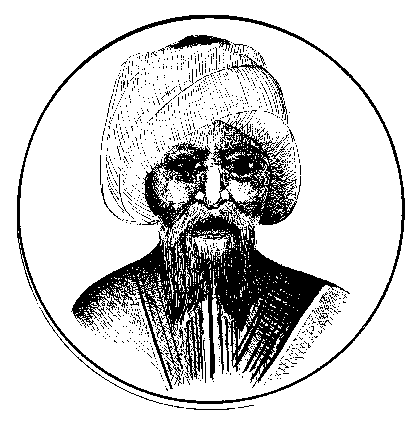
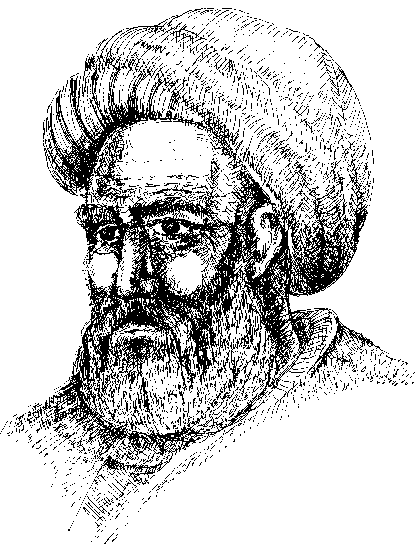
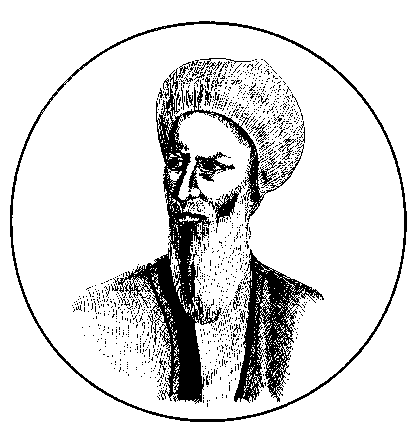
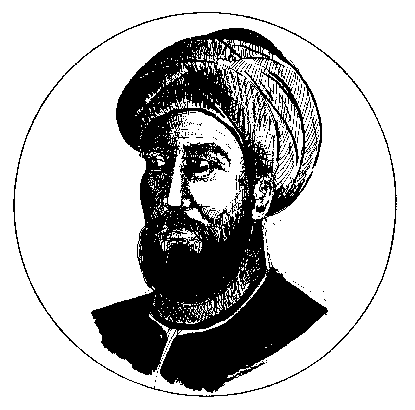
Jabir Ibn Haiyan (Geber) - Chemistry - (Died 803 C.E).


Ali Ibn Rabban Al-Tabari - Medicine, Mathematics, Calligraphy - (838-870)


Al-Farabi (Al Pharabius) - Sociology, Logic, Philosophy, Political Science, Music -(870-950)


Al-Razi (Rhazes) - Medicine, Ophthalmology, Smallpox , Chemistry, Astronomy - (864-930)


Abu Al-Qasim Al-Zahravi (Albucasis) - Surgery, Medicine - (936-1013)


Nasir Al-Din Al-Tusi - Astronomy, Non-Euclidean Geometry - (1201-1274)


Omar Al-Khayyam - Mathematics, Poetry - (1044-1123)


Ibn Al-Nafis Damishqui - Medicine - (1213-1288)


Muhammad Al-Buzjani - Mathematics, Astronomy - (940-997)


Ibn Al-Haitham (Alhazen) - Physics,Optics, Mathematics - (965-1040)


Ibn Sina (Avicenna) - Medicine, Philosophy, Mathematics, Astronomy - (986-1037)


Abu Raihan Al-Biruni - Astronomy, Mathematics, determined Earth's circumference - (973-1048)


Omar Al-Khayyam - Mathematics, Poetry - (1044-1123)

MUSLIM ANCIENT SCIENTIST PART 7

ORIGINAL SOURCE

Based on the book Introduction to the History of Scienceby George Sarton
(provided with photos and portraits) Edited and prepared by Prof. Hamed A. Ead


The Time of Omar Khayyam
(Second Half Of Eleventh Century)


The most original creations of this time were made in the field of mathematics by Muslims, and the most original genius among those to whom we owe these creations was the Persian Omar Khayyam. It is thus very appropriate to call this time the Time of Omar Khayyam, as Omar is already very well known to a large number of readers. It is probable that his name is more familiar to them than that of any other Muslim scientist. It will thus be relatively easy to remember the title, and I trust that this remembrance will reach to some extent the contents of the following pages. The time of Omar Khayyam was the end of the golden age of Muslim science.

A new Muslim sect, that of the Assassins, an off-shoot of the Ismailiya movement, originated in Cairo about 1080.

They took possession of the fortress of Alamut, which remained their main stronghold for a century and a half. Alamut seems to have been also a center of learning.
The Muslim philosopher who has obtained the largest following in the West, in fact the only one who has become at all popular, is the persian poet and sufi Omar Khayyam. On the other hand, one of Omar's contemporaries, al-Ghazzali, was the greatest theologian of Islam. He might be compared to Thomas Aquinas, to whom he was in many ways superior. Al-Ghazzali was also a Persian and spent part of his life in Omar's native place, Nishabur. While Omar Khayyam is the most popular fingure of mediaeval times, al-Ghazzali is probably the noblest.

Muslim Mathematics and Astronomy

Important astronomical work was done at Cordova. Ibn Said, aided by other Muslim and Jewish astronomers, made a number of observations. These observations were used by al-Zarqaili (Arzachel), for the compilation of new tables, the so-called Toledan tables, which obtained considerable authority in western Europe. Al-Zarqaili invented a new kind of astrolabe and proved the movement of the solar apogee; unfortunately, he confirmed the erroneous theory of the "trepidation" of the equinoxes. His tables were preceded, as usual, by an elaborate trigonometrical introduction.

The philosopher al-Ghazzali wrote a treatise on the motion and nature of stars and an astronomical summary; he had some knowledge of magic squares. The Bagdadite Muhammad ibn Àbd al-Baqí wrote a commentary on the tenth book of Euclid.

The activity of Muslim geographers, which had been so intense during the ninth and tenth centuries, abated during the present century. For the second half of this century two men will be recorded, one in the West and the other in the East. The western one, al-Bakri, is of special importance, become the road-book which the compiled in the traditional manner is the oldest one of its kind due to a Spaniard. He also compiled a dictionary of ancient (i.e., Arabian) geography. The Eastern one is also a very arresting personality. Nasir-I-Khusraw was an Ismaili missionary who, starting from Egypt, traveled extensively in the Near East and as far east as Persia.

He wrote in Persia an account of his travels, which is equally valuable from the geographical and from the historical point of view.

The contributions of Islam may seem small, but they were still of a very high quality.

In spite of Anselm, Psellos, and Constantine, in spite of the Chanson de Roland, in spite of Alfasi, Rashi, and Nathan, Islam was still at the vanguard of humanity. There was nowhere else in the world, in those days, a philosopher who could at all compare with al-Ghazzali, neither an astronomer like al-Zarqali, neither a mathematician like Omar Khayyam. These men were to towering far above their contemporaries.

If we proceed to examine more carefully the intellectual condition of Islam, we discover, in the first place, that some of the most important contributions were due to Persians; this was not novelty, but what is more starting, they were written in Persian.

Al-Ghazzali was the only Persian who wrote in Arabic; al-Hasan ibn al-Sabbah, Omar Khayyam, Nasir-I-Khusraw, Zarrin Dast, Nidham al-Mulk, and Asadi wrote in Persian.
The city of the caliphs gave us still a number of scientists but none of great distinction - Muhammad ibn Àbd al-Baqí, Ibn Jazla (of Christian origin), Sa'íd ibn hibat Allah, al-Khatíb al-Baghdadí, and al-Mawardí. The only center of intellectual progress in Islam was Spain, but the heyday of Cordova was already over. Indeed, of the seven scientists and scholars who make us think of the Muslim Spain of those days with gratitude, only one can be connected with Cordova, the geographer al-Bakrí.

The greatest of them all, al-Zarqali, flourished in Toledo, and so did the original historian Ibn Sa'íd. Yusuf al-Mutamin lived in Saragossa; Abu 'Umar ibn Hajjaj in Seville. Ibn Sída, was born in Murcia and died in Denia.

But the development of astronomy by al-Zarqal and of algebra by Omar Khayyam were definite steps forward.

A great orientalist went so far as to say : "The fourth century is the turning-point in the history of the spirit of Islam".

MUSLIM MATHEMATICS AND ASTRONOMY

AL-ZARQALI

In Latin : Arzachel. Abu Ishaq Ibrahim ibn Yahya al-Naqqash, the engraver. Better known as Ibn al-Zarqali. From Cordova, lived from c.1029 to c.1080. Astronomer. The best observer of his time (observations dated 1061, 1080).

He invented an improved astrolabe called safiham (saphaea Arzachelis); his description of it was translated into Latin, Hebrew, and many vernaculars. He was the first to prove explicitly the motion of the solar apogee with reference to the stars; according to his measurements it amounted to 12.04" per year (the real value being 11.8").

On the other hand, comparing his observation of the obliquity of the ecliptic with previous ones, he concluded that it oscillated between 23o 33' and 23o 53', thus reenforcing the erroneous belief in the "trepidation" of the equinoxes. He edited the so-called Toledan Tables, planetary tables based upon the observations made by him and probably other Muslim and Jewish astronomers in Toledo (notably Ibn Sa'íd).
These tables were translated into Latin by Gherardo Cremonese and enjoyed much popularity. The trigonometrical introduction (Canones sive regulae tabularum astronomiae) was al- Zarqali's own work; it explains the construction of the trigonometrical tables.

YUSUF AL-MUTAMIN

Of the tribe of the Banu Hud; king of Saragossa from 1081 to 1085. His father, Ahmed al-Muqtadir Billah, king from 1046 to 1081, was also a student and a patron of students. Hispano-Muslim mathematician and patron of science.

He wrote a mathematical treatise, Istikmal (Bringing to perfection), of which it was said that it should be studied together with Euclid, the Almagest, and the "middle books."p

No copy of Yusuf's treatise is known; it is strange that a work believed to be so important and written by a king should be lost.

Stanley Lane Poole: Mohammedan Dynasties (26,1893)
H.Suter: Mathematiker (108,1900).


OMAR KHAYYAM

Abu-l-Fath 'Umar ibn Ibrahím al-khayyamí - the tentmaker - Ghiyath al-dín. Born in or near Níshabur c. 1038 to 1048, died there in 1123-24.

Persian mathematician, astronomer, and poet. One of the greatest mathematicians of mediaeval times. His Algebra contains geometric and algebraic solutions of equations of the second degree; an admirable classification of equations, including the cubic; a systematic attempt to solve them all, and partial geometric solutions of most of them (he did not consider negative roots and his failure to use both branches or halves of a conic caused him to miss sometimes one of the positive roots). His classification of equations is very different from our own; it is based on the complexity of the equations (the number of different terms which they include).
Of course the higher the degree of an equation the more different terms, or combinations of terms, it can contain. Thus Omar recognizes 13 different forms of cubic equation. (The modern classification based primarily upon the degree dates only from the end of the sixteenth and the beginning of the seventeenth century).

Binomial development when the exponent is a positive integer. Study of the postulates and generalities of Euclid.

In 1074-75 the saljuq sultan Malikshah, Jalal al-dín, called him to the new observatory of Ray (or Níshabur, or Isfahan?) to reform the old Persian calendar:
(30x12)d.+5d.=365 d. The latter had been temporarily replaced by the Muslim calendar after the conquest. Omar's calendar was called al-ta'rikh al-Jalal.

Its era was the 10th Ramadan 471=16 March 1079. There are many interpretations of Omar's reform and to each corresponds a certain degree of accuracy, but at any rate, Omar's calendar was very accurate, probably more so than the Gregorian calendar.
The correct interpretation is probably one of the three following, the second being the most probable of them. I quote for each, the authority, then the gist of the change, and finally the resulting error:

According to al-Shirazi (d.1449), 15 intercalary days in 62 years; error, 1 day in about 3,770 years.

Moden interpretation, 8 intercalary days in 33 years; error, 1 day in about 5,000 years.

(The Gregorian calendar leads to an error of 1 day in 3,330 years).

Methods for the determination of specific gravity.

It is impossible not to mention the Ruba'iyat (quatrains) of Omar Khayyam, which have become, especially since 159 (when Edward Fitzgerald published the first instalment of his English paraphrase), one of the most popular classics of the world literature. Omar Khayyam was probably not a sufi, but rather an agnostic.

Comparisons of his thought with that of Lucretius and that of Voltaire are suggestive but indaequate.

MUHAMMAD IBN' ABD AL-BAQI

Abu Bakr(?) Muhammad ibn 'Abd al-Baghdadi. Flourished c. 1100.

Possibly the author of a commentary on the tenth book of Euclid, which was very popular because of its numerical applications. It is entitled "Liber judei super decimum Euclidis" in the translation by Gherardo Cremonese.

MUSLIM MEDICINE

IBN JAZIA

Abu 'ali Yahya ibn Isa Ibn Jazla. Latin forms: Bengesla, Buhahylyha, Byngezla, etc.
Flourished in Bagdad, died in 1100. Christian physician, who embraced Islam in 1074. His most important work is a medical synopsis, wherein 44 tables of two pages each contain the description and outline the treatment of 352 diseases (8 in each table); it was probably modeled upon similar work of Ibn Butlan (q .v; first half of eleventh century) and is called "Tables of the Bodies with regard to their constitutions" (Taqwim al-abdan fi tadbir al-insa; dispositio corporum de constitutions hominis). He wrote for al-Muqtadi (caliph from 1075 to 1094) an alphabetical list of simple and compound medicines called "The Pathway of Explanation as to that which Man Uses" (Minhaj al-bayan fi ma yasta 'miluhu al-insan; methodica dispositio eorum, quibus homo uti solet).


SA'ID IBN HIBAT ALLAH

Abu-I-Hassan Sa'id ibn Hibat Allah ibn al-Hasan. Flourished in Bagded under al-Muqtadi, caliph from 1075 to 1094, died in 1101-2. Physician and philosopher.
Author of a synopsis of medicine, Al-mughni fi tadbir al-amrad wa ma 'rifat al-'ilal wal-a'rad (Sufficiens de cura morborum et eognitione causarum et symptomarum) and of a treatise on physiology and psychology called "Discourse on the creation of Man", Maqala fi khalq al-insan (De constitutione hominis), dealing with such subjects as reproduction, gestation, parturition, growth, decay, survival of the soul, etc.

ZARRIN DAST

Abu Ruh Muhammad ibn Mansur ibn abi 'Abdallah ibn Mansur al-Jamani (or al-Jurjani). Zarrin Dast means the Golden Hand, a good name for an eye surgeon.

Flourished under the Saljuq sultan Abu-l-Fath Malikshah ibn Muhammad, ruling from 1072-73 to 1092-93. Persian oculist. He completed in 1087-88, a very comprehensive and very remarkable treatise on ophthalmology entitled "The Light of the Eyes" (Nur al-ayun) (in Persian).

Hirschberg: Geschichte der Augenheilkunde bei den Arabern (57 sq., Leipzig, 1905).

Adolf Fonahn: Quellenkunde der persischen Medizin (38-41, 1910. Includes summary of the treatise, based upon Hirschberg).

MUSLIM ANCIENT SCIENTIST PART 6

ORIGINAL SOURCE

Based on the book 'Introduction to the History of Science' by George Sarton (provided with photos and portraits) Edited and prepared by Prof. Hamed A. Ead


The Time of Abu-l-Wafa
Second Half of Tenth Century


The period which we have just tried to analyze, and then to reconstruct, was on the whole one of comparative rest. There was no retrogression, but the advance of mankind, which had been so vigorously accelerated during the ninth century through the youthful energy of Islam, was then distinctly slowed up. It is not the first time that we thus witness a momentary quieting down of human activity; on the contrary, we have already had occasion to observe many such periods of fallow. e. g., the first half of the second century B. C., the second half of the fifth, the second half of the sixth, the second half of the seventh, the first half of the eighth. But in each case the slowing up was followed by a new acceleration.

In other words, when we study the creative activity of the mankind as a whole, we find that humanity behaves very much as an individual man would do, that period of unusual achievements are generally followed by depressions, and periods of rest and fallow by new efforts. The intellectual progress of mankind would not be correctly represented by a constantly increasing function, but rather by a sort of sinusoidal curve moving steadily upward. But how do we account for human tiredness, considering that the burden is periodically taken up by new generations? Leaving out of the question political and other external factors which must necessarily influence human energy, we may explain the periodical slowing up in two ways. In the first place, the original flame of enthusiasm, which stimulates intellectual advance, is bound to die out gradually unless new men of genius appear from time to time to keep it alive; of course, there are no means of predicting when and where such men will appear. In the second place, the very progress of knowledge is certain to fill the more conservative minds with a growing anxiety, and finally to determine an orthodox reaction. For example, in the first half of the tenth century an intellectual reaction was led, very successfully, by al-Ash'ari. Man kind does not go forward as a united body; on the contrary, each advance has to be paid a protracted struggle between those who long for more light and those who are afraid of it. The latter are far more numerous than the former, but less intelligent, and thus bound to be beaten in the end, this accounts at once for the sinusoidal advance and its upward tendency, or, in other words, for the slowness, but also for the continuity of human progress.

To come back to the second half of the tenth century, we shall see presently that it was a period of renewed activity in almost every field; the partial fallowness of the first half of the century was thus amply rewarded by more abundant crops and mankind was able to make a few more leaps forward.

Cultural background: Mohammed ibn Ahmed al-Khwarizmi wrote "The Key of the Sciences."

Muslim Mathematics and astronomy: All of the creative work was done in Islam. Muslim mathematicians were so numerous that, for the sake of clarity, I must divide them into three groups - arithmeticians, algebraists, and geometers; astronomers and trigonometricians; astrologers.

Arithmeticians, algebraists, and geometers: It is well to begin this section with a brief account of the progress of the Hindu numerals. By the middle of the tenth century a special form of them, the so called dust (ghubar) numerals, was already used in Muslim Spain. The eastern Arabic form was represented in an Egyptian grafitto, dated 960-61. Mutahhar ibn Taher wrote a number of 10 figures by their means. The earliest Latin example of these numerals is found in a manuscript written in 976 near Logrono, in the Christian part of Spain.

Abu Ja'far al-Khazin wrote commentaries on the tenth book of Euclid and other works and solved al-Mahani's cubic equation. Al-Shaghani investigated the trisection of the angle. Nazif ibn Yumn translated the tenth book of Euclid. The great astronomer Abu-l-Wafa wrote commentaries on Euclid, Diophantos, and al-Khwarizmi, arithmetical and geometrical treatises, and solved a number of geometrical and algebraical problems. Abu-l-Fath improved the Arabic translation of Apollonios's Conics and commented upon the first five books. Al-Kuhi was especially interested in the Archimedian and Apollonian problems leading up to higher equations and discovered some elegant solutions. which he discussed. Al-Sijzi worked along the same lines; he made a special study of the intersections of conics and found a geometrical means of trisecting angles. Al-Khujandi, better known as an astronomer, proved that the sum of two cubic numbers can not be a cubic number. Maslama ibn Ahmed composed a commercial arithmetic and studied an amicable number. (This would confirm that he was acquainted to the writings of the Brethren of Purity, for these were very much interested in the theory of numbers - a natural consequence of their Neoplatonic tendencies.)

Astronomical and trigonometricians: At the very beginning of this period we meet one of the best Muslim astronomers: Abd al-Rahman al-Sufi, who compiled an illustrated catalogue of stars, based upon his own observations. Ibn al-A'lam was also a famous observer and published astronomical tables. Al-Shaghani invented and constructed astronomical instruments. The Buwayhid rulers, especially Sharaf al-dawla, were deeply interested in astronomy; Sharaf built a new observatory in Bagdad. The instruments were probably made by al-Shaghani, and the great mathematician, al-Kuhi, was the leader of the astronomers.

The foremost of the astronomers employed by Sharaf was the Persian Abu-l-Wafa. It is true he was once believed to be; he did not discover the variation of the moon, but he continued in a masterly way the elaboration of trigonometry. Taken all in all, the fame of Abu-l-Wafa is more solidly based upon his mathematical than upon his astronomical contributions, but I placed him here because, in those days, trigonometry was considered a branch of astronomy.

Al-Khujandi made astronomical observations in Ray. Abu Nasr improved the Arabic text of Menelaos's Spherics and dealt with trigonometrical subjects. Maslama ibn Ahmed edited and revised al-Khwarizmi's astronomical tables, and wrote a commentary on Ptolemy's Planisphere.

Astrologers: The main astrologers were al-Qabisi in Syria and Rabi ibn Zaid in Spain; the latter was a Christian, Bishop of Cordova under al-Hakam II.

Muslim Alchemy and Technology

The earliest scientific treatise in modern Persian (hitherto the Muslim Persians had written in Arabic) happens to be one of the most chemical works written by a Muslim until that time. It is really a treatise on materia medica, but it contains abundant information upon the preparation and properties of mineral substances. It is obvious that its author; Abu Mansour Muwaffak, was unusually stepped in chemistry. More may be learned about the chemical knowledge of those days, in the Eastern Caliphate, in the encyclopaedic works dealt with in Section III.

As to the Muslim West, the medical treatise of Abu-l-Qasim contains also various items of chemical interest; it explains the preparation of drugs by sublimation and distillation. two important alchemic writings have been ascribed to Maslama ibn Ahmed, but they are possibly a little later.

Muslim Medicine

The subtitle of this section is a little misleading, for the many adjectives tend to be the fact that everything was done by the Muslims alone.

Muslim physicians were so numerous that it is necessary to divide them into groups, and the most expedient division is, this time, a regional one. Thus I shall deal successively with the physician who flourished in the Eastern Caliphate (reserving a separate place for one of them who wrote in Persian), in Egypt, in Spain, and in North Africa.

The first group is the most numerous, as we would expect it. Ahmed al-Tabari wrote a medical treatise called Hippocratic treatments. Ali ibn Abbas (Hally Abbas), who flourished a little later, was one of the greatest physicians of Islam. He compiled a medical encyclopedia, "The Royal Book", which was very valuable but superseded by Avicenna's Qanun. It contains a number of original observations, under the patronage of Adud-al-Dawla, a new hospital was established in Bagdad in 979. Al-Husain ibn Ibrahim improved the Arabic text of Dioscorides. Abu Sahl al-Masihi, who was, as his name indicates, a Christian, wrote a number of medical treatises. He shares with al-Qumri the fame of having been one of the teacher of Avicenna, the prince of mediaeval physicians. It is even possible that one of Abu Sahl's treatises gave Avicenna the first idea of composing his Qanun.

Note that all of those were Persians, but all wrote, as far as we know, in Arabic. Another Persian, Abu Masour Muwaffak, had the idea of compiling a great medical treatise in Persian. That treatise dealt with materia medica and contains a general outline of pharmacological theory. Its intrinsic value is great, but it has also a considerable extrinsic importance, because it is the oldest prose work in modern Persian.

Two distinguished physicians of that time flourished in Egypt, al-Tamimi and al-Baladi. The former is chiefly known because of his medical guide (Murshid), the latter wrote a treatise on the hygiene of pregnancy and infancy.

Medical activity in Muslim Spain, was almost of the same level as that which obtained in the Eastern Caliphate; in some respects it was even superior. One of the most distinguished of the Spanish physicians, however, was not a Muslim, but a Jew, the great Hasdia ibn Shaprut. He translated Dioscorides into Arabic with the aid of the Greek monk Nicholas. Arib ibn Sa'd wrote a treatise on gynecology, obstetrics, and pediatrics. Abu-lQasim (Abulcasis) was the greatest Muslim surgeon; he exerted a very deep influence upon he development of the European surgery down to the Renaissance. Ibn Juljul wrote a commentary on Dioscorides and added a supplement to it, and he compiled a history of the Hispano-Muslim physicians of his time.

The last Muslim country to be considered, Tunis, nutured also a great physician, Ibn al-Jazzar (Algizar), author of a medical vade-mecum which obtained considerable success throughout the Middle Ages.

Muslim Mathematics and Astronomy

MUTAHHAR IBN TAHIR

Mutahhar ibn Tahir al-Maqdisi (or al-Muqaddasi), i. e., the native or inhabitant of the Holy City. From Jerusalem, flourished in Bust, Sijistan, c. 966. Encylcopaedist. Author of the book of the Creation and of History (Kitab al-bad'wal-tarikh), a summary of the knowledge of his day based not simply on Muslim, but also on Iranian and jewish sources. He quoted as a curiosity a very large number, 4,320,000,000 (representing the duration of the world in years according to the Hindus), in Hindu or Devanagari numerals.

Cl. Haurt: Leveritable auteur du Libre de la creation et de lhistoire (Journal Asiatique (9), vol. 18, 16-21, 1901. Concludind that Mutahhar was the author); Arabic literature (284, 291, London, 1903).


ABU JA'FAR AL-KHAZIN

Alkhazin means the treasurer or the librarian. Born in Khurasan, died between 961 and 971. Mathematician, astronomer. Author of a commentary on the Tenth book of Euclid and of other mathematical and astronomical writings. He solved by means of conic sections the cubic equation which had baffled al-Mahani's efforts, the so-called al-Mahani's equation (q. v., second half of the ninth century.)

Fihrist (p. 266, 282); Suter's translation (p. 17, 39).

NAZIF IBN YUMN

Nazif ibn Yumn (or Yaman?) al-Qass means the priest (particularly, the Christian priest). Flourished under the Buwayhid sultan Adud al-dawla; died c. 990.

Mathematician and translator from Greek into Arabic. He thus translated the Tenth book of Euclid.

H. Suter: Mathematiker (68, 1900).

ABU-L-FATH

Abu-l-Fath Mahmud ibn Mohammed ibn Qasim ibn Fadl al-Isfahani. From Ispahan, flourished probably c. 982. Persian mathematician. He gave a better Arabic edition of the Conics of Apollonios and commented on the first books.

The Conics had been translated a century before by Hilal al-Himsi (books 1-4) and Thabit ibn Qurra (books 5-7) (see second half of ninth century).

H. Suter: Die Mathematiker und Astronomen der Araber (98, 1900).

AL-KUHI

Abu Sahl Wijan (or Waijan) ibn Rustam al-Kuhi. Of Kuh, Tabaristan, flourished in Bagdad c. 988. Mathematician, astronomer. Many mathematical and astronomical writings are ascribed to him. He was the leader of the astronomers working in 988 at the observatory built of the Buwayhid Sharaf al-dawla. He devoted his attention to those Archimedian and Apollonian problems leading to equations of a higher degree than the second; He solved some of them and discussed the conditions of solvability. These investigations are among the best of Muslim geometry.

M. Steinschnieder: Lettere intorno ad Alcuhi a D. Bald. Boncompagni (Roma, 1863). Suter: Die Mathematiker und Astronomen der Araber (75-76, 1900).


AL-SIJZI

Abu Sa'id Ahmed ibn Mohammed ibn Abd al-Jalil al-Sijzi (short for al-Sijistani). Lived from c. 951 to c. 1024. Mathematician who made a special study of the intersections of conic sections and circles. He replaced the old kinematical trisection of an angle by a purely geometric solution (intersection of a circle and an equilateral hyperbola.)

Suter: Die Mathematiker und Astronomen der Araber (80-81, 224, 1900).

ABD AL-RAHMAN AL-SUFI

Abu-l-Husan Abd al-Rahman ibn Omar al-Fufi al-Razi. Born in Ray 903, died 986. One of the greatest Muslim astronomers. Friend and teacher of the Buwayhid sultan Adud al-dawla. His main work is the "Book of the Fixed Stars" illustrated with figures "Kitab al-kawakib al-thabita al-musawwar", one of the three masterpieces of Muslim observational astronomy (the two others being due to Ibn Yunus, first half of the eleventh century, and Ulugh Beg, first half of the fifteenth century).

Fihrist (284). Suter: Die Mathematiker und Astronomen der Araber (62, 1900).

IBN AL-A'LAM

Abu-l-Qasim Ali ibn al-Husain al-Alawi, al-Sharif al-Hisaini. Flourished at the Buwayhid court under Adud al-dawla (q. v.,); died at Bagdad in 985. Muslim astronomer. The accuracy of his observations was praised; he compiled astronomical tables which obtained much favor during at least two centuries.

H. Suter: Die Mathematiker der Araber (62, 1900).

AL-SAGHANI

Abu Hamid Ahmed ibn Mohammed al-Saghani al-Asturlabi, i. e., the astrolabe maker of Saghan, near Merv, flourished in Bagdad, died 990. Mathematician, astronomer, inventor and maker of instruments. He worked in Sharaf al-dawla's observatory and, perhaps, constructed the instruments which were used there. Trisection of the angle.

Suter: Die Mathematiker und Astronomen der Araber (p. 65, 1900).

ABU-L-WAFA

Abu-l-Wafa Mohammed ibn Mohammed ibn Yahya ibn Isma'il ibn al-Abbas al-Buzjani. Born in Buzjan, Quhistan, in 940, flourished in Bagdad, where he died at 997 or 998. Astronomer and one of the greatest Muslim mathematicians. One of the last Arabic translators and commentators of Greek works. He wrote commentaries on Euclid, Diophantos, and al-Khwarizimi (all lost); astronomical tables (zij al-wadih) of which we have possibly a later adaptation; a practical arithmetic; "the complete book" (Kitab al-kamil), probably a simplified version of the Almagest. The book of applied geometry (Kitab al handasa) is probably in its present form, the work of a disciple.
His astronomical knowledge was hardly superior to Ptolemy's. He did not discover the variation, the third inequality of the moon. He simply spoke of the second eviction, the Ptolematic, essentially different from the variation discovered by Tycho Brahe.
Solution of the geometrical problems with one opening of the compass. Construction of a square equivalent to other squares. Regular polyhedra (based on Pappos).

Approximative construction of regular heptagon (taking for its side half the side of the equilateral triangle inscribed in the same circle). Constructions of parabola by points. Geometrical solution of

x4 = a and x4 + ax4 = b.

Abu-l-Wafa contributed considerably to the development of trigonometry. He was probably the first to show the generality of the sine theorem relative to spherical triangles. He gave a new method for constructing sine tables, the value of sin 30` being correct to the eighth decimal place. He knew relations equivalent to ours for sin (a + b) (though in an awkward form) and to

2sin2a/2 = 1 - cos a sin a = 2 sin a/2 cos a/2.

He made a special study of the tangent; calculated a table of tangents; introduced the secant and cosecant; knew those simple relations between the sic trigonometric lines, which are now often used to define them.

Fihrist (I, 266, 283, Suter's translation, p. 39).

AL-KHUJANDI

Abu Muhamid Hamid ibn al-Khidr al-Khujandi. Of Khujanda, on the jax artes, or Sir Daria, Transoxania, died c. 1000. Astronomer, mathematicain. He made astronomical observations, including a determination of the obliquity of the ecliptic, in Ray in 994. He proved (impefectly) that the sum of two cubic numbers cannot be a cubic number> He may be the discoverer of the sine theorem relative to spherical triangles.
Suter : Die Mathematiker und Astronomen der Araber (74, 213, 1900).

ABU NASR

Abu Nasr Mansur ibn Ali ibn Iraq. Teacher of al-Bairuni; still active in 1007. Muslim mathematician and astronomer; one of three to whom the discovery of the sine theorem relative to spherical triangles is ascribed. He gave in 1007-8 an improved edition of Menelaos's Spherica. Various other writings on trigonometry are ascribed to him.
H. Suter : Die Mathematiker und Astronomen der Araber (81, 255, Leipzig, 1900).

MASLAMA IBN AHMED

Abu-l-Qasim Maslam ibn Ahmed al-Majriti. Of Madrid, flourished in Cordova, died in or before 1007. Astronomer, mathematician, occulist. The earliest Hispano-Muslim scientist of any importance. He edited and corrected the astronomical tables of al-Khwarizmi, replacing the Persian by the Arabic chronology. He wrote a treatise on the astrolabe (translated into Latin by Joan. Hispalensis); a commentary on Ptolemy's Planisphaerium translated by Rudolph of Bruges (q. v., first half of twelfth century); a commercial arithmetic (al-mu'amalat); a book on the generation of animals (?). He may have introduced into Spain the writings of the Prethren Purity, or else this was done later by one of his disciples, al-Karmani. He spoke of the erotic power of amicable numbers (220, 284). Two alchemic writings, the "Sage's step" (Rutbat al-hakim) and the "Aim of the Wise", (Ghayat al-hakim), are ascribed to him. The second is well known in the Latin translation made in 1252 by order of King Alfonso under the title Picatrix; the original Arabic text dates probably from the middle of the eleventh century.

Ibn Khaldun: Prolegmenes. F. Wustenfeld: Geschichte der arabischen Aerzte (61, 1840).

AL-QABISI

Abu-l-Saqr Abd al-Aziz ibn Uthman ibn Ali al-Qabisi. Pupil of al-Imrani (q. v. , first half of tenth century) in Mosul; after the latter's death in 955-56 he was patronized by the Hamdanid sultan Sayf al-dawla, who died in 966-67. Famous Muslim astrologer. His main writings are his introduction to the art of astrology (al-madkhal ila sina'at (ahkam) al-nujum) and treatise on the conjunctions of planets; both were translated into Latin by Joannes Hispalensis (first half of twelfth century). He, or his patron Sayf al-dawla, wrote a poem on the rainbow.

H. Suter : Die Mathematiker und Astronomen der Araber (60, 1900; Nachtrag, 165, 1902).


RABI IBN ZAID

Rabi ibn Zaid al-Usquf. Meaning the bishop (from the Greek). He was Bishop of Cordova and Elvira under al-Hakam II. Flourished at Cordova c. 961. Spanish Christian writing n Arabic. He coposed various astronological treatises and dedicated to Hakam II a calendar (Kitab al-anwa', liber anoe) entitled "The Division of times and the Good of bodies."

Suter : Mathematiker (96, 212, 1900).

Muslim Medicine

AHMED AL-TABARI

Abu-l-Hasan Ahmed ibn Mohammed al-Tabari. Of Tabaristan; was physician to the Buwwayhid Rukn al-dawla, c. 970. Persian Physician. Author of compendium of medicine, called Hippocratic treatments, in ten books. Was it written in Persian or in Arabic? It is extant only in Arabic, Kitab al-mu'alaja al-buqratiya.

F. Wustenfeld: Arabschen Aerzte (56, 1840).

ALI IBN ABBAS

Ali ibn Abbas al-Majusi, that is, the Magian, which means that he, or his father was of the Zoroastrian faith. Latin name: Ali Abbas or Hall Abbas. Born in Ahwaz, southwestern Persia; flourished under thw Buwayhid Adud al-dawla; died in 994. One of the three greatest physicians of the Eastern Caliphate. He wrote for Adud aldawla a medical encyclopedia called "the Royal Book" (Kitab al-Maliki, Liber regius, regalis dispositio; also called Kamil al-sana 'a al-tibbiya), which is more systematic and consice than Razi's Hawi, but more practical than Avicenna'a Qanun, by which it was superseded. The Maliki is divided into 20 discourses, of which the first half deal with theory and the other with the practice of medicine. the best parts of it are those devoted to dietetics and to materia medica. Rudimentary conception of the capillary system. Interesting clinical observations. Proof of the motions of the womb during parturition (the child does not come out; it is pushed out).

Wustenfeld: Geschichte der arabischen Aerzte (59, 1840).

AL-HUSAIN IBN IBRAHIM

Al Husain ibn Ibrahim ibn al-Hasan ibn Khurshid al-Tabari al-Natili. Flourished c. 900-91. Translator from Greek into Arabic. He dedicated, in 990-91, an improved translation of Dioscorides to the Prince Abu Ali al-Samjuri.

C. Brockelmann: Arabische Litteratur (189, 207).

AL-QUMRI

Abu Masur al-Hasan ibn Nuh al-Qumri. From Qum in Jibal. Flourished probably at Bagdad, about the end of the tenth century, and the begining of the eleventh. Muslim Physician. Teacher of Avicenna. He wrote a treatise on medicine, largely based upon al-Razi, called the book of life and death (Kitab Ghina wa mana'), divided into three parts (internal diseases, external diseases, fevers).

C. Brockelmann: Arabische Litteratur (vol. 1, 239, 1808).

ABU SAHL AL-MASIHI

Abu Sahl Isa ibn Yahya al-Masihi al-Jurjani, i. e., the Christian, from Jurjan, east of the Caspian Sea; died at the age of fourty in 999-1000. Christian physician writing in Arabic. Teacher of Avicenna. He wrote an encyclopaedic treatise on medicine in a hundred chapters (al-Kutub al-mi'a fi-l-sana'a al-tibbiya), which is one of the earliest Arabic works of its kind and may have been in some respects the model of the Qanun. He wrote a various smaller treatises: on measles, on the plague, on the pulse, demonstration of God's wisdom as evidenced in the creation of man, etc.

C. Brockelmann: Arabische Litteratur (vol. 1, 138, 1898).

ABU MANSUR MUWAFFAK

Abu Mansur Muwaffak ibn Ali al-Harawi. Flourished in Herat under the Samanid prince Mansur I ibn Nuh, who ruled from 961 to 976. Persian pharmacologist. He was apparently the first to think of compiling a treatise on materia medica in Persian; he travelled extensively in Persia and India to obtain necessary information. He wrote between 968 and 977, the "Book of the Remedies" (Kitab al-abnyia 'an Haqa'iq al-adwiya), which is the oldest pose work in modern Persian. It deals with 585 remedies (of which 466 are derived from plants, 75 from minerals, 44 from animals), classified into four groups according to their action. Outline of a general pharmacological theory. Abu mansur distinguished between sodium carbonate (natrun) and potassium carbonate (qli); he had some knowledge abot arsenious oxide, cupric oxide, silicic acid, antimony; he knew the toxilogical effects of copper and lead compounds, the depilatory vertue of quicklime, the composition of plaster of Paris and its surgical use.

E. G. Browne: Arabian Medicine (92, Cambridge, 1921).

AL-TAMIMI

Abu Abdallah Muhammed ibn Ahmed ibn Sa'id al-Tamimi al-Muqaddasi (meaning, the native or the inhabitant of the Holly City). Born in Jerusalen; he moved, c. 970, to Egypt and was still living there in 980. Palastinian physician. He made pharmaceutical experiments and wrote various medical works, chiefly on materia medica. His main work is a guide (Murshid) on materia medica, which contains valuable information on plants, minerals, etc. Kitab al-murshid ila jawahir al-aghdhiya wa quwa-lmufradat; guide toward (the understanding of) the substances of food-stuffs and (of) the simple drugs.

C. Brockelmann: Arabische Litteratur (vol. 1, 237, 1898).

AL-BALADI

Ahmed ibn Mohammed ibn Yahya al-Baladi. Flourished in Egypt under the Wazir Ya'qub ibn Kils, who died in 990-91. Egyptian physician. Author of a treatise on the hygiene of pregnant women and the babies (Kitab Tadbir al-habala wal-atfal).

C. Brockelmann: Arabische Litteratur (vol. 1, 237, 1898).

HASDAI IBN SHAPRUT

Alias shaprut, Shafrut, Bashrut, Shaprot. Abu Yusuf Isaac ibn Izra. Born c. 915 at Jaen, Andalus; flourished at Cordova at the court of Abd al-Rahman III; died in 970 or 990 at Cordova. Hispano-Jewish physician, translator of Greek into Arabic, Patron of science. Physician to the caliph. He discovered a panacea called al-faruq (the best).

A manuscript of Dioscorides having been presented in 948-49 to Abd al-Rahman III by the emperor Constantinos VII, Hasdai undertook to translate it with the assistance of the Greek monk Nicholas. This monk had been sent to Cordova by the emperor upon the caliph's request, in 951.

He wrote a Hebrew letter to the King of the Khazars discribing Andalus. He was a great patron of jewish science and it was partly due to his initiative and activity that the intellectual center of Israel was finally transfered from academies of Babylonia to Spain.

Article by Rabbi Meyer Kayserling in Jewish encyclopaedia, vol. 6, 248, 1904.

ARIB IBN SA'D

Arib ibn Sa'd al-Khatib (the secretary) al-Qurtubi. Flourished at Cordova at the court of Abd al-Rahman IIi and al-Hakim II, who died in 976. Hispano-Mislim historian and physician. Originally Christian. He wrote a chronicle of Muslim Spain and Afric some time between 961-976. This chronicle was extensively used by Ibn al-Idhari (q. v., second half of thirteenth century). He wrote also a treatise on gynaecology, hygiene of pregnant women and infants, and on obstetric (Khalq al-janin, Creation of the embryo, in 964-65), and a calender (Kitab al-anwa').

C. Brockelmann: Arabische Litteratur (vol. 1, 236, 1898).

ABU-L-QASIM

Latin names: Abulcasis, Albucasis, Alsaharavius. Khalaf ibn Abbas al-Zahrawi, from Zahra, near Cordova, where he flourished and died c. 1013. The greatest Muslim surgeon. Physician to al-Hakam II (961 to 976). His great medical encyclopedia in 30 sections, al-Tasrif (Vade-mecum) contains interesting methods of preparing drugs by sublimation and distillation. but its most important part is the surgical, in three books, largely based upon Paulos Aegineta. Great importance attached to cauterization and styptics. Parts of the surgery are devoted to obstetrics and to the surgical treatment of the eyes, ears, and teeth. This work was illustrated with views of the surgical instruments. It was early translated into Latin (by Gherardo Cremonese), Provencal and Hebrew. Muslim prejudices against surgery stifled Abu-l-Qasim's fame in Islam, but in the Christian world his prestigue was soon immense.

Wustenfled: Geschichte der Arabischen Aerschen (p. 85, 1840).

IBN JULJUL

Abu Da'ud Suliman ibn Hasan ibn Juljul. Physician to the Spanish Umayyad Hisham II, Mu'aiyad billah, caliph from 976 to 1009. Hispano-Muslim physician. He wrote, at Cordova, in 982, a commentary on Dioscorides, and later a supplement to it, and a history of the physicians and philosophers of his time in Spain (Ta'rikh al-atibba wal-falasifa), often quoted by Ibn abi Usaibi'a (q. v., first half of the thirteenth century).

The aim of the commentary was to determine the drugs dealt with by Dioscorides; the supplement was a list of drugs not mentioned by Dioscorides. As to the origin of these Dioscoridian studies, see my notes on Hasidai ibn Shaprut. It would seem that Ibn Juljul and others assisted in the translation of Dioscorides into Arabic.

C. Brockelmann: Arabische Litteratur (t. 1, 237, 1898).

IBN AL-JAZZAR

In Latin: Algizar, AlJazirah. Abu Ja'far Ahmed ibn Ibrahim Ibn Abi Khalid Ibn alJazzar. Flourished in Qairawan, Tunis, died in 1009, being more than 80 years old. Physician. Pupil of Ishaq al-Isra'ili (q. v., first half of the tenth century). Of his many writings, the most important because of its enormous popularity, was his "Traveller's Provision" (Zad al-Musafir) which was translated into Latin by Constantinus Africanus, into Greek by Synesios, and into Hebrew - the titles of these translations being: Viaticum pergrinantis; Zedat al-Derachim. It contains remarkable descriptions of smallpox and measles. He wrote also on the coryza, on the cuases of plague in Egypt, etc.

C. Brockelmann: Arabische Litteratur (vol. 1, 238, 1898).