16 September 2008
Spiritual Authenticity: An introduction - by Mohd Nadzrin - posted on http://silat-melayu.blogspot.com
Malaysia sits at the nexus of some very interesting commercial lines. I say interesting, because not only does the society acknowledge and condone their existence, but in a way, so does the government.
If you go to Kuala Lumpur, the tourist spot that everyone tells you you should visit is Petaling Street, or fondly known as Chinatown where knock offs abound: pirated handbags, wallets, watches, DVDs and what have you.
In all the government and non-government travel brochures, Petaling Street is touted as "the" place to get cheap goods, but stops short of revealing its ethical dilemma. The problem is, most of the goods aren't out and out pirated. They are overruns, meaning, they were produced at the same factory contracted to produce the originals. They are just as good as the real thing. And if there ever was an analogy that worked for plagiarism in silat, Petaling Street would be it.
Silat could properly be classified as Traditional Knowledge if we go by the definition here. Traditional Knowledge is deemed to belong to a community, but an issue arises when segments within that community cross-claim it to belong to a smaller group, a family or even an individual.
This was not always a problem. Long before there were 'schools' and 'styles', there was a master and a student. This minimum of a pair was the 'school' and what passed between them was the relationship.
From my surveys among silat masters, most of them agree that knowledge does not pass from them to their students, because they ultimately do not know what their student receives or understands. This is rooted in the sufi conception of knowledge, that when someone teaches something, it is not the facilitation skills of the teacher, nor the sheer intellect of the student that creates understanding. It is that Allah reveals this knowledge to both the teacher and his student at the same time with differing insights.
The master could, in his process of explaining a concept he studied, gain an updated enlightenment. Or, it is the student who gets it immediately, without the master having to say too much. This, especially in silat circles who are deeply influenced by Tariqat, is called "Haq Diri" or granted knowledge for one individual.
Because the master and student now have 'different' knowledge, and the master acknowledges the student as a master himself, they are now masters of different styles. Their own "Haq Diri".
When one studied with one's master, the master's duty was always to lead one on the right path of understanding, of seeing the universe in a holistic manner, which made Silat applicable in both wartime and peacetime. You'd use the same methodology to fight or debate, in diplomacy or marital facilitation, in economy or government and it was always your interpretation of the same basics.
Which means, whatever knowledge you learned was indisputably your right. This knowledge had good tendencies and would always guide its user towards good. However, in Islam, a right to something carries certain responsibilities, and it is understood that when abused or misused, can lead to the understanding being "repossessed" by Allah and in its place, false knowledge that resembles the original which guides its user, by virtue of the evil in his heart, towards evil.
A simple way of stating it is that the status of the knowledge changes from being "authorised" to "unauthorised".
Now, although this "authorisation" process happens spiritually, there are masters who claim to be intermediaries or are able to assess that his student has met the conditions for authorisation, in effect, becoming Allah's earthly authorised representative. For example, when a master grants masterhood to his student, he also places conditions, most of which are sourced from Islamic Law.
He is deemed to have lost his right to the knowledge his master facilitated if he kills without due reason, fornicates, commits adultery, steals, lies and so on. In one way, the conditions are also parameters to safeguard the sanctity of the knowledge.
We have to remember that this was a time when there was no style names, no uniforms and certainly no school colours. There was no plagiarism because there was no way to identify one from another. Everyone was graded on their skills in battle, or their wisdom in the village, not by how many students they have or what fancy techniques they employed.
They were valued more for their piety than their haughtiness. It was this humility that signalled the height of their skill and gave credence to their spiritual authenticity.
This method of authentication is practised by and an accepted part of many silat styles in Malaysia, and the modernisation of silat is threatening this age old tradition. Styles that are legally registered, are recognised by the government as organisations, and not as traditionally passed down schools.
This opens up opportunities for opportunists who see financial or material gain in leading his own version of a particular school. There have been cases where silat syllabi have been lifted wholesale and imported into another school under a different name.
Thus, in one way, law helps control the copyright of the master's knowledge, but it also robs him of many other rights, which he was granted under the spiritual authenticity system. Since there are very few things in culture that can be copyrighted, we are forced to accept it when dissenting factions split off from the main, and continue teaching the main art.
In extreme cases, offshoots actually manage to legally copyright their master's arts and claim them as their own.
Until the day that the law catches up with spiritual authentication, we will see more plagiarism of the efforts of masters who know nothing of the law and what it can and cannot protect.
--------------------------------------
Pok Nik's reply :
Salam Nadzrin...it's been quite a while...Here it comes
I was reading this interesting article of yours and thought of dropping a few lines.
I found your first 3 paras very intriguing but I think I can quickly recognize their significance.
Eventually, my 2 cents conclusion would be...
'be aware of 'inauthenticity' that may camouflaging itself using the label 'authentic' - I presume that you're referring to Silat.
Yes...different people have different views on this matter.
I do think that today (as we speak) there are so many 'inauthentic' Silats (please excuse my using the 's' - plural)
Let me tell you what I think...
The definitions and levels of inauthenticity may vary but to me (personally), whenever there are presence of 'hybrid elements' (some may not agree with me) I would say that this is an attempt to create another faction whether the practitioner realizes it or otherwise.
After looking into many angles - I humbly conclude that this 'hybrid' happens possibly due to :
a) For 'pesilat' that learns more than one silat - it is either simply reflex actions or an act tailoring oneself movements to the opponent's style (following the flow) Thus, the hybrid movements are unintentional. (perhaps self-discovery is also the reason)
b) For 'Pesilat' that learns more than one silat but has something else in his mind - to form up a new faction by combining 'Silat A' and 'Silat B'.
In this case, I wouldn't know what to say except wondering - Is the practitioner thinking of commercial purposes?
or just another 'publicity stunt' to say that 'I have improvised the method to make it better' (or worse?)
c) The best one - but I rarely heard of this one nowadays - By Act and Willing of Allah SWT, the practitioner 'discover some new movements' and established a total new 'Silat' - usually for the purpose of 'dakwah'(but I think this is more related to the spirituality domain - so 'no comments')
Whilst expressing the aforesaid personal opinion, I do not in any way against the 'hybrid' or 'spiritual discovery' (again, I'm merely saying out my personal views)
Traditional Knowledge? Hmmmm...it's difficult to say despite the definition that you quoted may sound convincing. Perhaps I'm not looking into Silat alone but into Martial Arts of Self Defence in general.
On the other hand, I find it hard to acknowledge the 'so-called' narrow claims (be it individual or groups) that Silat belongs to a certain community.
But if claims DO happen, the main reason is still somehow related to the 'self-discovery' (accidental) or as a result of 'hybrid'.
I would also second the motion of the silat masters that 'knowledge does not pass from them to their students, because they ultimately do not know what their student receives or understands' for the same reason - Sufi and 'how it should be' (once again, this phenomenon may involve the possibility of the future existence of the new versions coming out from the students eventually - is it 'inauthentic' or 'hybrid' or simply 'evolution')
On the 'authorized' or 'unauthorized' issue, my say :
"Is the practitioner using his skills for good or evil?"
"Is the movements (new movements that the-then student found out later) associated with some evil practice (black magic for example) or with something against the religious teachings?"
On the possibility of losing one's skills for 'committing sins' (unless I do not understand what you were referring to - as you use the word 'deem')
I do think that this action is still linked to 'taubat' (repent) and a practitioner can still; by God's Willing; self-discipline/restraint him/herself through 'taubat' and 'istiqamah' ('sustain' - rite?)
I somehow believe that every human being will be given 'second chances' to repair his/her mistakes.
Ok...that's all for now...
Wassalaam
Humbly
Pok Nik
--------------------------------------
Mohd Nadzrin's reply :
Salam hormat Pok Nik,
The whole point of this is not the effectiveness of techniques, but verification by an authority, whether the student has permission by his master (or whatever spiritual lineage the master represents) to carry on his work, even if it is totally different from the original.
As for Traditional Knowledge, yes, defining it is difficult, even for the United Nations because both silat and taekwondo are Asian heritages, but certain taekwondo federations are based outside Korea and ultimately led by non-Koreans. Where do draw the line? When does it stop becoming Traditional Knowledge and becoming public domain? For now, silat is still easier to corral than other global martial arts.
You said, "On the possibility of losing one's skills for 'committing sins' (unless I do not understand what you were referring to - as you use the word 'deem')". Yes, I was referring to sinning against Allah and mankind and that his knowledge can be restored by repentance, through proper decorum and methods (and of course biiznillah).
It's an honour having you back here again. Please visit us more often. We miss you.
Salam persilatan
-----------------------------
Pok Nik's Reply :
Salam again my bro. (The honour and the 'missing this blog feeling' is totally mine)
Even my close silat friends found me difficult and tightlipped - to talk about 'verification' (tashih) or 'permission' for a practitioner
to (become the new Guru/Master to) carry on his work especially when the issue is interlinked to lineage and spiritual
matters.
To talk about lineage alone will definitely conquer so much space in here. Spiritual? Even 'longer'
So, may I avoid the spiritual and validated lineage subjects for now? Please...
But I think I'm quite clear about the possibility of introducing a different version after becoming the new master. It's his prerogative to introduce or improvise the technique during his
time and tenure as a Guru.
(I think this is about becoming the new 'Guru' or one of the authorized representatives of the 'Guru' - in Abjad's case we called them 'Badal'?)
In GENERAL, to ascertain the authenticity of the lineage (sanad) besides than looking or have the guts of asking the Guru to seek proof, practitioners must first know what sort of Master and the kind of Martial Arts he/she is looking for. (not limited to the following)
(Not all Master is 'really qualified' to be called Master - some are self-proclaimed and not verified or authorised or permitted but 'claims that they have been given permission' (so far I've never fallen for this 'trick')
1. Observe certain good qualities, traits and specificiations of the Master being sought, (KPI : 30%)
2. What are the core objectives of learning such Martial Art/Silat? Self-Defence? Sports? Healthy Lifestyle? Dakwah? etc, (KPI : 30%)
3. How does learning the martial arts/silat affects the practitioner personally - is he/she changing for the better or worse? In life, in religious practice etc.(KPI : 40%)
Permission/Authorization; on the other hand; is usually 'AWARDED' by the Master - in many cases NOT INHERITED - meaning - being the heirs to the father who happens to be the Master at the same time shall not automatically qualifies the son/daughter to carry out the legacy - UNLESS THE MASTER SAYS OTHERWISE (in his capacity as a 'Master' NOT as a 'Father' - otherwise - it is not an accurate practice - I'm not saying that it's wrong but depending on situation being encountered)
Why? It defies the principle of 'spreading the word/knowledge freely' when the legacy is restricted only to the family line. (Spock says : It's not logic)
(Haha- We're also not talking about Harry Porter's - heir to the Slytherine that can practice magic because they are from the 'pure blood family line' and the 'muggles' can not - it's discrimination, nepotisme and cronisme..you name it, we got it. But we're talking something similar to the 'Dragon Warrior' Po - where the 'award' is not given to the 'senior member' but is given by prerogative of the Master)
This is one of many reasons that eventually led to many conflicts when the heir started claiming the legacy after their father's death especially in the event of there is no written or oral will. So how to solve this issue? (some spiritual signs? or an EGM among the committee members)
On the other hand, conflicts may also arise when a practitioner felt that he is 'much senior' or 'much more experienced' or much more 'skillful' (or 'I was born first') than the 'junior' being selected by the Master.
So once the 'dissatisfied senior' questioned the Guru's selection (an act of insubordination - derhaka), he will usually create a new faction (despite from the validated lineage) (Darth Vader : Welcome to the Dark Side of the Force --- 'Ngeri!')
------------------------
Formally speaking, Permission is granted via special ceremonies in the presence of the students. Usually via means of awarding 'selimpang' (belt) of the highest order, seal, certain weapon, cert or some other symbolic gifts etc.
The Master will then proclaim the practitioner as his or one of his authorized representatives or even one of the new Guru. Those who are not present are asked to disseminate the info.
The significance of such ceremonies are very clear - so that there will not be any future conflicts.
Mind you, I'm not touching on 'taking into account spiritual elements for selection criterion and the validity of lineage' - due to 'certain constraint'...
Back to the traditional knowledge - I must agree with you that it should basically related to the place of origin.
But nowadays, it's like branding (not 'deemed as'). - ie. Branding 'Silat' as 'Malay Legacy', Branding 'Kung Fu' as 'Chinese Legacy' etc. Thus, if branding is equivalent to traditional knowledge, then probably it makes things easier to be resolved.
When the line is not drawn, then a new set of ruling will usually follow. Take the case of 'silat olahraga' - even in boxing and wrestling - a set of fixed rules required to be complied with)
But I feel that if this is the case, the real secrets are still safe with the traditional knowledge domain - not all are being revealed.
(Anyway, where are you directing me too? Tell me what's bothering you really bro Nadzrin - perhaps I could help as now I don't know of whether I'm talking gibberish or related to what you wish me to?)
17 September, 2008 22:49

Showing posts with label SILAT-MARTIAL ARTS. Show all posts
Showing posts with label SILAT-MARTIAL ARTS. Show all posts
Wednesday, September 17, 2008
Saturday, June 28, 2008
SILAT MELAYU BLOG - WALLPAPER
FROM SILAT MELAYU BLOG - MOHD NADZRIN

27 June 2008
Silat Melayu Wallpaper
The above wallpaper was designed by a regular reader of Silat Melayu: The Blog, Mohd Fairuzuddin Faizan b. Mohd Yusoff the President of the Universiti Malaysia Sarawak chapter of Pertubuhan Silat Seni Gayong Malaysia.
The wallpaper depicts a Silat Seni Gayong grappling technique and includes a pantun from Poknik, also a regular visitor here. His pantun has appeared in this blog here. We thank Fairuzuddin for sharing this cool piece of work with us and hope to hear more from him. Thanks!
(click on the picture above to download the full-sized wallpaper).
Posted by Mohd Nadzrin Wahab at 3:19 PM

27 June 2008
Silat Melayu Wallpaper
The above wallpaper was designed by a regular reader of Silat Melayu: The Blog, Mohd Fairuzuddin Faizan b. Mohd Yusoff the President of the Universiti Malaysia Sarawak chapter of Pertubuhan Silat Seni Gayong Malaysia.
The wallpaper depicts a Silat Seni Gayong grappling technique and includes a pantun from Poknik, also a regular visitor here. His pantun has appeared in this blog here. We thank Fairuzuddin for sharing this cool piece of work with us and hope to hear more from him. Thanks!
(click on the picture above to download the full-sized wallpaper).
Posted by Mohd Nadzrin Wahab at 3:19 PM

Monday, May 26, 2008
MELAKA - PALACE AND WARRIORS
Note from Author : This is my small and humble personal tribute to the 5 Warriors and the Greatness of of the Once Malacca Sultanate
ORIGINAL SOURCE
THE MALLACA SULTANATE
The Sultanate of Malacca was founded by Parameswara in 1402 and later married the princess of Pasai in 1409. Centered in the modern town of Malacca, the sultanate stretched from southern Thailand in the north to Sumatra in the southwest. The Portuguese invaded its capital in 1511 and in 1528, the Sultanate of Johor was established by a Malaccan prince to succeed Malacca.
Parameswara founded Malacca around 1400. He was a Buddhist Srivijayan prince and Sejarah Melayu mentioned that he laid claims of being descended from the Macedonian King Alexander the Great / Iskandar Zulkarnain. When Parameswara became the ruler of Palembang, the Srivijaya Empire was already in decline. In 1390s, Majapahit sent thousands of ships to attack Palembang. Parameswara had fled his palace and eventually reached Temasek island which was headed by a Srivijayan descendent. However, Temasek had been a vassal of Majapahit since 1365. After several days, Parameswara was betrayed by his relative and he had to kill him. Parameswara then ruled Temasik for about 4 years, where he was finally attacked by the Majapahit armies when one of the ministers opened the gates for Majapahit armies to attack the palace. Parameswara fled north to Muar before founding Melaka in 1400. In 1409, Parameswara assumed the title Sultan Iskandar Shah due to his marriage to a princess from Pasai. His marriage to the Muslim princess encouraged a number of his subjects to embrace Islam. According to the Sejarah Melayu, legend has it that the king saw a mouse deer outwit a dog when he was resting under the Melaka tree. He took what he saw as a good omen and decided to establish a capital for his kingdom there. Today, the mouse deer is part of modern Malacca's coat of arms.
Malacca had a well-defined government with a set of laws. On top of the sultanate's hierarchy sat the sultan and he was an absolute monarch. Below him was a bendahara, a position similar to that of a prime minister. Most of all, a bendahara was an adviser to the sultan. A bendahara is a common person appointed by the sultan and it was the highest ranking officer that could be held by any common people. After bendahara, a laksamana's authority is paramount. A laksamana is an admiral and was responsible for the state and the sultan's security. He commanded the army. Later comes the temenggung which more or less a chief of public police. At the bottom of this nobility structure are penghulu bendahari, who was the treasurer of the state and the shahbandars of whom were responsible to matters of trade and ports.
The most famous Malaccan bendahara is Tun Perak. Under his advice, he managed to expand Malacca to its greatest extent. Hang Tuah is an example of Malaccan laksamana.
The sultanate was governed with several set of laws. The formal legal text of traditional Melaka consisted of the Undang-Undang Melaka (Laws of Malacca), variously called the Hukum Kanun Melaka and Risalat Hukum Kanun, and the Undang-Undang Laut Melaka (the Maritime Laws of Malacca). The laws as written in the legal digests went through an evolutionary process. The legal rules that eventually evolved were shaped by three main influences, namely the early non-indigenous Hindu/Buddhist tradition, Islam and the indigenous "adat".
The Sultanate thrived on entrepot trade and became the most important port in Southeast Asia during the 15th and the early 16th century. Furthermore, Malacca was as a major player in the spice trade, serving as a gateway between the Spice Islands and high-paying Eurasian markets. This is reflected by the Portuguese Tomé Pires who claimed "Whoever is lord of Malacca has his hand on the throat of Venice".
One of the factors that contributed to the rise of Malacca was the monsoon winds that enabled Arab and Indian traders from the west to travel to China in the east and vice versa. At the height of its power, the Sultanate encompassed most of modern day Peninsular Malaysia, the site of modern day Singapore and a great portion of eastern Sumatra. It was also the center of Islam in the eastern sphere, where imams and ustazes came to discuss religion and the like. Muslim missionaries were also sent by the Sultan to spread Islam to other communities in the Malay Archipelago, such as in Java, Borneo, and the Philippines. Most of South East Asia at that time was Hindu.
The Sultanate's most important regional rivals were Siam in the north and the declining Majapahit Empire in the south. Majapahit was not able to control or effectively compete with Malacca within the archipelago, and came to an end during the later 15th century. Siam on the other hand attacked Malacca three times, but all attacks were repelled.
At the same time, Malacca had a good relationship with Ming, resulting in Zheng He's visits. Parameswara had met the Ming emperor to receive a Letter of Friendship, hence making Malacca the first foreign kingdom to attain such treatment. In 1409, the sultan paid tribute to the Ming emperor to ask for protection against Siam. Moreover, one of the sultans, Mansur Shah even married a Ming princess named Hang Li Po. This Sino-Malacca relationship helped deter Siam from further threatening Malacca.
---------------------------
ORIGINAL SOURCE
ABOUT THE 5 WARRIORS
Hang Tuah was born in Kampung Sungai Duyong, Melaka. His parents were Hang Mahmud and Dang Merdu Wati. His parents owned a small shop near Kampung Bendahara. When Hang Tuah was small, he worked as a woodcutter in his parents� shop. Hang Tuah grasp of religious knowledge and his skill in the art of self-defence became obvious even when he was just ten years old. Hang Tuah had four special friends of his own age and they were Hang Kasturi, Hang Jebat, Hang Lekir and Hang Lekiu and they were known as The Five Comrades. The five of them on the advice of Hang Tuah learned the art of self defence from a teacher who called Guru Ali Putera who practiced the art of self defence at the top of a mountain. Hang Tuah also learned to meditate.
Hang Tuah's appearance in the history of the region began when some men ran amuk near Kampung Bendahara. Tun Perak came with a party of guards to investigate the incident, but was also attacked. His guards fled, but when Hang Tuah and his friends who happened to be at a nearby stall, saw what was happening and rushed to save Tun Perak. They fought the amuk group and killed them all.
Tun Perak was amazed by the courage of Hang Tuah and his friends and he rewarded them for their gallant service with a suit of clothes each and appointed them as commanders. They were also presented to Sultan Muzaffar Syah and they became a well known legend in the history of Melaka. Hang Tuah was later appointed as an admiral and served under four Sultans, that is, Sultan Muzaffar Syah, Sultan Mansur Syah, Sultan Alauddin Riayat Syah and Sultan Mahmud Syah. Hang Tuah died at an very old age during the reign of Sultan Mahmud Syah. He was given a state burial By Sultan Mahmud Syah and was buried in Tanjung Keling, Melaka.
ORIGINAL SOURCE
Hang Tuah
In the early days of Sultan Mansor’s reign in Malacca, a son is born to Hang Mahmud and his wife Dang Merdu Wati. The child is named Hang Tuah. When Hang Tuah is seven, his parents decide to move to Malacca. There they stay in the house of a relative not far from the residence of the Datuk Bendahara. Hang Mahmud starts a small provision shop, which his wife helps to run, while he himself goes into the forest to collect wood.
Hang Tuah meets Hang Jebat, Hang Kasturi. Hang Lekir and Hang Lekieu. Together the boys, who were to become lifelong friends, learn the art of silat. Hang Tuah is elected leader of the group of youngsters and they declare loyalty to him. At around the age of ten Hang Tuah and his friends, while on a boat into the open sea notice three boats approaching in their direction. The boats are those of pirates. The boys take refuge on an island, and when the pirates land on the island, the youngsters, kill several of them and wound ten others. The survivors escape. The wounded pirates are handed over to the Batin of Singapore, who tells the boys that their brave deed would be brought to the attention of the Datuk Bendahara. In Malacca, the boys’ deed becomes the talk of the town.
Fearing repercussions, Hang Tuah and his companions decide to delve deeper into the arts of silat and also to learn other skills from the guru named Sang Andi Putra lives. Their training lasts forty-four days. Sang Andi Putra advises them to go to his brother Sang Persanta Nata in Majapahit, Java, to further their mastery of the silat and mystical arts. Meanwhile the Datuk Bendahara meets Hang Mahmud and compliments the boys on their bravery.
On day while chopping firewood in front of his house, Hang Tuah sees a man running amok and killing several persons. Hang Tuah kills the amok. A few days later a similar incident causes disturbances in Malacca. The Datuk Bendahara is at that time on his way to the palace to meet the Sultan. Hang Tuah protects him from the violent crowd, and even succeeds in killing the leader of the group and a few others. Impressed, the Datuk Bendahara and his wife decide to “adopt” Hang Tuah and his companions.
Datuk Bendahara takes Hang Mahmud, his wife and the boys to pay respects to the Sultan. Already aware of their bravery as well as their exploits, the Sultan orders the five youths to serve him. Each of them receives a keris and is also given the title of “Tun”.
A few days later Sultan Mansor and his entourage leave Malacca for Java where the Sultan is to marry Raden Galoh Chandra Kirana, a Majapahit princess. In Majapahit a plot is hatched by Pateh Gajah Mada to kill Hang Tuah. First a hulubalang, and next Taming Sari, the famous warrior of Majapahit are given the task. Hang Tuah succeeds in killing the soldier and later also destroying Taming Sari with the sword belonging to the Majaphit warrior. This famous sword, also named Taming Sari, possessing the power of giving immortality to its user is presented to Hang Tuah by the Datuk Bendahara.
Hang Tuah and his friends visit Sang Persanta Nata at Gunung Winara as instructed by Sang Andi Putra. Here they receive seven days of intensive training at the hand of this famous teacher, who predicts that Hang Tuah would one day become the Admiral of the Malacca fleet as well as attain invulnerability. At the palace another attempt is made to kill Hang Tuah. Hang Tuah manages to kill his attackers. Sultan Mansor returns to Malacca with his new bride. Hang Tuah is welcomed as a great hero. Soon he is raised to the rank of Admiral or Laksamana.
A few years later, the Sultan becomes interested in marrying Tun Teja of Inderaputera, now known as Pahang. At the Sultan’s command, Hang Tuah and his companions sail to Inderaputra. Tun Teja is already engaged to be married to Megat Panji Alam of Trengganu. Her father, Bendahara Seri Buana, troubled by the impending visit by Hang Tuah, send word to Megat Panji Alam. Megat Panji Alam comes face to face with Hang Tuah who has just landed in Pahang and challenges Hang Tuah to a fight. The battle lasting several days, ends with Hang Tuah killing Megat Panji Alam. Tun Teja is married to Sultan Mansor in Malacca.
The Bentara of Majapahit, hearing of Sultan Mansor’s second marriage is upset. Pateh Gajah Mada says that he will create trouble in Malacca. Another plot is hatched to kill Hang Tuah, and seven warriors go to Malacca from Majapahit to try to achieve this end. Disguised as thieves they cause unrest in the town, hoping thereby to draw Hang Tuah out. Hang Tuah also disguises as a thief and joins them. Together they steal valuable items, including eight boxes of gold, from the palace. Killing the seven thieves, Hang Tuah resents their heads together with the stolen gold to the Sultan. Hang Tuah is now allowed free access to the Sultan’s palace.
The special treatment given to Hang Tuah by the Sultan arouses jealousy among court officials. A scandal is created involving Hang Tuah. The Sultan now upset with Hang Tuah, orders the Datuk Bendahara to immediately get rid of Hang Tuah. Datuk Bendahara sends Hang Tuah into hiding in his own orchard, but spreads the rumour that Hang Tuah has been killed.
Hang Jebat is appointed Admiral in Hang Tuah’s place, and he is now given free access to the palace. While in the palace, Hang Jebat misbehaves himself. The helpless Sultan and his consorts, thrown out of the palace by Hang Jebat, move in with the Datuk Bendahara. Hang Jebat now abandons himself to a life of debauchery. Those sent by the Sultan to apprehend him are killed. This he does in order to avenge the Sultan’s unjust treatment of Hang Tuah.
The Sultan now regrets at having so hastily sentenced Hang Tuah to death. Hang Hang Tuah alone could, if he were still alive, overcome Hang Jebat. Seeing the Sultan’s plight Datuk Bendahara asks the Sultan if he would be prepared to pardon Hang Tuah in the event that the hero was still alive. When the Sultan says that he would do anything to have Hang Tuah back, Datuk Bendahara confesses that in fact Hang Tuah is still alive.
Hang Tuah returns a few days later. He is fully pardoned by the Sultan, and is informed of the crisis in Malacca caused by Hang Jebat. Following a few days of rest, Hang Tuah is ready to face Hang Jebat. He discovers, however, that Jebat has been given possession of Taming Sari, following his own “death.” Despite his loss of confidence, Hang Tuah proceeds to face Hang Jebat. When at the palace, Hang Tuah calls out for his friend, Hang Jebat is taken aback at the fact that Hang Tuah is still alive. A reconciliation, however is no longer possible, in view of Hang Jebat’s disloyalty to the Sultan.
The battle between the two greatest warriors of Malacca begins. Hang Tuah, recovering Taming Sari for a moment, succeeds in killing his best friend, Hang Jebat, with it. Once again Hang Tuah becomes the Sultan’s favourite. He is, however, wary, knowing that he has enemies constantly on the lookout for opportunities to destroy him. Sultan Mansor dies and is succeeded by Sultan Mahmud as ruler of Malacca.
Soon after ascending the throne Sultan Mahmud loses his consort. Hearing of the beauty of the princess of Gunung Ledang, he decides to approach her for her hand in marriage. Hang Tuah, Hang Setia and Tun Mamat, the Datok Bendahara’s son, travel to Gunung Ledang, or Mount Ophir, to negotiate the terms of the proposed marriage. The princess is prepared to marry the Sultan if certain requirements are fulfilled. Due to the difficulties in fulfilling the conditions, the Sultan abandons his intention of marrying the princess.
Hang Tuah decides to forsake court life. Just before dawn one day, accompanied by Tun Mamat, Hang Tuah goes to the mouth of Sungei Duyong, taking his kris, Taming Sari, with him. He kisses the weapon and throws it into the river. A few days later he leaves the court to live a life of solitude at Gunung Ledang
-------------
ORIGINAL SOURCE
Hang Jebat

Hang Jebat was the closest companion of the legendary Malay hero Hang Tuah. He is well known for his vengeful rebellion against the Malacca Sultan whom he served. After Hang Tuah was sentenced to death, Hang Jebat was conferred by the Sultan of Malacca with the Taming Sari, a sacred kris formerly used by Hang Tuah. Believing that Hang Tuah was unjustly murdered by the Sultan he served, Hang Jebat turned against the Sultan to avenge his friend's death. No one knew, however, except the Bendahara who went against the Sultans orders and hid Hang Tuah in a remote region of Malacca that he was still alive.
With the kris in his possession, Hang Jebat became invincible and there was not one person in the entire Malacca Empire who was capable of killing him. Hang Jebat's revenge had forced the Sultan of Malacca to abandon his palace. Jebat seduced the women of the palace and spent his days eating, drinking and sporting with them. All the warriors sent by the Sultan to challenge him were killed. Even his friend Hang Kasturi was driven out when Hang Jebat realized that the other man hadn't come to join him in merrymaking.
After learning from the Bendahara that Hang Tuah was still alive, The Sultan had him recall Hang Tuah and gave Hang Tuah full amnesty. The Sultan then ordered Hang Tuah to kill Hang Jebat. Being unquestioningly loyal to the Sultan, Hang Tuah obeyed the Sultans biddings and went on to challenge Hang Jebat. After fighting in a battle that lasted for seven days, Hang Tuah eventually managed to reclaim the Taming Sari by tricking Hang Jebat. Although stabbed by Tuah, Hang Jebat bandaged his wounds and ran amok in the city square for three days, killing thousands of people before retreating to Tuah's house and dying in his friend's arms.
Hang Jebat's famous quote was "Raja adil raja disembah, raja zalim raja disanggah" which literally means "A fair king is a king to obey, a cruel king is a king to fight against".
After the fight, The Sultan ordered his men to tear down, burn and throw the ashes of the house into the sea. Two months later, when a lady of the Bendahara's retinue gave birth to Jebat's son, the sultan ordered Hang Tuah to throw the baby into the sea as well. Instead, the laksamana entrusted the child, Hang Kadim, to the Bendahara.
-------------
ORIGINAL SOURCE

Exploring the Hang Kasturi Mausoleum
Jalan Hang Jebat, Malacca
Hang Kasturi is one of the five great warriors during the time of the Malacca Sultanate, particularly during the reign of Sultan Mansur Shah (1456-1477), the other four being Hang Tuah, Hang Jebat, Hang Lekiu and Hang Lekir. As young men, they studied silat under the same silat master. The title "Hang" is bestowed by the sultan for the highest ranking Malay warriors.
According to a version of the Malay Annals (Sejarah Melayu), Hang Kasturi is said to have gained notoriety for having an affair or having outraged the modesty of one of the Sultan's concubines, and Hang Tuah was sent to kill him. Unfortunately in a different version (as the Malay Annals were initially handed down by mouth, there are now many different written versions in existence), it was Hang Tuah, another Malay warrior, who was accused of having an affair with the palace ladies.
In one popular version, Hang Tuah so offended the Sultan that he order Tuah to be executed. However, the Bendahara Tun Perak (similar to prime minister) took him into hiding. Later, courtiers discovered that Hang Kasturi was having an affair with one of the sultan's concubines. They surrounded the palace but no one dared to enter to capture Kasturi. When the sultan was told that Hang Tuah was still alive, he ordered Hang Tuah to kill his best friend to prove his loyalty. During the fight, Hang Tuah embedded his kris in the palace wall three times, but Kasturi allowed him to remove it. But when the same thing happened to Kasturi, Tuah stabbed him to death. The sultan later rewarded Hang Tuah the title of laksamana, for his loyalty.
Hang Kasturi's Mausoleum is located along, interestingly, Jalan Hang Jebat (formerly Jonker Street), whereas Hang Jebat's Mausoleum is located at Lorong Tukang Kuli, within a stone's throw from Jalan Hang Kasturi. Although the mausoleums were claimed to belong to these warriors, no factual evidence has been put forth to verify this.
--------------------
Note : Unfortunately - there isn't much about Hang Lekir and Hang Lekiu
ORIGINAL SOURCE
THE MALLACA SULTANATE
The Sultanate of Malacca was founded by Parameswara in 1402 and later married the princess of Pasai in 1409. Centered in the modern town of Malacca, the sultanate stretched from southern Thailand in the north to Sumatra in the southwest. The Portuguese invaded its capital in 1511 and in 1528, the Sultanate of Johor was established by a Malaccan prince to succeed Malacca.
Parameswara founded Malacca around 1400. He was a Buddhist Srivijayan prince and Sejarah Melayu mentioned that he laid claims of being descended from the Macedonian King Alexander the Great / Iskandar Zulkarnain. When Parameswara became the ruler of Palembang, the Srivijaya Empire was already in decline. In 1390s, Majapahit sent thousands of ships to attack Palembang. Parameswara had fled his palace and eventually reached Temasek island which was headed by a Srivijayan descendent. However, Temasek had been a vassal of Majapahit since 1365. After several days, Parameswara was betrayed by his relative and he had to kill him. Parameswara then ruled Temasik for about 4 years, where he was finally attacked by the Majapahit armies when one of the ministers opened the gates for Majapahit armies to attack the palace. Parameswara fled north to Muar before founding Melaka in 1400. In 1409, Parameswara assumed the title Sultan Iskandar Shah due to his marriage to a princess from Pasai. His marriage to the Muslim princess encouraged a number of his subjects to embrace Islam. According to the Sejarah Melayu, legend has it that the king saw a mouse deer outwit a dog when he was resting under the Melaka tree. He took what he saw as a good omen and decided to establish a capital for his kingdom there. Today, the mouse deer is part of modern Malacca's coat of arms.
Malacca had a well-defined government with a set of laws. On top of the sultanate's hierarchy sat the sultan and he was an absolute monarch. Below him was a bendahara, a position similar to that of a prime minister. Most of all, a bendahara was an adviser to the sultan. A bendahara is a common person appointed by the sultan and it was the highest ranking officer that could be held by any common people. After bendahara, a laksamana's authority is paramount. A laksamana is an admiral and was responsible for the state and the sultan's security. He commanded the army. Later comes the temenggung which more or less a chief of public police. At the bottom of this nobility structure are penghulu bendahari, who was the treasurer of the state and the shahbandars of whom were responsible to matters of trade and ports.
The most famous Malaccan bendahara is Tun Perak. Under his advice, he managed to expand Malacca to its greatest extent. Hang Tuah is an example of Malaccan laksamana.
The sultanate was governed with several set of laws. The formal legal text of traditional Melaka consisted of the Undang-Undang Melaka (Laws of Malacca), variously called the Hukum Kanun Melaka and Risalat Hukum Kanun, and the Undang-Undang Laut Melaka (the Maritime Laws of Malacca). The laws as written in the legal digests went through an evolutionary process. The legal rules that eventually evolved were shaped by three main influences, namely the early non-indigenous Hindu/Buddhist tradition, Islam and the indigenous "adat".
The Sultanate thrived on entrepot trade and became the most important port in Southeast Asia during the 15th and the early 16th century. Furthermore, Malacca was as a major player in the spice trade, serving as a gateway between the Spice Islands and high-paying Eurasian markets. This is reflected by the Portuguese Tomé Pires who claimed "Whoever is lord of Malacca has his hand on the throat of Venice".
One of the factors that contributed to the rise of Malacca was the monsoon winds that enabled Arab and Indian traders from the west to travel to China in the east and vice versa. At the height of its power, the Sultanate encompassed most of modern day Peninsular Malaysia, the site of modern day Singapore and a great portion of eastern Sumatra. It was also the center of Islam in the eastern sphere, where imams and ustazes came to discuss religion and the like. Muslim missionaries were also sent by the Sultan to spread Islam to other communities in the Malay Archipelago, such as in Java, Borneo, and the Philippines. Most of South East Asia at that time was Hindu.
The Sultanate's most important regional rivals were Siam in the north and the declining Majapahit Empire in the south. Majapahit was not able to control or effectively compete with Malacca within the archipelago, and came to an end during the later 15th century. Siam on the other hand attacked Malacca three times, but all attacks were repelled.
At the same time, Malacca had a good relationship with Ming, resulting in Zheng He's visits. Parameswara had met the Ming emperor to receive a Letter of Friendship, hence making Malacca the first foreign kingdom to attain such treatment. In 1409, the sultan paid tribute to the Ming emperor to ask for protection against Siam. Moreover, one of the sultans, Mansur Shah even married a Ming princess named Hang Li Po. This Sino-Malacca relationship helped deter Siam from further threatening Malacca.
---------------------------
ORIGINAL SOURCE
ABOUT THE 5 WARRIORS
Hang Tuah was born in Kampung Sungai Duyong, Melaka. His parents were Hang Mahmud and Dang Merdu Wati. His parents owned a small shop near Kampung Bendahara. When Hang Tuah was small, he worked as a woodcutter in his parents� shop. Hang Tuah grasp of religious knowledge and his skill in the art of self-defence became obvious even when he was just ten years old. Hang Tuah had four special friends of his own age and they were Hang Kasturi, Hang Jebat, Hang Lekir and Hang Lekiu and they were known as The Five Comrades. The five of them on the advice of Hang Tuah learned the art of self defence from a teacher who called Guru Ali Putera who practiced the art of self defence at the top of a mountain. Hang Tuah also learned to meditate.
Hang Tuah's appearance in the history of the region began when some men ran amuk near Kampung Bendahara. Tun Perak came with a party of guards to investigate the incident, but was also attacked. His guards fled, but when Hang Tuah and his friends who happened to be at a nearby stall, saw what was happening and rushed to save Tun Perak. They fought the amuk group and killed them all.
Tun Perak was amazed by the courage of Hang Tuah and his friends and he rewarded them for their gallant service with a suit of clothes each and appointed them as commanders. They were also presented to Sultan Muzaffar Syah and they became a well known legend in the history of Melaka. Hang Tuah was later appointed as an admiral and served under four Sultans, that is, Sultan Muzaffar Syah, Sultan Mansur Syah, Sultan Alauddin Riayat Syah and Sultan Mahmud Syah. Hang Tuah died at an very old age during the reign of Sultan Mahmud Syah. He was given a state burial By Sultan Mahmud Syah and was buried in Tanjung Keling, Melaka.
ORIGINAL SOURCE
Hang Tuah
In the early days of Sultan Mansor’s reign in Malacca, a son is born to Hang Mahmud and his wife Dang Merdu Wati. The child is named Hang Tuah. When Hang Tuah is seven, his parents decide to move to Malacca. There they stay in the house of a relative not far from the residence of the Datuk Bendahara. Hang Mahmud starts a small provision shop, which his wife helps to run, while he himself goes into the forest to collect wood.
Hang Tuah meets Hang Jebat, Hang Kasturi. Hang Lekir and Hang Lekieu. Together the boys, who were to become lifelong friends, learn the art of silat. Hang Tuah is elected leader of the group of youngsters and they declare loyalty to him. At around the age of ten Hang Tuah and his friends, while on a boat into the open sea notice three boats approaching in their direction. The boats are those of pirates. The boys take refuge on an island, and when the pirates land on the island, the youngsters, kill several of them and wound ten others. The survivors escape. The wounded pirates are handed over to the Batin of Singapore, who tells the boys that their brave deed would be brought to the attention of the Datuk Bendahara. In Malacca, the boys’ deed becomes the talk of the town.
Fearing repercussions, Hang Tuah and his companions decide to delve deeper into the arts of silat and also to learn other skills from the guru named Sang Andi Putra lives. Their training lasts forty-four days. Sang Andi Putra advises them to go to his brother Sang Persanta Nata in Majapahit, Java, to further their mastery of the silat and mystical arts. Meanwhile the Datuk Bendahara meets Hang Mahmud and compliments the boys on their bravery.
On day while chopping firewood in front of his house, Hang Tuah sees a man running amok and killing several persons. Hang Tuah kills the amok. A few days later a similar incident causes disturbances in Malacca. The Datuk Bendahara is at that time on his way to the palace to meet the Sultan. Hang Tuah protects him from the violent crowd, and even succeeds in killing the leader of the group and a few others. Impressed, the Datuk Bendahara and his wife decide to “adopt” Hang Tuah and his companions.
Datuk Bendahara takes Hang Mahmud, his wife and the boys to pay respects to the Sultan. Already aware of their bravery as well as their exploits, the Sultan orders the five youths to serve him. Each of them receives a keris and is also given the title of “Tun”.
A few days later Sultan Mansor and his entourage leave Malacca for Java where the Sultan is to marry Raden Galoh Chandra Kirana, a Majapahit princess. In Majapahit a plot is hatched by Pateh Gajah Mada to kill Hang Tuah. First a hulubalang, and next Taming Sari, the famous warrior of Majapahit are given the task. Hang Tuah succeeds in killing the soldier and later also destroying Taming Sari with the sword belonging to the Majaphit warrior. This famous sword, also named Taming Sari, possessing the power of giving immortality to its user is presented to Hang Tuah by the Datuk Bendahara.
Hang Tuah and his friends visit Sang Persanta Nata at Gunung Winara as instructed by Sang Andi Putra. Here they receive seven days of intensive training at the hand of this famous teacher, who predicts that Hang Tuah would one day become the Admiral of the Malacca fleet as well as attain invulnerability. At the palace another attempt is made to kill Hang Tuah. Hang Tuah manages to kill his attackers. Sultan Mansor returns to Malacca with his new bride. Hang Tuah is welcomed as a great hero. Soon he is raised to the rank of Admiral or Laksamana.
A few years later, the Sultan becomes interested in marrying Tun Teja of Inderaputera, now known as Pahang. At the Sultan’s command, Hang Tuah and his companions sail to Inderaputra. Tun Teja is already engaged to be married to Megat Panji Alam of Trengganu. Her father, Bendahara Seri Buana, troubled by the impending visit by Hang Tuah, send word to Megat Panji Alam. Megat Panji Alam comes face to face with Hang Tuah who has just landed in Pahang and challenges Hang Tuah to a fight. The battle lasting several days, ends with Hang Tuah killing Megat Panji Alam. Tun Teja is married to Sultan Mansor in Malacca.
The Bentara of Majapahit, hearing of Sultan Mansor’s second marriage is upset. Pateh Gajah Mada says that he will create trouble in Malacca. Another plot is hatched to kill Hang Tuah, and seven warriors go to Malacca from Majapahit to try to achieve this end. Disguised as thieves they cause unrest in the town, hoping thereby to draw Hang Tuah out. Hang Tuah also disguises as a thief and joins them. Together they steal valuable items, including eight boxes of gold, from the palace. Killing the seven thieves, Hang Tuah resents their heads together with the stolen gold to the Sultan. Hang Tuah is now allowed free access to the Sultan’s palace.
The special treatment given to Hang Tuah by the Sultan arouses jealousy among court officials. A scandal is created involving Hang Tuah. The Sultan now upset with Hang Tuah, orders the Datuk Bendahara to immediately get rid of Hang Tuah. Datuk Bendahara sends Hang Tuah into hiding in his own orchard, but spreads the rumour that Hang Tuah has been killed.
Hang Jebat is appointed Admiral in Hang Tuah’s place, and he is now given free access to the palace. While in the palace, Hang Jebat misbehaves himself. The helpless Sultan and his consorts, thrown out of the palace by Hang Jebat, move in with the Datuk Bendahara. Hang Jebat now abandons himself to a life of debauchery. Those sent by the Sultan to apprehend him are killed. This he does in order to avenge the Sultan’s unjust treatment of Hang Tuah.
The Sultan now regrets at having so hastily sentenced Hang Tuah to death. Hang Hang Tuah alone could, if he were still alive, overcome Hang Jebat. Seeing the Sultan’s plight Datuk Bendahara asks the Sultan if he would be prepared to pardon Hang Tuah in the event that the hero was still alive. When the Sultan says that he would do anything to have Hang Tuah back, Datuk Bendahara confesses that in fact Hang Tuah is still alive.
Hang Tuah returns a few days later. He is fully pardoned by the Sultan, and is informed of the crisis in Malacca caused by Hang Jebat. Following a few days of rest, Hang Tuah is ready to face Hang Jebat. He discovers, however, that Jebat has been given possession of Taming Sari, following his own “death.” Despite his loss of confidence, Hang Tuah proceeds to face Hang Jebat. When at the palace, Hang Tuah calls out for his friend, Hang Jebat is taken aback at the fact that Hang Tuah is still alive. A reconciliation, however is no longer possible, in view of Hang Jebat’s disloyalty to the Sultan.
The battle between the two greatest warriors of Malacca begins. Hang Tuah, recovering Taming Sari for a moment, succeeds in killing his best friend, Hang Jebat, with it. Once again Hang Tuah becomes the Sultan’s favourite. He is, however, wary, knowing that he has enemies constantly on the lookout for opportunities to destroy him. Sultan Mansor dies and is succeeded by Sultan Mahmud as ruler of Malacca.
Soon after ascending the throne Sultan Mahmud loses his consort. Hearing of the beauty of the princess of Gunung Ledang, he decides to approach her for her hand in marriage. Hang Tuah, Hang Setia and Tun Mamat, the Datok Bendahara’s son, travel to Gunung Ledang, or Mount Ophir, to negotiate the terms of the proposed marriage. The princess is prepared to marry the Sultan if certain requirements are fulfilled. Due to the difficulties in fulfilling the conditions, the Sultan abandons his intention of marrying the princess.
Hang Tuah decides to forsake court life. Just before dawn one day, accompanied by Tun Mamat, Hang Tuah goes to the mouth of Sungei Duyong, taking his kris, Taming Sari, with him. He kisses the weapon and throws it into the river. A few days later he leaves the court to live a life of solitude at Gunung Ledang
-------------
ORIGINAL SOURCE
Hang Jebat

Hang Jebat was the closest companion of the legendary Malay hero Hang Tuah. He is well known for his vengeful rebellion against the Malacca Sultan whom he served. After Hang Tuah was sentenced to death, Hang Jebat was conferred by the Sultan of Malacca with the Taming Sari, a sacred kris formerly used by Hang Tuah. Believing that Hang Tuah was unjustly murdered by the Sultan he served, Hang Jebat turned against the Sultan to avenge his friend's death. No one knew, however, except the Bendahara who went against the Sultans orders and hid Hang Tuah in a remote region of Malacca that he was still alive.
With the kris in his possession, Hang Jebat became invincible and there was not one person in the entire Malacca Empire who was capable of killing him. Hang Jebat's revenge had forced the Sultan of Malacca to abandon his palace. Jebat seduced the women of the palace and spent his days eating, drinking and sporting with them. All the warriors sent by the Sultan to challenge him were killed. Even his friend Hang Kasturi was driven out when Hang Jebat realized that the other man hadn't come to join him in merrymaking.
After learning from the Bendahara that Hang Tuah was still alive, The Sultan had him recall Hang Tuah and gave Hang Tuah full amnesty. The Sultan then ordered Hang Tuah to kill Hang Jebat. Being unquestioningly loyal to the Sultan, Hang Tuah obeyed the Sultans biddings and went on to challenge Hang Jebat. After fighting in a battle that lasted for seven days, Hang Tuah eventually managed to reclaim the Taming Sari by tricking Hang Jebat. Although stabbed by Tuah, Hang Jebat bandaged his wounds and ran amok in the city square for three days, killing thousands of people before retreating to Tuah's house and dying in his friend's arms.
Hang Jebat's famous quote was "Raja adil raja disembah, raja zalim raja disanggah" which literally means "A fair king is a king to obey, a cruel king is a king to fight against".
After the fight, The Sultan ordered his men to tear down, burn and throw the ashes of the house into the sea. Two months later, when a lady of the Bendahara's retinue gave birth to Jebat's son, the sultan ordered Hang Tuah to throw the baby into the sea as well. Instead, the laksamana entrusted the child, Hang Kadim, to the Bendahara.
-------------
ORIGINAL SOURCE
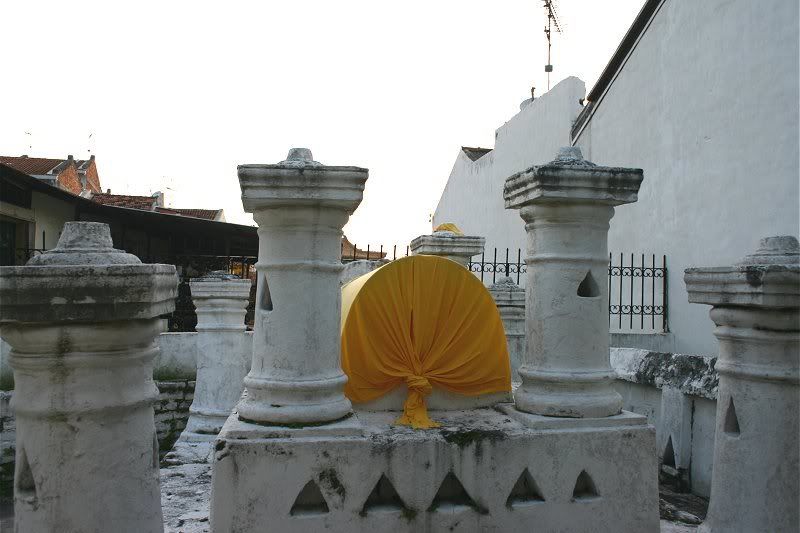
Exploring the Hang Kasturi Mausoleum
Jalan Hang Jebat, Malacca
Hang Kasturi is one of the five great warriors during the time of the Malacca Sultanate, particularly during the reign of Sultan Mansur Shah (1456-1477), the other four being Hang Tuah, Hang Jebat, Hang Lekiu and Hang Lekir. As young men, they studied silat under the same silat master. The title "Hang" is bestowed by the sultan for the highest ranking Malay warriors.
According to a version of the Malay Annals (Sejarah Melayu), Hang Kasturi is said to have gained notoriety for having an affair or having outraged the modesty of one of the Sultan's concubines, and Hang Tuah was sent to kill him. Unfortunately in a different version (as the Malay Annals were initially handed down by mouth, there are now many different written versions in existence), it was Hang Tuah, another Malay warrior, who was accused of having an affair with the palace ladies.
In one popular version, Hang Tuah so offended the Sultan that he order Tuah to be executed. However, the Bendahara Tun Perak (similar to prime minister) took him into hiding. Later, courtiers discovered that Hang Kasturi was having an affair with one of the sultan's concubines. They surrounded the palace but no one dared to enter to capture Kasturi. When the sultan was told that Hang Tuah was still alive, he ordered Hang Tuah to kill his best friend to prove his loyalty. During the fight, Hang Tuah embedded his kris in the palace wall three times, but Kasturi allowed him to remove it. But when the same thing happened to Kasturi, Tuah stabbed him to death. The sultan later rewarded Hang Tuah the title of laksamana, for his loyalty.
Hang Kasturi's Mausoleum is located along, interestingly, Jalan Hang Jebat (formerly Jonker Street), whereas Hang Jebat's Mausoleum is located at Lorong Tukang Kuli, within a stone's throw from Jalan Hang Kasturi. Although the mausoleums were claimed to belong to these warriors, no factual evidence has been put forth to verify this.
--------------------
Note : Unfortunately - there isn't much about Hang Lekir and Hang Lekiu
Friday, April 18, 2008
SILAT PULUT
The Star Metro - Thursday March 13, 2008
Silat Pulut blends graceful dance form and art of self defence
BY GRACE CHEN
ONE may liken ‘silat pulut’, (a series of self defence moves stylised into a ceremonial dance for celebratory occasions performed to the strains of traditional instruments) as our very own version of capoeira – the Afro-Brazilian combination of martial art, game and dance.
For silat exponent Baharudin Ghani, 48, a Kelantanese who migrated here in 2000 to open a laundry business, the whole affair is one big exercise to remind the new generation of their roots.

Baharudin pours lime water on a student's head to symbolise spiritual cleansing after a sparring.
Recently, a silat pulut graduation ceremony held at the Seri Samudra flats along Jalan Samudra Timur 1 in Batu Caves, revealed how the art of self defence can also present itself as a graceful dance form.
The father of four, who is also the leader of a dikir barat troupe, also sees this as an opportunity to engage his community in some sort of activity. According to Baharudin, one must realise that an idle mind is the devil’s workshop.

Blowing his horn: Shafic Aminuddin playing the serunai to inspire the exponents.
“The core lesson taught here is how to control one’s emotions. Another important aspect that we want to impart is for the young to uphold values such as courage, discipline, fairness and to maintain harmony. If you notice, before every silat performance, the exponent will shake hands with the audience to seek their blessings,” he explained.
Baharudin added that after each bout, the exponents will hug each other as a sign that the confrontation in the arena has been forgotten and they will not hold grudges against each other.

Offerings: Bunga telur, yellow glutinous rice and roasted meats to give thanks for safety and goodwill within the arena.
In explaining how ‘silat pulut’ got its name, Baharudin surmises that it may be due to custom that requires the offering of yellow glutinous rice as gifts to the ‘pesilat’ (silat exponents) during the graduation ceremony.
Another influencing factor may have its links to the exponent feeding newlyweds or VIPs with sticky rice upon completing his steps.

Facial expression: An exponent needs to convey moods as Abdullah Abdul Kadir, a practitioner of the art for 18 years, demonstrates.
But far from being a showy attraction at public events, Baharudin reveals the ‘silat pulut’ is in actual fact a sport that requires skill and agility. Though the soft movements may appear harmless and satirical, it hides an intricate game of steps and techniques that could be devastating when applied in combat.
Dwelling back into history, Baharudin reveals that the martial arts was developed as an avenue for practitioners in colonial times to fool others into believing that it was merely a harmless folk game.

Seeking blessings: The silat exponents must get the blessings of the audience before a sparring round.
At a time when the colonial masters were receiving opposition from Malay freedom fighters, silat teachers were cautious in letting these defence skills out in the open for fear that they may be used against them in times of battle. Thus, in order to preserve tradition, teachers disguised the steps as a dance form so that the art may live on.
Today, rather than teaching his students on how to engage in combat, ‘silat pulut’ has become an effective form of exercise to nurture body and soul. As for adult practitioners, not only have they found a way to de-stress but an opportunity to be the star of their own performance at weddings and VIP receptions.
Silat Pulut blends graceful dance form and art of self defence
BY GRACE CHEN
ONE may liken ‘silat pulut’, (a series of self defence moves stylised into a ceremonial dance for celebratory occasions performed to the strains of traditional instruments) as our very own version of capoeira – the Afro-Brazilian combination of martial art, game and dance.
For silat exponent Baharudin Ghani, 48, a Kelantanese who migrated here in 2000 to open a laundry business, the whole affair is one big exercise to remind the new generation of their roots.

Baharudin pours lime water on a student's head to symbolise spiritual cleansing after a sparring.
Recently, a silat pulut graduation ceremony held at the Seri Samudra flats along Jalan Samudra Timur 1 in Batu Caves, revealed how the art of self defence can also present itself as a graceful dance form.
The father of four, who is also the leader of a dikir barat troupe, also sees this as an opportunity to engage his community in some sort of activity. According to Baharudin, one must realise that an idle mind is the devil’s workshop.

Blowing his horn: Shafic Aminuddin playing the serunai to inspire the exponents.
“The core lesson taught here is how to control one’s emotions. Another important aspect that we want to impart is for the young to uphold values such as courage, discipline, fairness and to maintain harmony. If you notice, before every silat performance, the exponent will shake hands with the audience to seek their blessings,” he explained.
Baharudin added that after each bout, the exponents will hug each other as a sign that the confrontation in the arena has been forgotten and they will not hold grudges against each other.

Offerings: Bunga telur, yellow glutinous rice and roasted meats to give thanks for safety and goodwill within the arena.
In explaining how ‘silat pulut’ got its name, Baharudin surmises that it may be due to custom that requires the offering of yellow glutinous rice as gifts to the ‘pesilat’ (silat exponents) during the graduation ceremony.
Another influencing factor may have its links to the exponent feeding newlyweds or VIPs with sticky rice upon completing his steps.

Facial expression: An exponent needs to convey moods as Abdullah Abdul Kadir, a practitioner of the art for 18 years, demonstrates.
But far from being a showy attraction at public events, Baharudin reveals the ‘silat pulut’ is in actual fact a sport that requires skill and agility. Though the soft movements may appear harmless and satirical, it hides an intricate game of steps and techniques that could be devastating when applied in combat.
Dwelling back into history, Baharudin reveals that the martial arts was developed as an avenue for practitioners in colonial times to fool others into believing that it was merely a harmless folk game.

Seeking blessings: The silat exponents must get the blessings of the audience before a sparring round.
At a time when the colonial masters were receiving opposition from Malay freedom fighters, silat teachers were cautious in letting these defence skills out in the open for fear that they may be used against them in times of battle. Thus, in order to preserve tradition, teachers disguised the steps as a dance form so that the art may live on.
Today, rather than teaching his students on how to engage in combat, ‘silat pulut’ has become an effective form of exercise to nurture body and soul. As for adult practitioners, not only have they found a way to de-stress but an opportunity to be the star of their own performance at weddings and VIP receptions.
Monday, March 24, 2008
MARTIAL ARTS - PAST, PRESENT AND FUTURE

When analyzing the martial arts, there are many things that as a martial artist we need to look at and look past.
When the martial arts were developed they were developed for the soul purpose of combat, and learning a village, or group of people a form of fighting in a sense for total defense. The systems were developed as a complete devised system of movements, forms and techniques taught in either two fold. A quick fashion to teach soldiers a few basic movements to help them survive on the battlefield, or as a personal expression of a lifelong journey to teach one person or a group a system developed to self preservation and defense.
As the decades had passed the martial arts were only passed down to soldiers, and family members of those that were lucky enough to be taught only as a self preservation of an art. It was taught from Uncle, to Nephew, Father to Son, Mother to Daughter. Family systems were in abundance. This was how Martial Arts were brought forth pre WWII. Post WWII the martial arts took a toll and American soldiers based in Okinawa, Philippines, Korea, and elsewhere would then learn a system that was widely taught for the payment of the American Dollar, or for protection to a village or person,emporor etc...
When the Martial Arts arrived to the US in the 50’s -60’s we so many teachers that were American GI’s who brought the arts of the orient back with them. One most widely known was Master Robert Trias. He headed the USKA in Phoenix AZ. Helping organize sport KARATE for what many of us know as today. Of course we seen the silver screen begin to bring forth the martial arts by none other than Sijo Bruce Lee, he alone changed martial arts as what we see today.
In the past 20yrs sport karate has went from tournament level competition to full contact Kickboxing to what we know as today as NHB or MMA style fighting.
By recognizing in the Midwest one thing that is recognizable is the decline of sport karate. The tournamet style or sport TKD or Karate is rapidly declining. It is not as widely abundant as it was even 5 to 10 yrs ago. One thing is noticable is the BJJ or MMA type event. What has become of the traditional arts? Are they a thing of the past? Are those who teach traditional martial arts such as Sport Karate, TKD doing their students a diservice? One thing is for sure you cannot expect to use that style of fighting to protect oneself in this day and age. There was a time when sport karate was a valuable form of self defense.
The streets are more violent, the fighting has become more violent. MMA has taken over and its’ plain to see even our youth has become more violent.
Is Karate or TKD just a place to go and learn an ancient sport anymore?
One thing is if you watch the movie : Never Back Down. The young man who goes to the instructor to learn MMA has no discipline, no respect for his teacher in the begining. He is a hot head, He was told NOT TO FIGHT OUTSIDE of the school. What does he do? he fights outside the school. This would not even been tolerated in any Karate school many years ago. Lack of Discipline, Respect? That shows were our Martial Arts are going.
MMA has overtaken the roots of what Martial Arts represents. The string of competitors are BRUTES, ANIMALS who have no remorse, no boundries, and will pound thier opponent into hamburger if allowed. Many have anger problems. Many of the smaller circut cage fights have fighters who have little to no experience other than street fighting backgrounds going into the cage. Some are gangbangers, street thugs, just guys w/ big egos and a dream of gaining recognization as the baddest in the cage!! One of two outcomes happen, you go in fight, and win or lose. U get a large ego or you lose an ego.
The future to martial arts is reluctant. We who train in the combative arts are two fold! We maintain a sense of pride, a sense of respect to our fellow martial artist. We are a group of citizens with pride and respect and yet we follow a law of KILL or be KILLED mentality. We understand that the age of sport karate or sport martial arts will be one day all show. Many of us realize and recognize the real threat is the streets, and the possibility of a terrorist attack may and will land on US soil one day and we will not be a target. We will fight back and have the know how. We are survivalist. We are warriors, and fighters. We don’t fear the fact we have to kill, cut, or maim someone to survive. However what makes us different from a MMA fighter? We don’t do it for the glory or fame. We do it for the self preservation of the Martial arts as it was originally taught from our ancestors and teachers past.
BAHALA NA
MABUHAY NG KALI
this is an eye opener to all that has been wondering what may and will happen in the future.
We FMA and all serious combative martial artist band together and stand strong in the understanding that one day we may have to fight for survival and there will not be any rules and BIG JOHN MCCARTHY won’t be there to break it up!!!!
KALI
KRAV MAGA
SILAT
and many of the other Combative Arts are the way of the future!!!
Friday, February 22, 2008
BEST MARTIAL ARTS?
Original Source
What is the "Best Martial Arts" for Self-Defense? - by Wayne Muromoto
What is the "Best Martial Arts" for Self-Defense? - by Wayne Muromoto
A while ago, someone emailed me asking my opinion about the best martial arts to study in terms of self-defense.
Stupidly, I was my usual facetious self in answering that question, until the person gave me the reason why he queried me. He, a young, healthy male, had been robbed. In the course of the crime, he had been assaulted and found himself unable to protect himself from bodily harm. The physical injuries were minor, but the experience shook him to his psychological core. To have your sense of self, of destiny, and control taken over by a criminal is surely one of the worst feelings you can have, and in a sense, this young man might have had a sense of being violated similar to the trauma suffered by sexual assault and rape victims.
One way this young man thought he could rebuild his sense of self-confidence was through becoming trained in a martial art that would enable him to fend off such an attack in the future. Once I realized the seriousness that underlined his question, I tried to reply to him in the way that I am writing now: Basically, I told him, in all honesty, no martial art is a foolproof method against being hurt in a robbery or crime, if the assailant is unarmed, or with a knife, or especially a gun. You can slip on a banana peel, miss a block, or be in the wrong place in the wrong time and get clobbered. Or worse, your life could be in danger if you resist.
Then again, there are instances when compliance or resistance don't really matter one way or another; the attacker is just bent on doing you harm one way or another, and, unable to escape, you just have to figure a way out of your predicament using whatever means are at your disposal, including martial arts. With that caveat, I told him that martial arts can give you a better sense of awareness and physical ability to possibly deal with an attack, but it's no panacea.
Now, although I practice martial arts, what I then informed him was my own, honest opinion, and I had nothing to gain or lose because he lived thousands of miles away from me and I wasn't looking to recruit him for my school, or for any particular martial arts school. If my following opinions rile anyone, then just take it as it is; simply my own opinion, and there are, I'm sure, many more opinions coming from all quarters.
The first line of self-defense, even before being physically trained, is self-awareness. In this, I include being aware of one's own limitations as well as being aware of one's surroundings. If a dark alley seems suspiciously like a great place to ambush someone, then don't go down it if it's late at night and you're walking through it alone. Take a slightly longer route home. So know your own limitations, and avoid the possible places or situations where you could get caught. Old martial artists would call this "winning by not fighting." You maneuver yourself out of a combative situation before it even happens. In a similar manner, if you don't want a fight, then don't go into a bar known for its brawls acting and looking for a fight. Know yourself, know the others. Again, in knowing oneself, don't dress or act the part of a victim. Walk erect but not proud, aware of your surroundings, and put away your Rolex watch and fancy gold chain necklace. Be "normal," i.e., don't act overconfident, but don't act like you're scared of your own shadow.
Don't rely on externals to protect you. What I mean is, don't pack a Saturday Night Special when you decide to go to that raunchy bar on the other side of town. In some places it's illegal to carry a concealed weapon. And in the worst case, it gives you a sense of false confidence. Just don't go to that bar, period. Don't place your hopes on having a pistol in your drawer at home, or carrying a knife or baseball bat in your car, or a can of Mace on your key chain, or a stun gun in your purse. While Mace or a stun gun may help, there's no iron-clad guarantee that you can reach for it in your purse in time to protect yourself. Remember there are limitations to any weapon at hand, and be aware of the local law regarding carrying such weapons on your body and the damage you can inflict in a given situation.
I'm not advocating or denouncing gun control laws here; that's another matter entirely.What I'm talking about doesn't deal with guns as a means of self-defense. I don't want to go there because that's another humongous controversy.
That said, sometimes all your best intentions come to nothing; you try to avoid danger zones, you try to not exude fear or false bravado, and still the bad guys try to rob you. The advice I hear from local police officers is the advice I prefer. If a robber wants your money, give it to him.
Getting involved in a struggle over money is not worth risking your life. There are too many variables so that even as a trained martial artist, you may not survive unscathed. In terms of rape, sexual assault or physical assault, I would refer you to discussions with your local police as to what is the safest, most reasonable responses. I'm a martial arts instructor (a mediocre one at that); not a specialist in counseling rape victims, and I don't pretend to be one.
However, I'm sure that avoiding fighting with a criminal is usually best because you never know what other variables may put you in danger. The assailant could have friends lurking around the corner, for example. Or he could have a knife or gun that you missed seeing. Or he could just be bigger and meaner and stronger than you.
So what about the times when, as this young man noted, that you try to avoid difficult situations, but you nevertheless are attacked. Even though you give the criminal your money and try to avoid conflict by backing off, the attacker still assaults you and you have to fight for your life? Then, I said, you fight as if it's a matter of sheer basic survival. You use whatever you can, whether it's martial art, a two by four, whatever.
So he pressed me. What martial art is the best, then? In that situation I said, it's not so much the style of martial arts in itself, but how much you train and how well that martial arts fits you.
In most instances, assaults require a rapid response. You don't have time to think, "Okay, he's coming in with an overhead strike. I can use either an age-uke block and punch combination, or I could step to the right side, deflect the strike, and kick. . .or. . ." The attack comes quickly, and you must respond reflexively, without the luxury of thinking up a fancy defense. Whether it's judo, karatedo, aikido, or whatever, you need to train long enough so that your response is quick, simple and reflexive.
So if you take up any form of martial arts as a means of self-defense, then you have to focus on the basics, repeating the methods over and over again until they are a natural, reflexive part of you, so that as soon as you see an overhand attack, for example, you can react quickly, without hesitation or thinking, without intellectualizing what you're doing or letting the fear/flight emotional response render you frozen in your tracks.
Repetitive training will help. But mental training also helps a great deal. Martial arts practice is wonderful in that it puts you in a physical situation that challenges both your body, mind and emotion to maintain calmness and deliberateness in the middle of physical mayhem. It's a very good fit for training for self-defense, but not a complete fit, because when all is said and done, a real self-defense situation is still different from martial arts. But the martial arts can prepare you somewhat for it.
To paraphrase one combat veteran, "five minutes of real combat is worth months of basic training." In other words, nothing can prepare you completely for a real self-defense situation. Nothing. Proper training, however, will at least have you ready and more prepared compared to someone who has had no training at all. That is why soldiers are drilled repeatedly for combat; once in combat their reactions have to be reflexive, and the only way to develop that short of throwing them into real battle and letting the rate of natural attrition decide who has natural survival skills is to train the soldiers, over and over again, until such simple and complex tasks under duress become second nature.
Self-defense training's end goals is just that: physical self-defense. There's nothing wrong with that, but that is its limit. Martial arts has a myriad of goals: mental and physical health, self-confidence, spiritual training, learning body dynamics, and thus self-defense is but one of various goals of martial arts. That said, therefore, ten-step self-defense courses for women, etc., have obvious limitations and I am ambivalent about the worthiness of many of those courses. They may give some basic physical tools and techniques to people, they may bolster self-confidence, and within those limited parameters they may serve a purpose and be somewhat adequate.
But it is my experience that without constant and lengthy training in mental and physical methodologies, it is really hard to inculcate the rapid response reflexes needed in a real self-defense situation. I'm not saying such focused short workshops are entirely useless; I'm sure they serve some purpose, but as they are often structured, I don't think the benefits are as great as they are often touted, or as they could be if the whole situation was further studied by specialists in the field over a longer period of time.
Such short workshops may give a brief introduction to some simple safety and self-defense "tips," but students should always be forewarned that it will not turn them into a Jackie Chan overnight.
Nor should any of the aerobic-martial arts instructors give students a false sense that they can "kick butt" after doing aerobics-based martial arts, such as Tae Bo or kickboxing aerobics. I'm sure Tae Bo and the other spin offs are a great workout, and it will slim down and tone students, but unless it's augmented with traditional martial arts training, that emphasizes focus, power punching, proper balance for striking a real physical object, reaction drills and so on, aerobics-based martial arts' primary focus is on body fitness and toning, NOT self-defense. Ditto aerobic kickboxing. You may look great in a Spandex outfit, but it doesn't mean you can really kick butt in the street.
But if instructors in those courses are honest, they will admit to the limitations, as well as the possible benefits, of such courses. If so, then I have no quarrels with them.
For example (and here I know I'm going to get clobbered by some advocates), in some self-defense workshops a favorite practice is to have a guy dressed up in protective padding from top to bottom "assault" a student. The student fights back with punches, kicks and all the methods he/she learned in the few weeks' worth of training that the class offered. All other things being equal, that's not a bad exercise. But it's not a be-all and end-all.
You usually don't get attacked by someone in such padded gear unless you're on a football field carrying a football. Attackers will come in all shapes, sizes, assortments and numbers. They will come at you unarmed, armed with bladed weapons, and/or with guns. Heck, you could even be attacked by someone trying to run you over with an SUV in an instance of road rage.
So I concluded by telling the young man that self-defense courses may be good for a quick dose of self-confidence, and possibly some simple techniques that may or may not work. But it's not the be-all and end-all of everything; it's a quickie stop gap band aid for people who don't have the time to invest in long-term martial arts. And quickie stop gaps can't guarentee you anything permanent or long-lasting.
Thus, if he really was serious, he should take up martial arts, but realize that he should accept whatever martial arts he studies as having more than the limited goal of self-defense. He should realize that everything goes hand in hand; learning the mental and physical discipline, the body dynamics, the basics, all will tie in to his need to learn self-defense, by giving him a firm foundation that will accumulate over the years, like compounded interest in a bank account.
And like compounded interest, there's no quick road to profit. You just have to keep training and training, until the martial arts becomes a part of you. But which martial art is the best, he reitereated. I replied (getting into my dumb-jokes mode again), heck, even learning baseball is great. If you learn how to swing a bat and throw a baseball, then you can swing a stick or throw things at the guy. Or run like heck away from the attack.
Maybe he would enjoy the grappling and free-for-all randori of judo. Or he might prefer the clean and intricate techniques of aikido, or the punching and kicking of karate. Or he may opt to do something like Tae Kwon Do or Chinese Kung Fu, or Filipino Escrima, or Western style boxing. What mattered was that he find something he could stick with and study for years and years. I'm real open about that. I don't think my own martial arts is the best for everyone. He had to find something that would best fit his character and tastes.
I close with a true anecdote, relayed to me by a student of an aikido sensei long since passed away. One day, the sensei came into the dojo with a torn T-shirt. As everyone changed to their training gi, the student said, "Sensei, what happened to your shirt?"
The sensei said that a petty thief had accosted him in the street just before he went to the dojo and tried to rob him.
"What happened?" the student asked.
"I have to study aikido more..." the sensei said. "He tried to grab my shoulder and pull my wallet from my pocket, so I grabbed him and threw him, and he tore my T-shirt when I threw him. The punk was so surprised he got up and ran away. Oh, but I have to study aikido more..."
"Oh, but sensei, that's great. I mean, you threw the guy!" his student said.
"No, you don't understand. I threw him, but it was with a seoi nage (over-the-shoulder judo throw). That's not aikido. I have to study aikido more."
The sensei had studied judo as a young boy for years before he devoted himself to aikido. When faced with an immediate situation, his most basic reflexes kicked in and rather than react in an aikido fashion, he reverted back to the imprinting he received as a child. That is what disturbed the sensei; he realized he hadn't truly integrated aikido into his gut level reflexes as he had done with judo. And this is a sensei who had studied aikido for decades.
So the moral of the story, I guess, is that true self-defense is based on long term training, over and over again. Like a lot of things in life, there really is no quick, short term solution that lasts very long. You simply train. What is the best martial arts for self-defense? One that you have trained in for years and years and years.
Sunday, January 20, 2008
OBJECTIVES OF LEARNING SILAT
12 January 2008 - Objectives of learning silat
It has been acknowledged that among the common objectives of learning silat (my typical common objectives) are:
a) To defend - oneself, immediate family members, belongings, those in need and the nation in general.
b) Recreational/Sports & Self-Development (Physical and Mental)
c) perhaps - to delve into the mysteries and the unknowns whether they are of religious-related domains (i.e. Spiritual/Metaphysical) or simply crave for 'inner powers'.
In this century, internet has played an unquestionable role in promoting silat. Those who possesses keen interest in Silat can simply find abundance of information about them by one click in the search engines.
The good part about the internet in the context of silat promotion is that, the apprentice knows in advance what to be expected out of him/her such as the protocol between the master and the student and some form of brief explanation of what Silat is all about. (Example - is this article that Nadzrin speaks about giving some good tips or insight or overview of Silat)
Back to the common objectives of learning silat – factors (a) and (b) would always be the standard core reasons but factor (c) is usually initiated by certain strong influence that is related to the following:
a) Having watching movies or some stories or perhaps documentaries on television that are of silat and spiritual related aspects,
b) Knowing some friends or close relatives who somehow have demonstrated the 'spiritual forces/powers' that relates to silat.
c) Hearing stories about the 'mystical parts' of silat e.g. By God's Willing, you would be 'invulnerable' during the 'boiling oil bath' session.
d) Even, surprisingly, due to the urge to be 'recognized' in certain community in order not to be called some sort of 'weakling',
e) and the aspiration to become a 'new person' – usually from a 'bad guy' to a 'good guy'.
f) encouragement from close friends, relatives and even from parents who are silat practitioners themselves.
Whatever the reasons, I have discovered an interesting phenomenon, that for those who love challenges for the sake of both spiritual and physical strengths would always be the frontline in Silat. Nothing beats the awesome feeling of 'graduation'. It is when the practitioner feeling mixed excitement and nervousness at the same time.
“Can I pass or can't I?”
Of course, the 'level by level achievements' would really depends on the kind of silat that the practitioner is involved in. Most of the silats nowadays would produce their own modules to benchmark the performance and achievement but usually in the end, some masters would tell them that 'there is no ending in the journey of learning silat'.
In a way, it's like the conventional alma-mater graduation – the good lecturers would tell you 'to move on with life and be more matured or learning never ends.
Thanks Poknik for allowing me to post this as an article in my blog. I liked this article because it contrasted nicely with my rant in 'Monolog for a friend'.
Posted by Mohd Nadzrin Wahab
----------------------
PART 2
I like the 3 classification of standard methods - Impression, Expression, Activation respectively.
What I can understand having reading the concepts are :
a. Impression - is the method requiring standard module - e.g. the opponent punches, the person blocks.
'Impression' in this sense is 'memorizing'.
b. Expression - is the method requiring standard module on serving as reference -
i) e.g. the opponent punches, the person blocks followed by counter attack. (the counter attack is not necessarily taught in the module).
ii) e.g. why would sandbags be tied on legs while running on the sand by the seaside? - the answer would be probably to train your 'kicks' and 'jumps' much 'lighter' and 'agile' after a while of this gruelling training.
It is also a form of leg exercise and would help in 'muscle building'.
- thus 'Impression' is actually 'understanding' (why)
c) Activation completes the Impression and Expression. It's like learning the silat history and become part of silat life evolution
- thus 'Activation' is 'the way of life'.
Whether the students like them or not, one factor cannot survive without the other factor complementing it.
To become a really good student, he/she must undergo all the 3 phases without skipping any one of them.
---------------------
Reference Article
10 January 2008
Buah, Born or Barakah: The Nurture, Nature and Gnosis of Silat
by : Mohd Nadzrin Wahab
It is a standard scene. The student has come here to study silat. He harbours a personal goal in wanting to be able to defend himself. It may be for revenge, for protection, for self-development or simply for recreation.
He sees the other students milling about, talking about things other than martial arts until one of them becomes aware of the teacher approaching. He is the first to stand at attention followed by the others.
The teacher says a few words and indicates the beginning of the class. The students salute the teacher, their friends and begin training. Here, the commonality of this scene fractures into three separate realities.
In one reality, the teacher asks one of his students to strike him in the chest. One obligingly does and is met with an evasion and a parry, a strike to the vitals, usually just indicated, followed up with a lock or takedown.
The teacher then repeats it a few more times, ensuring they remember what they see. Once he is satisfied, he tells them to copy his exact movements and apply them on their partners. End of scene one.
In a second reality, the teacher has prepared his student for months in the field. The work he does on the farm has given him proficiency in his physique.
When he executes the wardance, it is something neither master nor student has seen before. It comes naturally to him, and yet, each blossoming of the hands and prancing of the feet are calculated, as if reacting to an unseen enemy.
Every angle is in his control, every imbalance correctable, every muscle in its proper place, every beat of the accompanying rhythm matched note for note. His movements are both pleasing to the eye and intoxicating to the self. End of scene two.
In a third reality, the teacher sits in front of his student and clasps his right hand, or recites some verses into a glass of water, which he drinks, or pats the small of his back, or, or, or... Almost immediately, the student feels empowered, as if his sinews have been charged by a battery. He is pit against a senior student and they fight.
He defends successfully against all his senior's attacks and manages to beat him back and wins the round. He has never studied a martial art before. End of scene three.
Three foreign students who come to Malaysia with the specific intention of studying Silat Melayu may get a shock of their lives when they meet each other at the airport to compare notes on their way home.
Each of them has trained in a different system with different methods and has been indoctrinated with a different idea of what silat is. None of them can comprehend what the other is rambling about because the methods they studied make no sense. Is this a familiar problem?
Impression, Expression, Activation
The truth is that all three methods are considered standard practise by many Melayu martial artists in Malaysia. Ironically, because of the often exclusiveness of major Silat Melayu styles in Malaysia, not many pesilat are aware of alternative training methods. That is, alternative to their own.
Impression Method
The Impression Method (IM), which is technique or buah-based, relies heavily on the impression of the syllabus upon the mind and physique of the student.
This involves the creation of standardised blocks of movement with a set beginning and an end. The student begins with nothing and is taught to mimic and act out the blocks and eventually string them together.
The key characteristics of this system is the initial rigidity of the process, the stressing of reflex as against analytical thought and the belief that a particular block of movements (often termed technique) are a result of strenuous research and is the best possible answer to a particular incursion.
Although the term ‘buah’ is also used to describe any strikeform that makes contact with the opponent, even if it isn’t a reflex action but a result of strategic analysis, most modern Malaysian Silat styles subscribe to this impression method to achieve immediate results.
The advantages are numerous. It keeps the student’s attention focused upon the apparent physical goals of silat: that is learning how to fight. It creates a realistic setting in which the student learns: reacting off a partner who is simulating violence.
It also allows for minimal supervision of a large group: several instructors could monitor a group of hundreds. It allows for training of large numbers of students in a short span and it also produces immediate results: The student usually apply the technique drilled into him almost immediately.
Disadvantages of IM
Unfortunately, there are two sides to every coin. A fighting-focused student usually shies away from the more esoteric aspects of the art such as ethics, responsibility, philosophy, religion, etc. Only a small percentage actually do find themselves interested in such topics and even less finally adopt it as an integral part of their worldview.
Secondly, a realistic setting doesn’t necessarily mean real. A reflex-conditioned fighter may find himself dealing with situations that were not inherent in his training. Since his analytical mind has already been trained to take a back seat to his reflexes, he may survive by sheer effort, but will rarely escape unscathed.
Thirdly, large group training creates minor mistakes and bad habits that unless attended to personally by a trained instructor (and not mass-produced carbon copy yes-men), could result in the ineffectiveness of the technique when applied combatively, or worse, muscular and ligament injury that will lead to permanent damage.
Fourthly, strict IM style training often mentally cages a student and teaches him to think within the box and rarely outside of it. This cuts off important avenues of creative and lateral thinking in problem solving. In combat, life or death hangs in the balance.
IM arts have been very popular in Malaysia because of their apparent systematic pedagogical style and are quite well represented among the major silat styles. Silat Seni Gayong[1], Silat Cekak and Silat Lincah are some of the better examples. Each of them has encountered the setbacks of the Impression Method and have compensated for them in their own ways.
For example, in Silat Cekak, after the initial memorisation and drilling of the standardised buah to completion, students are taken through a Skill Set. Unusual and sneaky attack styles are introduced, of which no standard answer was provided for in the syllabus. Students are guided to analyse the tools provided in the memorised buah and apply them in their unique fashion to counter these new threats[2].
Expression Method
Next is the Expression Method (EM). Counter to IM, the Expression Method seeks to draw personal ability out of the student and makes his thinking a large part of the development process.
Instead of forcing him to accept indoctrination, he is guided through several stages of empowerment, namely physical (re)education, attitude orientation, affinity identification, skill development and practical application.
Because of the unpredictability and delicate psychological processes involved, it can sometimes take years or a matter of months before any noticeable change can be observed. This training method can also be described as experience-guided learning. It is the hallmark of many traditional martial arts and to be fair, traditional education.
A fictional scene reflects this training orientation. A student who had come to study from a silat master was told he had to perform physical duties around his master’s home. The reason is often and justifiably so, that if the master was to devote time to training him, his energies couldn’t be put to sustaining his livelihood.
However, tending to the garden or performing menial tasks served a double purpose. It was meant to educate the student in physical efficiency. Not only would he be taught to swing a hoe properly – using minimal strength and maximum leverage – to reduce long term physical damage and increase work efficiency, he would obviously receive superb physical conditioning.
Going to the gym always ends up with no productivity and glistening muscles, but farmwork got you that and potatoes as well.
Doing work would eventually bore the young student and once in a while, for displaying patience, kindness, diligence – and other good qualities that the master would have deliberately inculcated within him – he would be rewarded with a lesson of empowerment.
The master then identifies the student’s strength in a particular area and develops him towards mastering that end. If his coordination leans toward high fighting, his skills would be developed in that direction.
If he seems comfortable on the ground, then ground fighting and so on. However, the student wouldn’t be forced into any direction, simply given the opportunity to develop.
Finally, the student is given the opportunity to see for himself what he has achieved. He is tested not for what he has learned from his master, but for what he has discovered about himself.
Thus, confidence-breakers such as wrestling with wild animals, engaging full-fledged masters of rival schools, jumping into pits full of sharpened bamboo or being buried alive ensure that the student brings not his master with him to his tests, but that he has all the tools already at hand. He just had to discover them with a little help.
Silat & Karate Kid?
Two very interesting examples of this traditional method come to mind. The first was told to the author. A student who wished to study silat was given farmwork to carry out[3].
However, the master didn’t teach him anything but used to hit him in the back of the head. When asked why, he replied that it was his own fault for not being wary.
Soon after, the student was sensitive enough to his surroundings to sense his master’s approach. After several sad attempts, he finally discovered the most effective and least painful way to parry his blows.
When the master was satisfied, he began throwing stones, requiring the student to master evasions. And so on, and so on.
Eventually, he developed his own martial art, not from being taught, but from guided self-discovery. As they say, necessity IS the mother of creation.
Another example is, ironically, a scene from the first Karate Kid movie when Miyagi sensei (played by the late Pat Morita) had tasked his impatient student Daniel with waxing his cars and painting his fence.
Not realizing what Miyagi sensei was doing, Daniel did what he was told, but in order to make the process smoother, naturalised the tasks with as little muscle inhibition as possible.
He interacted with the curves on the cars and the grains on the fence, until the movements became second nature to him. Yet, they were not combat moves. That is, until Miyagi sensei decoded them for him.
That sudden discovery led to others and the method of trying without trying was made clear to him, as to many other students of the traditional martial arts.
Natural University
Naturally, the advantages include a complete education that shapes and coordinates both aspects of the mind and body. A deepened understanding of the physical and psychological self rids one of muscular and mental inhibition, which could prove disastrous in combat situations.
It makes the adherent a master of himself and a student of none and frees his mind from mental barriers. He thinks in three dimensions and automatically chooses the path of least resistance and most profit.
Most of the students who study this way have an affinity for the esoteric and live their lives by the philosophy that they have been taught/ discovered.
Because of the understanding of his abilities, he is not tied down to one style of fighting, but adapts to the threat, irrespective of whether it comes from man or beast. In silat, this was eventually coded into the form of tari, bunga or kembangan. These flowing forms which have been compared to kata in effect educate the player about himself.
The degree is in Self-Discovery. His core courses are physics, biology, chemistry, biomechanics, balance and percussion while his elective courses are attitude adjustment, psychology, neurolinguistic programming and so on. When he graduates, it is with the ability to control himself. And self-control facilitates the control of others.
EM in Senaman
Today, this method is rarely used in the major silat styles but exist primarily in small, rural silat groups and one on one sessions. However, a modern method is currently practiced in Silat Melayu Keris Lok 9 as founded by guru Azlan Ghanie.
The method, popularly known as Senaman Tua redefines silat tari and kembangan into static calisthenic exercises that seek to reeducate the physical culture of the human being[4].
Disadvantages of EM
Sadly, what was good for IM is not for EM. Training in this method could never produce a ready army on hand, nor can it create cohesion for lack of a solid common identity among students.
A student who is unaware of the process may even become bored, disenchanted and eventually leave his master for other 'greener' pastures. Because of the due attention a master has to provide, this also means groups larger than ten would be difficult to control or monitor.
Activation Method
The third method is the Activation Method (AM). Depending on who you speak to, this can be spiritual, supernatural or psychological in nature. However you want to label it, AM deals with the direct activation of hidden potential within the human being and can be carried out in a number of ways.
It begins with the assumption that every human being is imbued with innate potential for movement. They say, everyone is born with it.
Some call it Gerak (motion), Ibu Gerak (source of motion), Ibu Gayong (source of divine motion), al-Aql al-Awwal (the first mind), Barakah (divine gift), The First Principle, etc.
Whereas IM sought to mold the student to accept the art and EM sought to have the art developed by the student, AM simply bypasses the body and mind and goes straight to the soul and activates the ‘art’ from there.
Scientifically, there is no explanation. Some may try to wave it away as hypnosis, hoaxes or even plain delusion. Since this method is, at best, incredible, I shall proceed to only discuss those examples which have been documented.
In one instance, Ustaz Azam, the Khalifah Perang (War Caliph) of Persatuan Seni Silat Gayong Maarifat Malaysia claimed in an advertisement[5] that "By participating in this Gerak Laksamana course … the caliph/ caliph’s representative will open the door of your body’s ‘batin’ energy … in a short period you will be able to explore any form of silat … perform silat movements and master complex combat techniques".
The advert goes on to explain "It should be mentioned that this energy door is present in all human beings and all masters or practitioners of ilmu batin who are experts are able to open these batin doors within the human body".
"By mastering the knowledge of true internal energy which lies within the human being there is no need for requesting of assistance from jin[6] or other superstitious aspects".
Is the statement an oxymoron? Apparently, it isn’t for many Malaysians who took the advert in stride.
Another explanation is given by guru Abdul Karim Mat Shah[7] of Silat Semula Jadi (Natural Silat). According to him, silat (self-defence) is inherent knowledge in the self. It is present even in a baby who blinks when one attempts to touch his eyes.
The difference here lies is his attestation that training is a must. He stressed that without physical training, ‘natural’ motion cannot translate into movement. He describes the ‘natural’ motion akin to an electric shock.
"It’s like a flowing current… we can sense the enemy’s pulse (intent). We instinctively know his movement and can move anywhere (he goes)"."Silat Semula Jadi will only come to those who really want it to. It will seep into the body if it is really wanted. Within a month, it can be done, if it is really wanted," he repeats.
Islamic Activation?
However, these attempts at clarification often fog the issue and leave the devout Muslim scratching his head (not to mention the pronounced skeptics).
Ustaz Zainuddin Othman[8] of Silat Sendeng Nusantara, a religious teacher of sufistic background gives it a more Islamic spin.
In his explanation, he calls it Ibu Gayong."… in reality, Ibu Gayong is a secret of the soul that emanates from every human being, conferred by Allah to us, which is called reflective movement. In the sufi’s language, it is Al-‘Aql Al-Awwal, or the pure soul".
He gave the example of the Holy Prophet Muhammad PBUH who wrestled two Arab wrestling champions, Al Aswad and Rukanah, and won.
"How did he win, when he wasn’t even an expert in wrestling? Clearly, he had stepped forward to prove that subscription to Allah’s strength is far more powerful than depending on one’s own … therefore, defensive reflective motion arose from his submission to Allah".
A more graphic and practical display was described by Ustaz Wan Kamarulzaman Wan Abdul Aziz[9], founder of Persilatan Gerak Suci Mangkubumi. When he first made known his intention of studying a silat style named Silat Gerakan Suci, the master guru Wan Asri initiated him with some H2O.
"He gave me a glass of water and immediately, I could extrapolate movements. But my movements were too fast, they were uncontrollable. It came quickly, just as when we first learn to drive a car, just as uncontrollable. After you get your licence, then you’ve mastered it," he quipped.
According to Ustaz Wan, this ‘motion’ exists in all human beings. It only has to be ‘activated’ so that it may be used consciously. He gives the example of reflexive movements that occur during sleep.
"Motion in this silat is a result of our supplications (to Allah) and our spiritual practices … in other silat, the physical is taught first, such as buah, kuncian and such, but in Gerakan Suci, the ‘gerak’ method is given priority".
"Initially, when I began teaching, I also favoured the ‘gerak’ method … but I noticed it wasn’t appropriate. The emanated movements depend on the practitioner. If he has studied silat before, his movements are beautiful".
"But, for those with no silat basics … pandemonium. Some just start rolling around. The silat movements are just rubbish. No artistry whatsoever … that is why … I began teaching the physical aspect first".
It may surprise many to know even though the three methods (IM, EM and AM) seem different, but many perguruan of the former two also subscribe to the AM concept, albeit later, much later in the training.
Sometimes, this is because of the situation that Ustaz Wan faced early on in his teaching career, others because it is considered the highest secret of their perguruan.
Personally, I have only experienced examples of IM and EM but have yet to sample AM. It would make an interesting article should it ever happen. In any case, all three methods, and more besides, exist in all Silat Melayu to a certain degree or other.
To be able to determine the extent of subscription, surveys have to be done on a case by case basis, and because of the secrecy surrounding most of these practices/ beliefs, it mostly has to be done by participative observation.
Whatever method you chose to train in, you’ll almost always have an interesting tale to tell your mates back home, of pain, ecstasy or pandemonium.
_________________________________
[1] Sheikh Shamsuddin S. M. Salim, The Malay Art of Self Defence: Silat Seni Gayong, North Atlantic Books, 2005.
[2] PSSCUHM, Silat Cekak Hanafi: Peneraju Warisan Mutlak, Kuala Lumpur.
[3] Mohd Zainudin Ismail, 2001.
[4] Senaman Tua VCD Vol 1, 2003.
[5] SENI BELADIRI April 2000, p59.
[6] Jin or Djinn, an Arab word used to classify all non-corporeal creatures which are not from the Angelic Hierarchy in Islamic theology.
[7] SENI BELADIRI February 2001, p8.
[8] SENI BELADIRI September 2002, pp7 and 17.
[9] SENI BELADIRI August 2002, pp7, 28 and 29.
Tuesday, January 1, 2008
MYSTICAL ABILITIES
02 January 2008 - From silat-melayu.blogspot.com
Mystical Abilities of Silat Masters
The mystical abilities of silat masters cannot be defined in any straightforward manner.
In the old days, in Pahang and other states in Malaysia, a real Melayu silat master needs to have profound skills and competency in the self-defence techniques of his silat style and to be at his peak always, as there will bound to be someone who will try to challenge him to a duel.
It is not just to test his ability, but sometimes it is by someone who wants to be his pupil or student, and to learn new techniques to improve his own art of self-defence.
Besides having to strengthen their physical beings, silat masters sometimes need to enhance their spiritual or mystical abilities through methods they were taught.
We know from stories told by their children, close friends and students that some of these silat masters have some kind of mystical abilities and supernatural energies beyond comprehension by the laymen.
It is definitely beyond rational logic and belief, perhaps one step beyond the normal paradigm, closer to the twilight zone.
Below are some of the extraordinary capabilities and mystical abilities of silat masters covering not merely brute physical strength but also extra-physical abilities bordering on spiritual and supernatural powers, from stories told and from my own personal knowledge.
Invincibility
These are special abilities where no bullets, deadly weapons and even poisons cannot kill them. Sometimes their shirt or clothes are completely torn by gunpowder bullets and cannon fire but they are still alive and strong.
Mat Kilau, the great Pahang nationalist who fought against the British in the late 1890s, was said to be invulnerable to bullets. In fact he showed bullet scars in several places of his body during the investigation on the veracity of his identity in 1975. The bullets could not penetrate further than just below the skin.
He is also said to be able to eat a fish whole - bones and all - without being choked.
Hang Tuah, the great Melayu silat exponent during the Sultanate of Melaka, was said to be invincible when in possession of the keris Taming Sari keris.
Localised power and strength
A master may have power and extraordinary strength concentrated secretly in one part of his body, such as a finger in one hand, where he will use its killer potent during actual fights to kill. Just a touch will kill an opponent.
His students will know this when he will close the finger and not use it when teaching silat to his students or during his normal everyday activities, as it is dangerous when touched.
Brute strength
Stories have been told of Tok Gajah (father of Mat Kilau) who can lift a house. Mat Kilau himself had the super ability to lift a cow or cattle single-handedly.
And I know that my silat master (who died about twenty-five years ago), once lifted a Volkswagen Beetle and threw it when a group of disrespectful strangers messed up with him. No need to say what they then did!
Turning a common object into a deadly weapon
The silat master could use ordinary twigs or branches of trees or rattan cane to fight guns and cannons. The item used will turn deadly and if it doesn’t kill immediately, the opponent touched by the object will die sooner or later.
Mat Kilau is said to have used only a piece of sharpened cane in battles with the British who used modern gunfires.
Making weapons search and kill targets from afar
Stories of flying kerises, parang (machete) and other weapons, searching for their targets, are common. These weapons kill or injure the targeted opponent or enemy, whether individually or many.
And understandably this method is really accurate, unlike the modern cruise missiles where the innocents are also killed or maimed, crudely termed as "collateral damage". In contrast, the pre-directed weapon (keris or machete) knows what or who to target and look for.
Invisibility
This usually happens when a master is outnumbered or surrounded, and he will use the ability to turn himself invisible to escape from opponents.
Mock death
Mat Kilau has the ability to make himself looked dead, even when examined. He is in a sort of hibernation mode with no breathing and no pulse - a super-normal ability to stop his heartbeat for several hours when doing this.
Thus Mat Kilau was thought by the British to have died in an ambush by the Siamese in Kelantan in the late 1890s. And after having been examined and certified dead by both the Siamese and then the British, he was later buried.
Apparently his supporters replaced his body with a banana trunk when they pretended to bury him.
Well, he lived to 122 years old and actually died only in 1976!
Making projectiles miss their target
This ability is where bullets or weapons directed at him will miss the target. The master will just stand there and the bullets, spears, arrows or whatever, will never touch him. It is as though those bullets or objects were deflected by something.
This phenomena can sometimes be seen today during performances and demonstrations by certain styles of the Silat Melayu.
Turning into a another creature
Mystical abilities of some silat masters to change their form into a certain animal, such as a cat or bird, are for the purpose of listening to the strategies and tactics of their enemies.
This method is also used to escape from enemies, besides becoming invisible as mentioned above.
Some masters of the silat harimau style are able to change themselves into the cat family ("harimau" is Malay for "tiger") to suit their purpose.
Walking on water
His ability to walk on water is also one of the mystical abilities of a silat master.
Mat Kilau and his friend, Dato’ Bahaman, another famous Pahang nationalist fighter against the British, were known to be able to walk, skim and glide on the rivers of Pahang, not only when escaping, but when going for the attack.
Making an opponent immobile
Making their opponent or enemy unable to move is also one of the mystical abilities of silat masters and such stories are also quite common.
An opponent or enemy sometimes get stuck on his feet, or is unable to stand up when sitting down, or unable to take out his weapon, such as a pistol or sword from its sheath, as it is stuck. The opponent is then at the silat master’s mercy.
Well, I’ve just outlined just some of the unbelievable things that a great Melayu silat master can do.
Super abilities are God-given and are to be used only for good purposes. Otherwise the abilities will never happen.
The cynics will probably laugh at the supposedly mystical abilities of silat masters mentioned above. But as I mentioned somewhere before, never, ever underestimate the real silat masters.
Most Melayu probably know and learn to respect them, especially those silat masters who are humble, who hide and never show off their skills to others.
Be really afraid of such people – they are the real masters. They use their powers only when truly needed.
So next time you learn silat from a great master, in Pahang or elsewhere, observe how the master keeps his secret weapon. It could be anything.
This article was sourced from http://www.pahang-delights.com/mystical-abilities.html. I believe it's a good seed for discussion, especially since it highlights many things that modern media no longer talk about when it comes to silat. For obvious reasons, of course. So, discuss!
Posted by Mohd Nadzrin Wahab on silat-melayu.blogspot.com
----------------------------------
Salam
(Here's my 2 sens worth)
To many, the following views might be construed as 'sensitive matters'. Thus, as the commenter, I would like to ask the readers to treat the following as 'the thought for the day' or 'something worth thinking' of.
To the Prophets, the supernatural Powers are known as 'Mukjizat' (I think the closest translation would be 'Divine Miracles' - please correct me..) - Objective? - Clear cut - limited for 'facilitation of Dakwah Nubuwwah' in order to strenghten follower's faith in God. (of whether they accept the 'Signs' or not...or deemed such 'Divine Miracles' as 'Magic'/Sihir..that's a different story)
This was proven that once a person decides to follow (the follower) the religion of the Prophets, then it is NOT the 'Mukjizat' that the Prophets would be teaching but 'all you need to know about faith!'
The 'Mukjizat'; in this context; is clearly for 'mini-demonstration' of 'Allah's Power' and can occur only by 'His Exclusive Commands/Will' alone.
Prophet Moses a.s. would not have known how to use his 'tongkat' against the Pharaoh's magicians if not for Allah S.W.T. commanded him - "Jatuhkan tongkatmu" (drop the (your) cane)
Prophet Muhammad S.A.W. would not have come out with the various 'Miracles' if not for his prayers for Allah's Signs to take place - for example : In The Badr War - it was clearly narrated that the Prophet prayed for Allah's Help (NasrunminAllah) and Help came in from 'heavens'.
To the Sufism quarters - the stories about supernatural powers or generally known to Sufism as as 'karomah' or 'maunah'.
It was said (not me saying..ok?)that to the Sufis - 'karomah' and 'maunah' are some forms of supernatural powers manifested by Allah's willing in order to educate and convince 'some' (not all) their students/practitioners on the Greatness and Unlimited Powers of Allah S.W.T.
In another word, it is also closely related to 'Dakwah' (Propagation of Religion)
(Refer to the stories of the Nine Saints - Wali Songo)
The opposite to 'karamah' is 'istidraj' - something that looks/similar to the process of 'karamah' but can simply be 'demonstrated' without any purpose but for 'pride and ego' sake or 'to convince followers to be led 'astrayed' by anyone.
The supernatural powers; however; are defined differently to the Malay Warriors but despite these different approaches, applications, interpretation - the objective remains the same - it's still about 'strenghtening one's faith in Allah S.W.T.
Take for example - 'Invincibility' - to a real learned warrior/guru, they will ask the students/apprentices with this question (this is a typical presumption not the actual case):
"Do you believe that you will be harmed/hurt - by a sharp object; by Allah's Willing; OR by the object's natural characteristics of sharpness?"
If you say "Yes - It's by Allah's Willing", the typical reply would be :
"Then can I 'test' you by stabbing you with the sharp object?"
This is not about ridiculing the students but it's about testing one's faith in Allah S.W.T. - thus it is still related to 'Dakwah'
"If you say "No - it's about the sharpness of such object" the typical reply would be :
"You only believe in what you see (logic) but not what you have professed or claim you have professed"
Thus, like a scientist - test the theory not merely accepting the theory.
-----------------------------------
Some cases of what appear to look like 'supernatural powers' among the Malay Warriors are surprisingly not really about supernaturality at all.
It's about wit, cunning and believing into something firmly.
Example - Invisibility - some said that this can be done by knowing how to 'manipulate' the 'blind spot' of the eye. (whatever that means)
Example 2 - Camouflaging - much like the Armed Forces using 'greens' (uniform and utilities) to 'fool' the enemy.
-----------------------------------
Another scenario that interests me is an Illusionist - who can make or rather divert e.g. your attention on his other hand (while he hides the real object that you're supposed to see (card for e.g.) using the other hand) - "sleight of hands"
Or 'use' your ability to see and hear in order to convince you that what you're hearing or seeing is the 'actual' thing - where in reality, the sound that you're hearing comes from elsewhere (but very close to the actual object that you're looking at) or what you are really supposed to see. - e.g. Mirror tricks or tying a box of matches in the magician's long sleeve while shaking the other empty box.
-----------------------------------
I believe I have spoken once in Nazdrin's Silat Melayu Dot Com about how the concept of Bruce Lee's martial arts skill where he 'trained' himself evolutionarily in order to get used to level of 'physical strength' (Please note that he also practiced the 'self-confidence' within as well)
Example, punching 'sand bag', once you're used to it, you will upgrade the challenge to 'punching bag full of ice-blocks' and once you're used to the latter, you go further by punching 'bag full of stones blocks'. So on and so forth. The same thing applies by the 'jumping' exercise (or first using the trampoline and next using the ground). Higher and higher you go.
I have heard people - practicing the 'one move exercise' - e.g. punching mere air - hundreds of times daily repetitively for years.
When the 'time' comes, if the opponent tried to block his punch, the opponent may break his arm due to the strength and speed of the practitioner majoring ONLY in punching.
-----------------------------------
During my school days, my favourite best event was sprinting. (even to the MSSM - National Level)
One of my favourite practices (trained by a tomoi master) were :
a) running by the seaside on sand - where you get quickly exhausted...faster and faster I go until I get used to running on the sand.
a1) running by the seaside with small sand bags tied to both legs. This was even more exhausting than (a)
b) Later 'upgraded' myself by practicing running in the seawater (boy..it was really tough) - not only I have to run in the 'wet soaked sand' but going against/withstanding the 'water pressure' as well,
b1) The BEST part was again running in seawater, wet and soaked sand PLUS tying the sand bag on both of my legs. (So you see what I mean)
Then what happened to me on the actual track itself. I think you all know when I say to you I've won consecutive state champions in short distance but finally was beaten by this one very good sprinter.
I did asked him, how he managed to beat me : Guess what?
He also practiced exactly the same way I've practiced (ironically trained by another tomoi master) - the difference was that, he started 2 years earlier than I did...
-----------------------------------
Now, despite of what I've said above, of course there is 'genuinity' about the manifestation of supernaturality by reciting incantations, Qur'anic Verses, Allah's Names/Atrributes etc. Just find the right Gurus, you'll find the right 'abilities'.
The one thing (coincidence?) that is undeniable is that most of these Warriors quoted herein were also known as 'very religious Muslims' and have been linked to some Sufi Masters/Orders during their time.
In conclusion,
a) supernatural powers are very real and do exist - there are still things seen but cannot be explained by any kind of logic and even science. Supernatural is NOT a legend or myth.
b) 'Practice also makes perfect'
c) 'Confidence' can make one stronger
Wallahu'alam (Allah knows Better)
p.s. Many more I can talk about this - but let's open it for open discussion.
e.g. "Why would the 'sahabat' got hurt or become martyrs in the 'Jihad' wars - when stabbled with a sword?" and
"Prophet Muhammad S.A.W. broke his teeth in the Uhud war?"
Paradox? I'll continue later..InsyaAllah
----------------------------
Salams...I wish to add one more point :
Ironically, most Silat and Sufi apprentices look for masters :
a) to 'learn' the 'how to manifest 'supernaturality' or perhaps to 'become invincible' or whatsoever,
b) seeking for sufi masters to learn of how to become a 'saint' or 'wali' or at least to possess 'supernatural powers' (karamah/maunah)
Personally, I must object to this common/typical attitude/intentions - it is really not ethical or inaccurate to have such intentions.
Let's say you have to visit or invited by an elderly person to visit him,
My question to all of you :
If the elderly person appears to you NOT having 'anything mystical powers to your interest', so you would not visit him? At least as a sign of respect?
or
You visit this elderly person upon hearing 'his supernaturality'.
Don't you think this is almost equivalent to 'insincerity"?
--------------------------
If you read carefully of what I've said before this post, you will understand the rationale of 'my objection'.
Wassalaam.
Mystical Abilities of Silat Masters
The mystical abilities of silat masters cannot be defined in any straightforward manner.
In the old days, in Pahang and other states in Malaysia, a real Melayu silat master needs to have profound skills and competency in the self-defence techniques of his silat style and to be at his peak always, as there will bound to be someone who will try to challenge him to a duel.
It is not just to test his ability, but sometimes it is by someone who wants to be his pupil or student, and to learn new techniques to improve his own art of self-defence.
Besides having to strengthen their physical beings, silat masters sometimes need to enhance their spiritual or mystical abilities through methods they were taught.
We know from stories told by their children, close friends and students that some of these silat masters have some kind of mystical abilities and supernatural energies beyond comprehension by the laymen.
It is definitely beyond rational logic and belief, perhaps one step beyond the normal paradigm, closer to the twilight zone.
Below are some of the extraordinary capabilities and mystical abilities of silat masters covering not merely brute physical strength but also extra-physical abilities bordering on spiritual and supernatural powers, from stories told and from my own personal knowledge.
Invincibility
These are special abilities where no bullets, deadly weapons and even poisons cannot kill them. Sometimes their shirt or clothes are completely torn by gunpowder bullets and cannon fire but they are still alive and strong.
Mat Kilau, the great Pahang nationalist who fought against the British in the late 1890s, was said to be invulnerable to bullets. In fact he showed bullet scars in several places of his body during the investigation on the veracity of his identity in 1975. The bullets could not penetrate further than just below the skin.
He is also said to be able to eat a fish whole - bones and all - without being choked.
Hang Tuah, the great Melayu silat exponent during the Sultanate of Melaka, was said to be invincible when in possession of the keris Taming Sari keris.
Localised power and strength
A master may have power and extraordinary strength concentrated secretly in one part of his body, such as a finger in one hand, where he will use its killer potent during actual fights to kill. Just a touch will kill an opponent.
His students will know this when he will close the finger and not use it when teaching silat to his students or during his normal everyday activities, as it is dangerous when touched.
Brute strength
Stories have been told of Tok Gajah (father of Mat Kilau) who can lift a house. Mat Kilau himself had the super ability to lift a cow or cattle single-handedly.
And I know that my silat master (who died about twenty-five years ago), once lifted a Volkswagen Beetle and threw it when a group of disrespectful strangers messed up with him. No need to say what they then did!
Turning a common object into a deadly weapon
The silat master could use ordinary twigs or branches of trees or rattan cane to fight guns and cannons. The item used will turn deadly and if it doesn’t kill immediately, the opponent touched by the object will die sooner or later.
Mat Kilau is said to have used only a piece of sharpened cane in battles with the British who used modern gunfires.
Making weapons search and kill targets from afar
Stories of flying kerises, parang (machete) and other weapons, searching for their targets, are common. These weapons kill or injure the targeted opponent or enemy, whether individually or many.
And understandably this method is really accurate, unlike the modern cruise missiles where the innocents are also killed or maimed, crudely termed as "collateral damage". In contrast, the pre-directed weapon (keris or machete) knows what or who to target and look for.
Invisibility
This usually happens when a master is outnumbered or surrounded, and he will use the ability to turn himself invisible to escape from opponents.
Mock death
Mat Kilau has the ability to make himself looked dead, even when examined. He is in a sort of hibernation mode with no breathing and no pulse - a super-normal ability to stop his heartbeat for several hours when doing this.
Thus Mat Kilau was thought by the British to have died in an ambush by the Siamese in Kelantan in the late 1890s. And after having been examined and certified dead by both the Siamese and then the British, he was later buried.
Apparently his supporters replaced his body with a banana trunk when they pretended to bury him.
Well, he lived to 122 years old and actually died only in 1976!
Making projectiles miss their target
This ability is where bullets or weapons directed at him will miss the target. The master will just stand there and the bullets, spears, arrows or whatever, will never touch him. It is as though those bullets or objects were deflected by something.
This phenomena can sometimes be seen today during performances and demonstrations by certain styles of the Silat Melayu.
Turning into a another creature
Mystical abilities of some silat masters to change their form into a certain animal, such as a cat or bird, are for the purpose of listening to the strategies and tactics of their enemies.
This method is also used to escape from enemies, besides becoming invisible as mentioned above.
Some masters of the silat harimau style are able to change themselves into the cat family ("harimau" is Malay for "tiger") to suit their purpose.
Walking on water
His ability to walk on water is also one of the mystical abilities of a silat master.
Mat Kilau and his friend, Dato’ Bahaman, another famous Pahang nationalist fighter against the British, were known to be able to walk, skim and glide on the rivers of Pahang, not only when escaping, but when going for the attack.
Making an opponent immobile
Making their opponent or enemy unable to move is also one of the mystical abilities of silat masters and such stories are also quite common.
An opponent or enemy sometimes get stuck on his feet, or is unable to stand up when sitting down, or unable to take out his weapon, such as a pistol or sword from its sheath, as it is stuck. The opponent is then at the silat master’s mercy.
Well, I’ve just outlined just some of the unbelievable things that a great Melayu silat master can do.
Super abilities are God-given and are to be used only for good purposes. Otherwise the abilities will never happen.
The cynics will probably laugh at the supposedly mystical abilities of silat masters mentioned above. But as I mentioned somewhere before, never, ever underestimate the real silat masters.
Most Melayu probably know and learn to respect them, especially those silat masters who are humble, who hide and never show off their skills to others.
Be really afraid of such people – they are the real masters. They use their powers only when truly needed.
So next time you learn silat from a great master, in Pahang or elsewhere, observe how the master keeps his secret weapon. It could be anything.
This article was sourced from http://www.pahang-delights.com/mystical-abilities.html. I believe it's a good seed for discussion, especially since it highlights many things that modern media no longer talk about when it comes to silat. For obvious reasons, of course. So, discuss!
Posted by Mohd Nadzrin Wahab on silat-melayu.blogspot.com
----------------------------------
Salam
(Here's my 2 sens worth)
To many, the following views might be construed as 'sensitive matters'. Thus, as the commenter, I would like to ask the readers to treat the following as 'the thought for the day' or 'something worth thinking' of.
To the Prophets, the supernatural Powers are known as 'Mukjizat' (I think the closest translation would be 'Divine Miracles' - please correct me..) - Objective? - Clear cut - limited for 'facilitation of Dakwah Nubuwwah' in order to strenghten follower's faith in God. (of whether they accept the 'Signs' or not...or deemed such 'Divine Miracles' as 'Magic'/Sihir..that's a different story)
This was proven that once a person decides to follow (the follower) the religion of the Prophets, then it is NOT the 'Mukjizat' that the Prophets would be teaching but 'all you need to know about faith!'
The 'Mukjizat'; in this context; is clearly for 'mini-demonstration' of 'Allah's Power' and can occur only by 'His Exclusive Commands/Will' alone.
Prophet Moses a.s. would not have known how to use his 'tongkat' against the Pharaoh's magicians if not for Allah S.W.T. commanded him - "Jatuhkan tongkatmu" (drop the (your) cane)
Prophet Muhammad S.A.W. would not have come out with the various 'Miracles' if not for his prayers for Allah's Signs to take place - for example : In The Badr War - it was clearly narrated that the Prophet prayed for Allah's Help (NasrunminAllah) and Help came in from 'heavens'.
To the Sufism quarters - the stories about supernatural powers or generally known to Sufism as as 'karomah' or 'maunah'.
It was said (not me saying..ok?)that to the Sufis - 'karomah' and 'maunah' are some forms of supernatural powers manifested by Allah's willing in order to educate and convince 'some' (not all) their students/practitioners on the Greatness and Unlimited Powers of Allah S.W.T.
In another word, it is also closely related to 'Dakwah' (Propagation of Religion)
(Refer to the stories of the Nine Saints - Wali Songo)
The opposite to 'karamah' is 'istidraj' - something that looks/similar to the process of 'karamah' but can simply be 'demonstrated' without any purpose but for 'pride and ego' sake or 'to convince followers to be led 'astrayed' by anyone.
The supernatural powers; however; are defined differently to the Malay Warriors but despite these different approaches, applications, interpretation - the objective remains the same - it's still about 'strenghtening one's faith in Allah S.W.T.
Take for example - 'Invincibility' - to a real learned warrior/guru, they will ask the students/apprentices with this question (this is a typical presumption not the actual case):
"Do you believe that you will be harmed/hurt - by a sharp object; by Allah's Willing; OR by the object's natural characteristics of sharpness?"
If you say "Yes - It's by Allah's Willing", the typical reply would be :
"Then can I 'test' you by stabbing you with the sharp object?"
This is not about ridiculing the students but it's about testing one's faith in Allah S.W.T. - thus it is still related to 'Dakwah'
"If you say "No - it's about the sharpness of such object" the typical reply would be :
"You only believe in what you see (logic) but not what you have professed or claim you have professed"
Thus, like a scientist - test the theory not merely accepting the theory.
-----------------------------------
Some cases of what appear to look like 'supernatural powers' among the Malay Warriors are surprisingly not really about supernaturality at all.
It's about wit, cunning and believing into something firmly.
Example - Invisibility - some said that this can be done by knowing how to 'manipulate' the 'blind spot' of the eye. (whatever that means)
Example 2 - Camouflaging - much like the Armed Forces using 'greens' (uniform and utilities) to 'fool' the enemy.
-----------------------------------
Another scenario that interests me is an Illusionist - who can make or rather divert e.g. your attention on his other hand (while he hides the real object that you're supposed to see (card for e.g.) using the other hand) - "sleight of hands"
Or 'use' your ability to see and hear in order to convince you that what you're hearing or seeing is the 'actual' thing - where in reality, the sound that you're hearing comes from elsewhere (but very close to the actual object that you're looking at) or what you are really supposed to see. - e.g. Mirror tricks or tying a box of matches in the magician's long sleeve while shaking the other empty box.
-----------------------------------
I believe I have spoken once in Nazdrin's Silat Melayu Dot Com about how the concept of Bruce Lee's martial arts skill where he 'trained' himself evolutionarily in order to get used to level of 'physical strength' (Please note that he also practiced the 'self-confidence' within as well)
Example, punching 'sand bag', once you're used to it, you will upgrade the challenge to 'punching bag full of ice-blocks' and once you're used to the latter, you go further by punching 'bag full of stones blocks'. So on and so forth. The same thing applies by the 'jumping' exercise (or first using the trampoline and next using the ground). Higher and higher you go.
I have heard people - practicing the 'one move exercise' - e.g. punching mere air - hundreds of times daily repetitively for years.
When the 'time' comes, if the opponent tried to block his punch, the opponent may break his arm due to the strength and speed of the practitioner majoring ONLY in punching.
-----------------------------------
During my school days, my favourite best event was sprinting. (even to the MSSM - National Level)
One of my favourite practices (trained by a tomoi master) were :
a) running by the seaside on sand - where you get quickly exhausted...faster and faster I go until I get used to running on the sand.
a1) running by the seaside with small sand bags tied to both legs. This was even more exhausting than (a)
b) Later 'upgraded' myself by practicing running in the seawater (boy..it was really tough) - not only I have to run in the 'wet soaked sand' but going against/withstanding the 'water pressure' as well,
b1) The BEST part was again running in seawater, wet and soaked sand PLUS tying the sand bag on both of my legs. (So you see what I mean)
Then what happened to me on the actual track itself. I think you all know when I say to you I've won consecutive state champions in short distance but finally was beaten by this one very good sprinter.
I did asked him, how he managed to beat me : Guess what?
He also practiced exactly the same way I've practiced (ironically trained by another tomoi master) - the difference was that, he started 2 years earlier than I did...
-----------------------------------
Now, despite of what I've said above, of course there is 'genuinity' about the manifestation of supernaturality by reciting incantations, Qur'anic Verses, Allah's Names/Atrributes etc. Just find the right Gurus, you'll find the right 'abilities'.
The one thing (coincidence?) that is undeniable is that most of these Warriors quoted herein were also known as 'very religious Muslims' and have been linked to some Sufi Masters/Orders during their time.
In conclusion,
a) supernatural powers are very real and do exist - there are still things seen but cannot be explained by any kind of logic and even science. Supernatural is NOT a legend or myth.
b) 'Practice also makes perfect'
c) 'Confidence' can make one stronger
Wallahu'alam (Allah knows Better)
p.s. Many more I can talk about this - but let's open it for open discussion.
e.g. "Why would the 'sahabat' got hurt or become martyrs in the 'Jihad' wars - when stabbled with a sword?" and
"Prophet Muhammad S.A.W. broke his teeth in the Uhud war?"
Paradox? I'll continue later..InsyaAllah
----------------------------
Salams...I wish to add one more point :
Ironically, most Silat and Sufi apprentices look for masters :
a) to 'learn' the 'how to manifest 'supernaturality' or perhaps to 'become invincible' or whatsoever,
b) seeking for sufi masters to learn of how to become a 'saint' or 'wali' or at least to possess 'supernatural powers' (karamah/maunah)
Personally, I must object to this common/typical attitude/intentions - it is really not ethical or inaccurate to have such intentions.
Let's say you have to visit or invited by an elderly person to visit him,
My question to all of you :
If the elderly person appears to you NOT having 'anything mystical powers to your interest', so you would not visit him? At least as a sign of respect?
or
You visit this elderly person upon hearing 'his supernaturality'.
Don't you think this is almost equivalent to 'insincerity"?
--------------------------
If you read carefully of what I've said before this post, you will understand the rationale of 'my objection'.
Wassalaam.
Subscribe to:
Posts (Atom)